
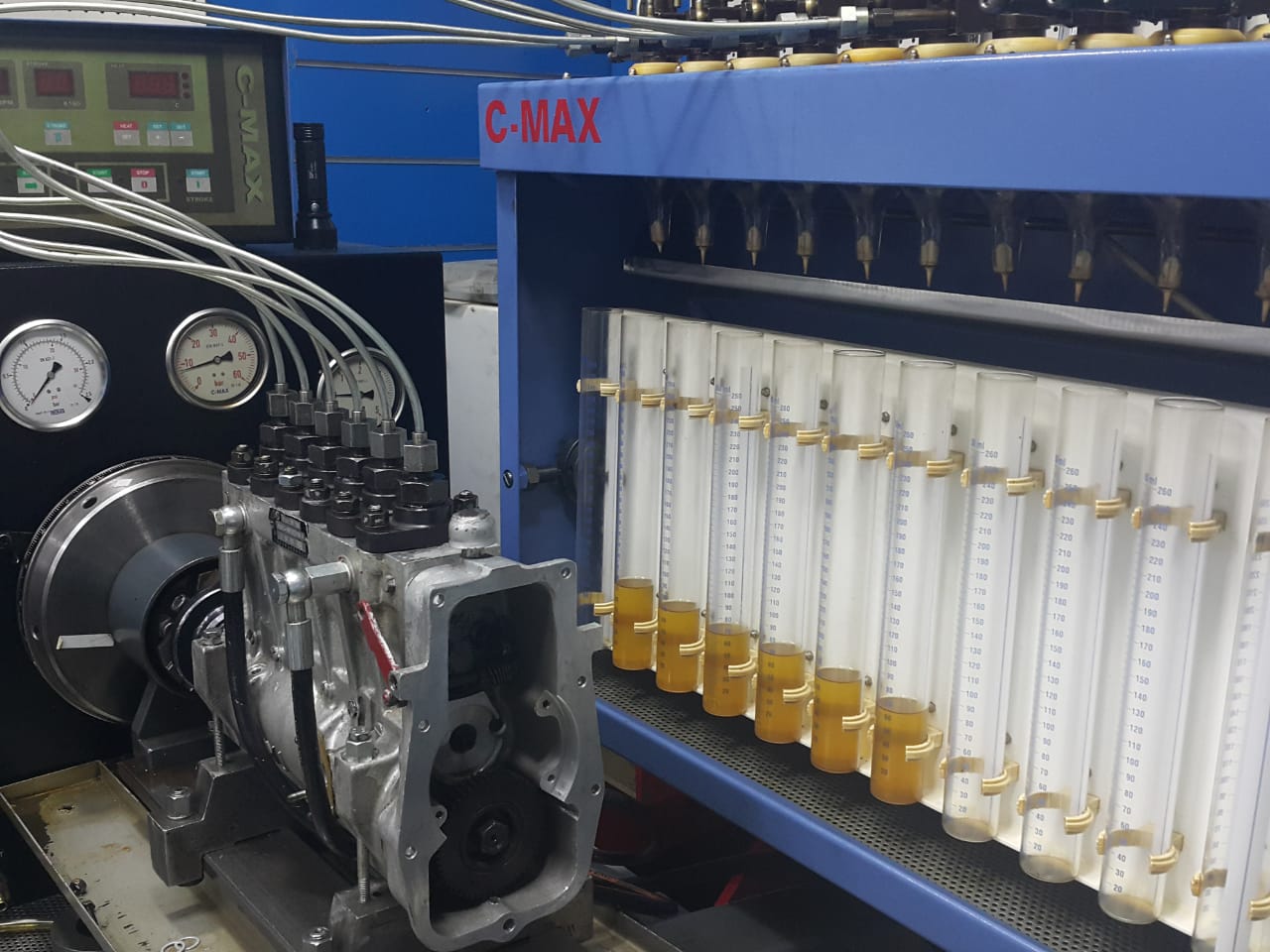
Calibration is not a tune-up. It is a measurement exercise: the pump is driven at defined speeds, the fuel delivered by each element over a defined number of strokes is collected in graduated tubes, and the result is compared against the manufacturer's published test plan. Either the numbers fall inside the window or they do not.
Why it matters that the bench is ours
A subcontracted calibration is a single pass. The pump goes out, someone sets it, it comes back, and if the numbers are marginal nobody is going to send it out a second time for the sake of a few cubic millimetres. That is how pumps end up "within tolerance" individually and still uneven as a set.
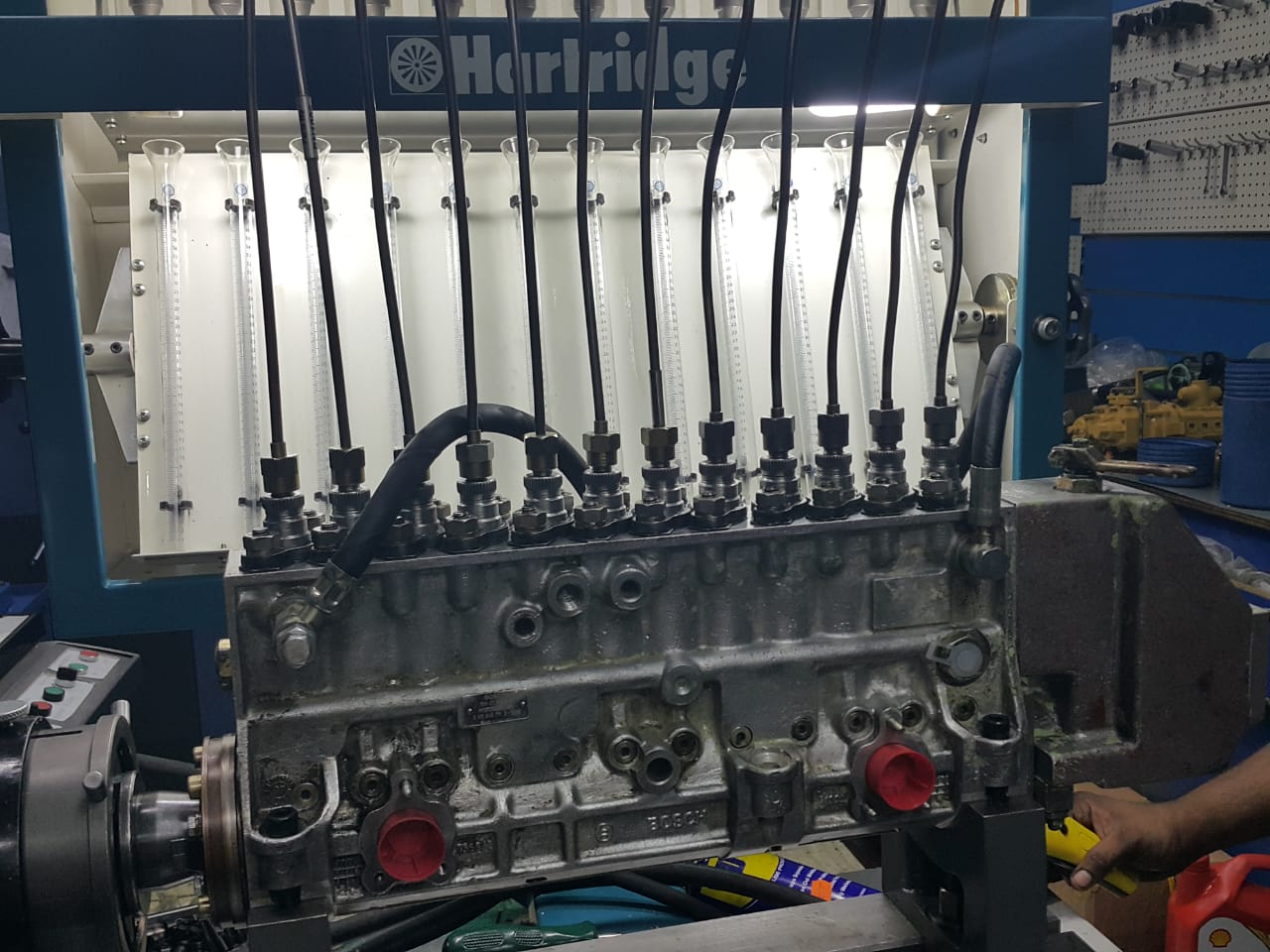
When the bench is twenty paces from the strip bench, the loop changes completely:
Adjust, run, measure, adjust again — at no cost in time. A pump is not signed off at the first acceptable reading. It is worked until every element sits where the plan wants it and the spread between the highest and lowest element is as tight as the pump can be made to hold.
The incoming test is free to perform, so it always happens. Nobody sends a pump out for a diagnostic run they will have to pay for. Here every drivable pump is run as received, which routinely tells the customer that one element is at fault, or that the pump is fine and the money should be spent elsewhere.
The pump and its governor are set on the same run. They are one control system. Set separately, you are hoping they agree; set together, you can see that they do.
The pump and its injectors can be set as a matched pair of jobs. Delivery balanced at the pump is undone by uneven nozzles downstream, and both sets of equipment are in this building.
Nothing is stripped, boxed, couriered and unboxed twice. Fewer transfers of a precision assembly, less contamination, no parts adrift between two workshops.
The report is written by the person who did the work, from measurements taken here, on our equipment. There is no third party to refer a question to.
What actually gets measured
A calibration run is a sequence of test points, not a single reading. On a typical inline pump these are:
- Cranking / starting delivery — the volume available at low rpm, which is what decides whether the engine starts cold.
- Idle delivery and idle balance — small volumes, where element-to-element variance shows up most clearly.
- Full-load delivery at rated speed — the number that sets engine power.
- Smoke-limit / boost-compensator point — where the aneroid or LDA device limits fuel until boost arrives.
- Maximum speed cut-off — the point at which the governor pulls fuel back, protecting the engine from overspeed.
- Phasing — the crank-angle interval between one element beginning delivery and the next. If phasing drifts, cylinders fire unevenly no matter how well delivery is matched.
- Timing / port closing — the point in the pump's rotation at which delivery begins, set against the manufacturer's static timing figure.
- Governor characteristics — breakaway, droop and cut-off, set at the same time. Deeper detail on governor repair and calibration.
The two figures a customer should look for on a report are delivery per element and the variance between the highest and lowest element. Delivery sets power. Variance sets how smoothly the engine runs, how evenly the cylinders load, and whether one piston is quietly being cooked while the others idle.
That second figure is the one that separates a calibrated pump from a rebuilt one, and it is the one a single-pass subcontracted job tends to leave on the table.
Why the fluid and the temperature matter
Injection pumps are calibrated on a specified reference calibration fluid — ISO 4113 — and not on diesel. The reference fluid has controlled viscosity and density, so that a pump tested in Sharjah gives the same reading as the same pump tested at the factory. Viscosity changes with temperature, and a change in viscosity changes how much fluid slips past a plunger — so the fluid temperature during the test is part of the specification, not a detail. Testing hot fuel against a cold-fuel test plan produces confident, precise, wrong numbers.
This is the difference between a bench test and a bench. Anyone can spin a pump.
What you receive
A signed test report, showing what the pump measured at each test point in the manufacturer's plan, element by element, on a dated document. Where the pump could be driven on arrival, the as-received figures sit alongside the as-left ones, so you can see what changed rather than being told that something did.
The report is the product. If a pump is later blamed for an engine problem, the report is what settles the argument — it shows what the pump delivered when it left, at each test point, on a traceable date. It also belongs in the engine's maintenance record, which is where a chief engineer or a fleet supervisor will want it three years from now.
When to calibrate without a full overhaul
- After an engine rebuild, to confirm the pump matches the engine's specification before commissioning.
- After a governor or timing adjustment made in the field, to verify it.
- When a pump has been rebuilt elsewhere and you want it independently measured before fitting.
- As a diagnostic step when an engine smokes or lacks power and you want the pump ruled in or out before stripping anything.
- On a periodic basis for critical standby equipment — fire pump engines and standby gensets that run rarely and are expected to work on the day they are needed.
If the incoming test shows delivery is down or variance is wide, calibration alone will not fix it; worn components have to be replaced first. That job is diesel fuel pump repair and overhaul.
Repair, recalibrate or replace — the test decides
Customers often arrive asking for a price and leave with something more useful: a number. A pump that is down on delivery might need a set of elements, or a single delivery valve, or nothing at all beyond re-setting after somebody adjusted it in the field. Those are three very different jobs and no one can tell them apart by looking.
So the sequence is always the same. Run it, measure it, then decide. Send us the pump and the incoming test will tell you whether you are looking at a calibration, an overhaul, or a unit that should be replaced.
Pumps we calibrate
Inline multi-element pumps, rotary/distributor pumps, unit pumps, and common rail high-pressure pumps — the last on separate equipment, described under common rail service. Bosch, Denso, Delphi/CAV, Stanadyne, Zexel and Diesel Kiki units, on Caterpillar, Cummins, Perkins, Yanmar, Volvo, MAN, Deutz, Mitsubishi, Kubota and John Deere engines among others.
Large marine and industrial pumps are routine work here rather than an exception — jerk pump sets and multi-element pumps off main and auxiliary engines are a substantial share of what the calibration room does. If you have an unusually large unit, send the pump number and the element count and you will get a straight answer on it before you arrange transport.