Common rail changed the engineering. A mechanical system generates injection pressure at the moment of injection; a common rail system holds fuel at very high pressure in a rail, continuously, and the injector decides when to open. That gives multiple injection events per cycle, precise pilot quantities and much better combustion — and it makes the system unforgiving in two specific ways.
Why this work has to be done in house
Common rail is where subcontracted bench work fails most visibly, because the job is not one test — it is a map.
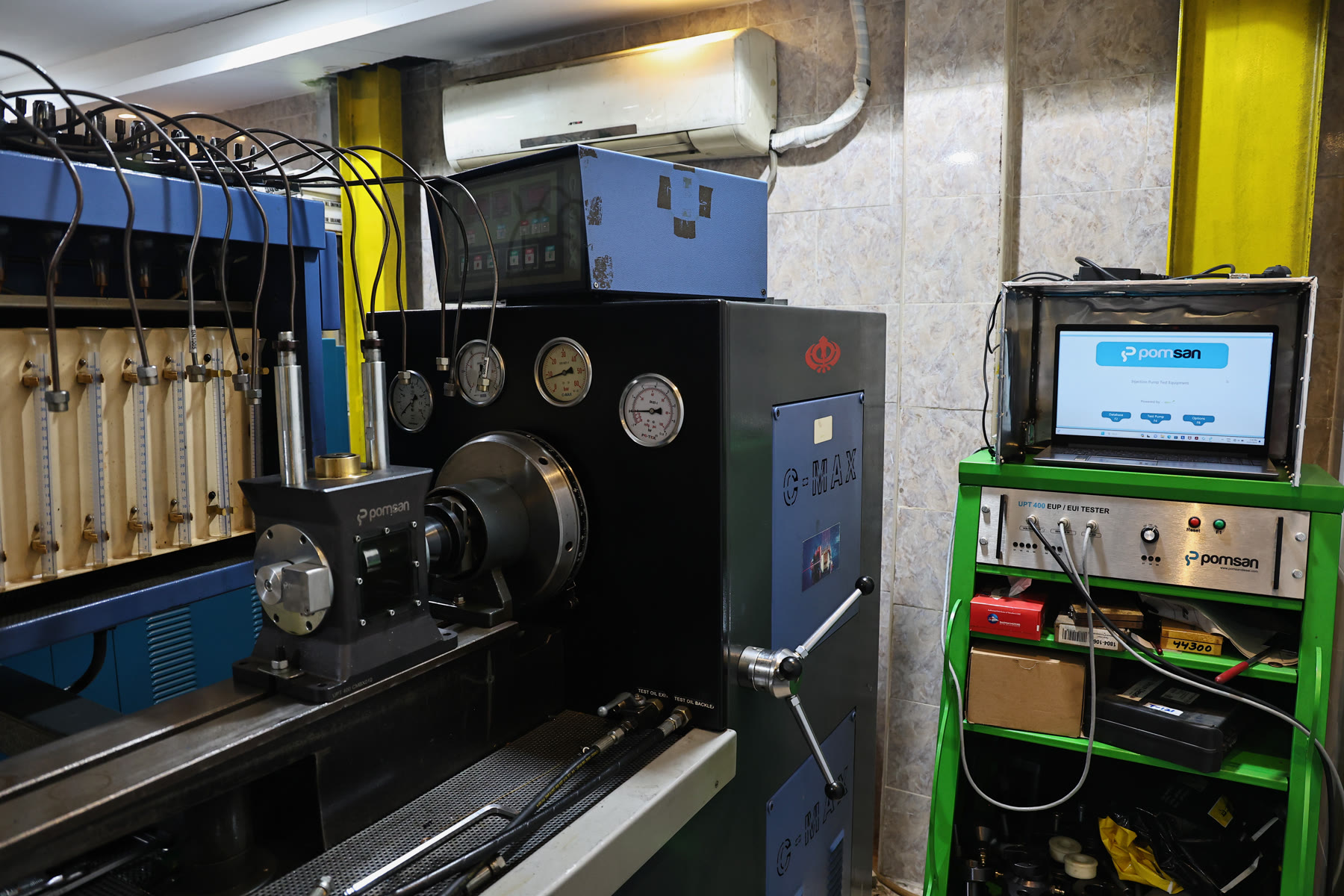
An injector has to be measured at every point, not at one. Full load, part load, idle, pilot and pre-injection, plus return flow. A unit can be perfect at full delivery and badly wrong on a pilot quantity of a few cubic millimetres, and the engine will feel that as a rattle at idle. Working a map means running the injector repeatedly, and repeated runs only happen when the bench belongs to you.
Rebuild and re-test is an iterative loop. Strip, replace, reassemble, run, measure, and if the numbers are not right, go again. A workshop paying per test round-trip stops at the first pass.
Cleanliness cannot be delegated. A common rail injector rebuilt on the same bench that just had a dirty inline pump stripped on it will fail again. The work is done in a dedicated clean area with tooling that is used for nothing else, and that is a discipline you can only guarantee in a room you control.
The diagnosis happens before the strip. Return-flow testing on the running engine, live rail pressure data and fault codes come first, so that what arrives on the bench is a suspect unit rather than a whole set stripped on a guess.
Nothing is transferred more than it has to be. Every extra journey for an assembly with micron clearances is another chance to introduce the exact contamination that killed it the first time.
The two things that kill common rail systems
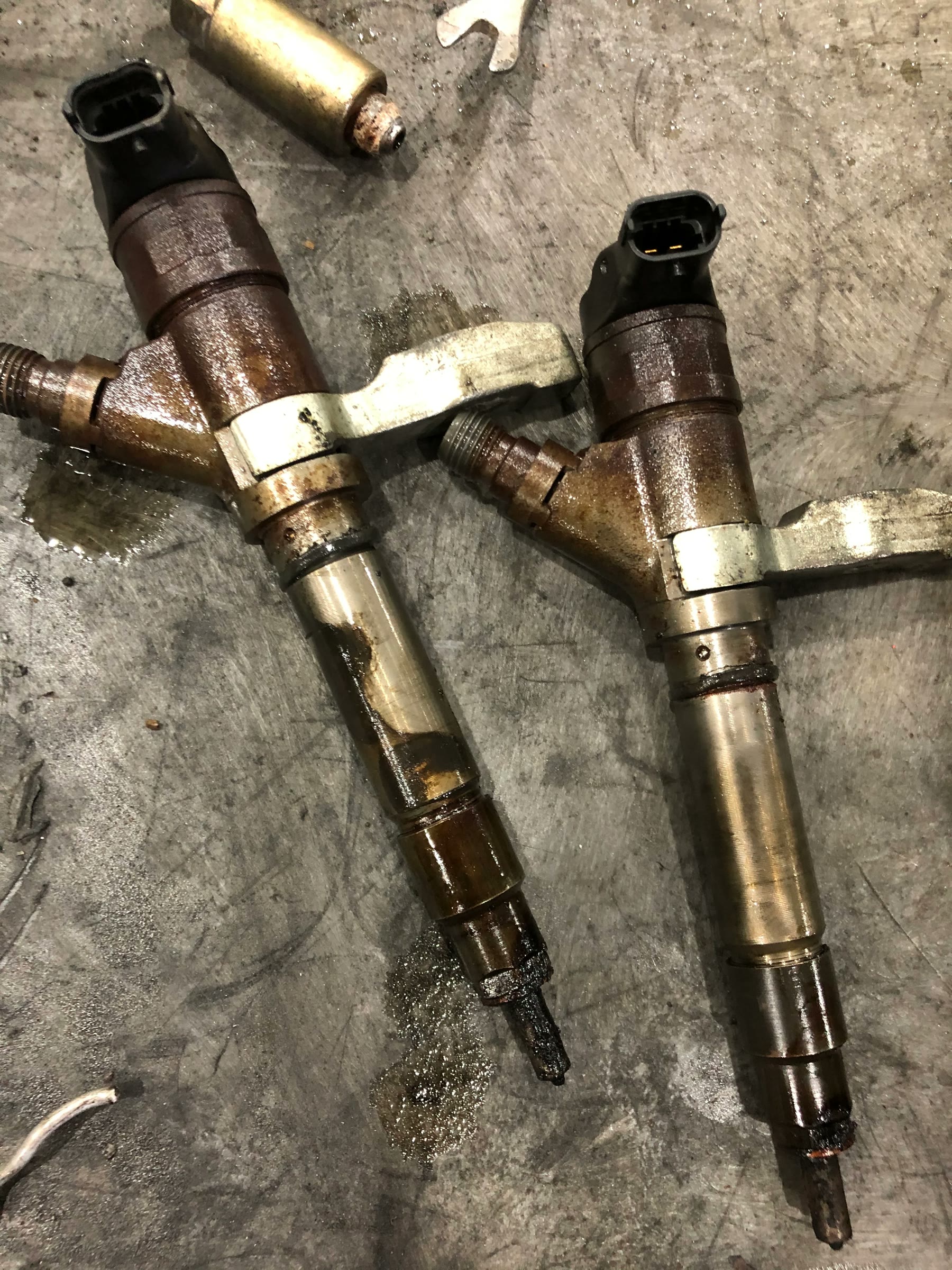
Contamination. The clearances inside a common rail injector's control valve are a few microns, and the fuel passing them is at very high pressure. A particle that a mechanical system would have swallowed without noticing will cut a valve seat here. That is why the failure so often follows a fuel filter left too long, a dirty tank, or a fuel delivery of poor quality — and why the repair has to be done in a clean area with dedicated tooling.
Water. Water in the fuel at rail pressure causes rapid erosion of pump and injector internals, and it strips the lubricating film in the high-pressure pump, which is lubricated only by the fuel it pumps. In the Gulf, tank condensation is the usual entry route. When a high-pressure pump fails catastrophically it sends metal debris down the rail and into every injector — which is why a pump failure is almost always a whole-system job, not a pump job.
The operations we perform
On-engine return-flow test · fault code and live rail pressure review · incoming high-pressure bench test across the injection map · pilot, pre, main and post quantity measurement · return flow and back-leak measurement · response time check · strip in the clean area · ultrasonic cleaning · control valve inspection and replacement · nozzle and needle replacement as a matched pair · seal kit renewal · reassembly to specified torque · post-rebuild verification run across the same map · injector calibration codes read, recorded and issued with the paperwork · high-pressure pump strip, inspection and rebuild · pressure control valve and volume control valve testing · rail pressure sensor and regulator checks · system contamination assessment after a pump failure.
What we do
Diagnosis before disassembly. Fault codes, live rail pressure data and — the decisive test — a return-flow measurement across the injectors with the engine running. An injector returning far more than its neighbours has an internal leak, and this test identifies it on the engine before anything is removed. It is the cheapest test in the whole discipline and it is the one most often skipped.
Injector test and overhaul. Incoming test on the bench across the full pressure and quantity map, including the pilot quantities. Then strip, ultrasonic clean, inspect the control valve, nozzle and needle, replace what is worn, reassemble to torque, and retest against the same map. Nozzle and needle are replaced as a matched pair, never individually. Because the bench is here, that retest can be repeated until the unit is right rather than accepted at the first pass.
Calibration codes. Every common rail injector carries a calibration code — Bosch call it IMA or ISA, Delphi C2i or C3i, Denso print a QR code, VDO/Siemens use IIC. The code describes that individual injector's measured flow behaviour, and the ECU uses it to trim the injection quantity for that cylinder. Fit an injector without the correct code and the engine will run, badly and permanently: rough idle, uneven cylinder loading, and emissions out of specification. We read and record the codes on your units and issue them with your paperwork, and we will tell you exactly what your engine needs at the point of refitting so that step is planned rather than discovered afterwards. Tell us which engine and ECU you are working with when the injectors come in.
High-pressure pump work. CP-series and equivalent pump testing and overhaul, plus the pressure control valve and volume control valve that most "low rail pressure" faults actually come down to.
System decontamination. Where a pump has failed and put debris into the rail, the honest answer is that the rail, lines and injectors all need attention. We will tell you when that is the case, and we will show you the debris.
Brands and systems
Bosch — CP1, CP3, CP4 high-pressure pumps and CRI/CRIN injectors. Delphi — common rail injectors and pumps, and the older DPA/DPS heritage on the same engines. Denso — HP0, HP3 and HP4 pumps, G2 and G3 injectors. Scania XPI.
Engine applications: Caterpillar C-series, Cummins, Perkins, Volvo, MAN, Mitsubishi, Scania, Hyundai and Doosan.
Send the injector or pump part number with the engine serial before you arrange transport and you will get a straight answer on your specific units rather than a general one.
Repair or replace — the bench decides, not the sales pitch
Common rail is where "repair what everyone else replaces" needs qualifying rather than repeating, and where a measurement is worth more than an opinion in either direction.
Many common rail injectors are fully rebuildable: nozzles, control valves and seal kits are available, and a rebuilt injector, correctly set and correctly coded, performs to specification. On others — particularly some piezo designs — the internal stack or valve is not supplied as a service part, and any workshop claiming to rebuild them is guessing.
What separates the two cases is measurable: what the unit delivers at each point on the map, what its return flow is, and whether the worn part is one that can be bought. We test first, tell you which category yours falls into, and quote accordingly. A remanufactured exchange unit is sometimes the right answer, and we will say so.
This is why the first step is to send the units in to be tested rather than to ask for a price. A test costs a fraction of a set of injectors and it is the only thing that turns the question into an answer.