
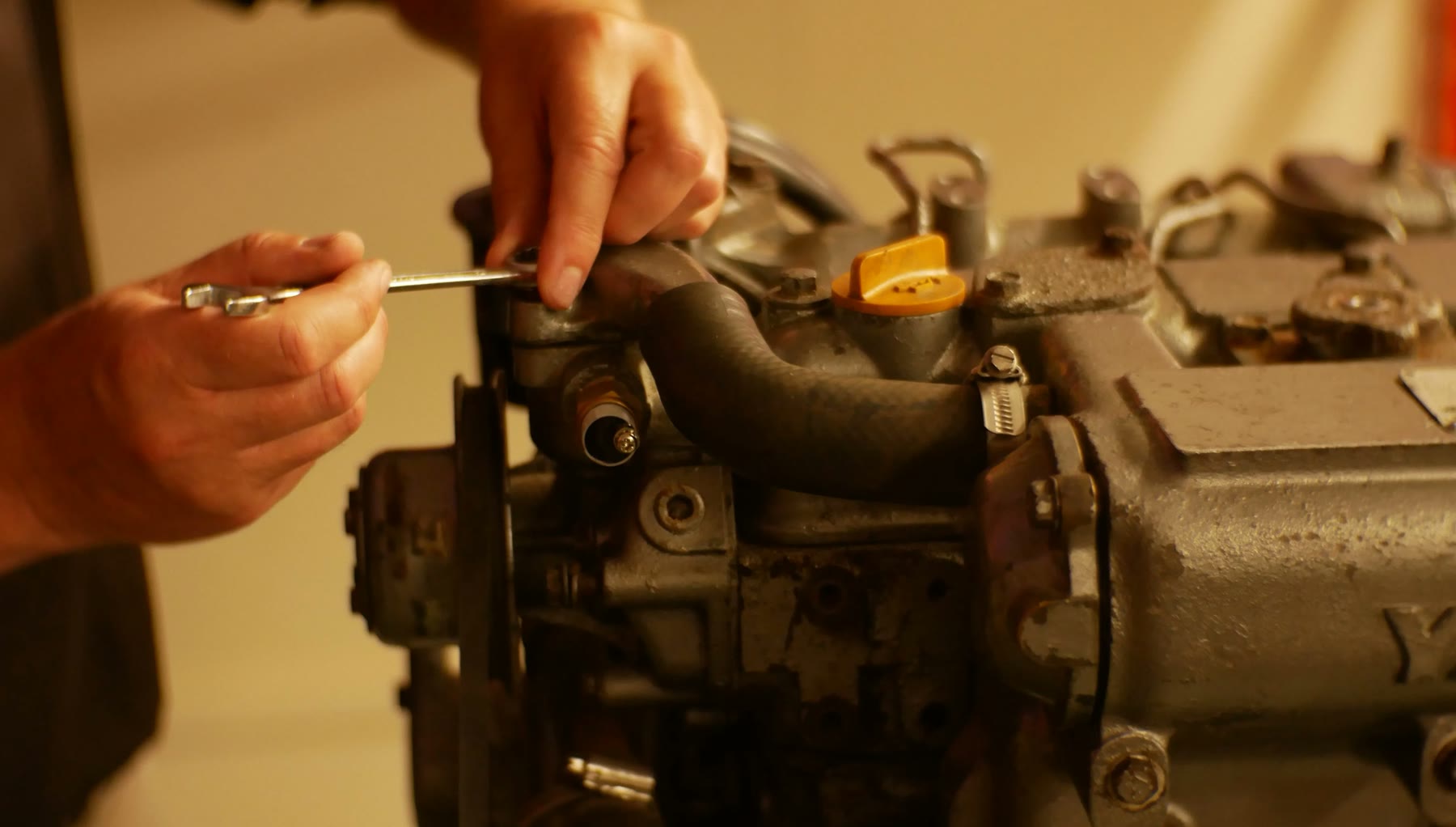
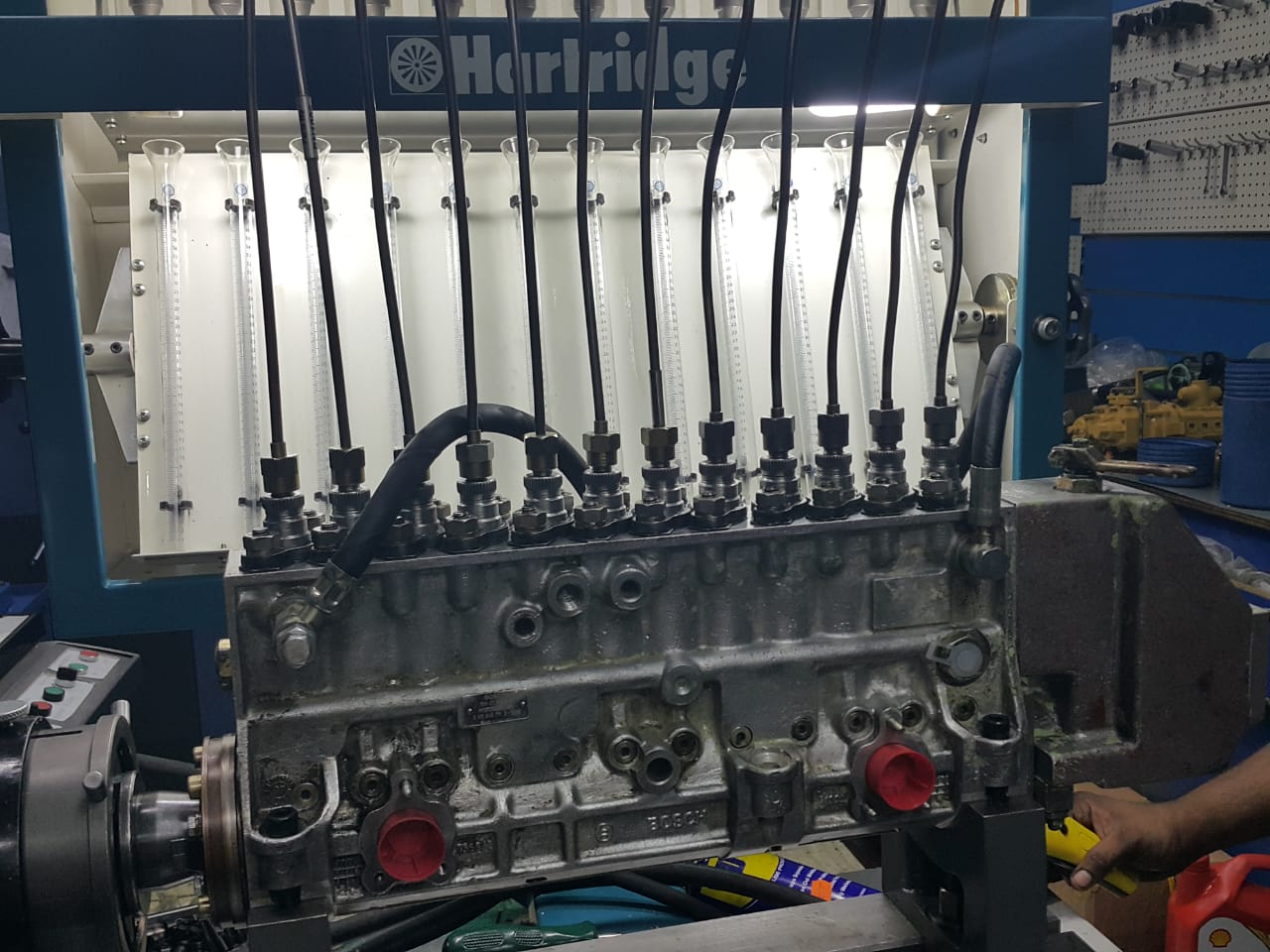
That pairing matters more than it sounds. A governor and its pump are one control system. Set the governor on a bench with the pump it belongs to and the whole speed characteristic can be verified; set it in isolation and you are hoping.
Why setting it here changes the result
The governor and the pump are set on the same run. The governor's cut-off and the pump's delivery curve are two halves of one behaviour. Set in the same session, against each other, they agree when the engine sees them. Set in two different workshops, weeks apart, they meet for the first time on your engine.
Compensation is tuned by iteration, not by one attempt. Almost every hunting-genset complaint comes down to compensation, and getting it right means run, observe, adjust, run again — many times. That loop is free when the rig is here and expensive when it is not, which is why so many governors arrive with every screw already moved by someone chasing a hunt in the field.
The incoming run always happens. Where the unit can be driven as received, we record what it is doing before touching it. That record is what stops previous field guesswork from being rebuilt into the unit.
Setting is done on clean oil at temperature. Hydraulic governor response is viscosity-dependent, so a unit set cold reads differently from the same unit set hot. Running it up properly before any adjustment is a matter of taking the time, and taking the time is what having your own rig buys.
One workshop answers for the whole control loop. If the set still will not hold frequency, there is no argument between the pump shop and the governor shop about whose work it is.
How a mechanical-hydraulic governor works, and what fails
A mechanical-hydraulic governor senses engine speed with rotating flyweights working against a speeder spring. The spring tension sets the speed reference. When load rises and speed falls, the flyweights move in, the pilot valve plunger uncovers a port, and pressurised oil drives a power piston that pulls the fuel rack towards more fuel. When speed rises, the reverse happens.
Left at that, the system would hunt — it always over-corrects. So every serious governor contains a compensation mechanism: a needle valve and compensating land that introduce a temporary droop, telling the governor to stop moving before the speed error is fully corrected, then bleeding that signal away as the engine settles. Almost every "hunting genset" complaint is compensation, either mis-set or worn.
Droop is the permanent version of the same idea: the deliberate fall in speed from no load to full load, expressed as a percentage of rated speed. A set running in droop will share load stably with other sets on the same bus, because each one settles at a different fuel position for a given frequency. A set running isochronous holds exactly rated speed at any load — right for a single set on its own load, wrong for a paralleled set without a load-sharing control.
What actually wears out:
- Pilot valve plunger and bushing — the precision pair that meters oil. Wear here shows as sluggish response and a governor that will not hold a setting.
- Compensating needle valve — blocked with varnish, or previously screwed fully in or out by someone chasing a hunt in the field.
- Ballhead bearing and flyweight pivots — wear introduces hysteresis, so the governor responds differently to rising and falling speed.
- Oil pump and relief valve — low oil pressure means slow, weak correction.
- Seals and the drive shaft seal — leaks, and dilution of governor oil with engine oil or fuel.
- Terminal shaft, linkage and rod ends — backlash in the linkage between governor and fuel rack undoes everything the governor gets right.
- Degraded governor oil — thickened, contaminated or simply the wrong grade. Viscosity is part of the tuning; changing oil grade changes the response.
Electronic governors fail differently: speed pickup gaps and failed magnetic pickups, actuator coils, wiring and connector corrosion, and controller settings lost or wrongly tuned. The diagnosis is different, but the same question applies — is it the sensor, the controller or the actuator? Tell us the make and model of the control and the actuator when you call, and you will get a straight answer on what we can take on before anything is shipped.
Symptoms
- Engine hunts or surges at no load, or cycles slowly under steady load
- Speed will not come up to rated, or overshoots and trips on overspeed
- Frequency drifts on a genset as load changes and will not settle
- Two paralleled sets fight each other, one taking all the load
- Slow response to load acceptance — the set dips heavily on block load and recovers late
- Governor oil leaking, milky, or black
- Governor will not respond to the speed adjust at all
Model coverage
| Governor family | Types serviced | Typical application |
|---|---|---|
| Woodward UG-8 | Dial and lever, mechanical-hydraulic | Marine main and auxiliary engines, gensets |
| Woodward UG-10 | Mechanical-hydraulic, including motor-driven and remote speed-setting variants | Gensets, marine propulsion |
| Woodward PSG | Mechanical-hydraulic | Industrial and marine engines |
| Woodward 3161 | Mechanical-hydraulic, higher work capacity | Larger diesel and gas engines |
| Woodward RHD / RHD-6 | Mechanical-hydraulic | Marine and industrial diesels |
| Zexel | Governor units on Zexel inline injection pumps | Japanese industrial, marine and truck engines |
| Bosch RQ / RQV / RSV | Mechanical governors integral to inline pumps | Industrial and truck engines |
| Engine-mounted OEM governors | Caterpillar 3406, 3408 and 3412 governor arrangements; Cummins governors on KTA19, KTA38, KTA50 and NTA855; Niigata; Wärtsilä; Yanmar | Marine main and auxiliary, standby power |
Send the nameplate data for your unit and you will get a straight answer on it. Woodward units in particular carry a part and serial number that identifies the exact build, and the correct settings cannot be established without it.
The operations we perform
Incoming run and record where the unit can be driven · full strip · drain and flush · pilot valve plunger and bushing clearance measurement and renewal · compensating needle and land inspection, cleaning and renewal · ballhead bearing and flyweight pivot renewal · power piston and cylinder inspection · oil pump and relief valve overhaul · drive shaft, seal and bearing renewal · terminal shaft and linkage inspection · overhaul kit fitted · reassembly and run-in on clean oil of the specified grade at temperature · speed range set · maximum-speed stop set · droop set to the required percentage · compensation adjusted for stable response · terminal shaft travel matched to fuel rack travel · final run and record.
What we do
- Incoming assessment. Where possible, run the governor on the rig as received and record speed, droop and response before touching it. Many governors arrive after someone has adjusted every screw on them in the field, and the incoming record is what stops that guesswork carrying into the rebuild.
- Strip and clean. Full disassembly, drain and flush, every part cleaned and laid out.
- Measure and inspect. Pilot valve plunger and bushing clearance, ballhead bearing condition, flyweight pivots, compensating land and needle, power piston and cylinder, oil pump gears, drive shaft and seals.
- Replace. Overhaul kit, seals, bearings and any precision pair outside limit.
- Reassemble and run in. On clean oil of the specified grade, brought up to temperature before any setting is attempted.
- Set and verify. Speed range and maximum speed stop, droop setting to the required percentage, compensation adjusted for stable response, and the terminal shaft travel matched to the fuel rack travel it will drive.
- Document. The settings the unit left with, recorded on paper, so the next engineer is not starting from scratch.
Where the governor is integral to an injection pump, this work is done as part of fuel injection pump calibration, so the governor's cut-off and the pump's delivery are set against each other on the same run.
The setting that gets everything else blamed
A very large share of "engine problems" on standby gensets are governor problems. The engine is mechanically healthy, the injectors are good, the pump is in calibration — and the set still will not hold frequency on load acceptance, or hunts on light load. Before condemning an injection pump on a genset, test the governor: it is cheaper to test and it is more often the cause.
Equally, a governor cannot fix a fuel system. If delivery is uneven cylinder to cylinder, the governor will chase it forever. Both have to be right, which is the argument for setting them together — see diesel fuel pump repair and overhaul.
Overhaul or replace — the rig decides
Governor replacement, where a replacement even exists for the unit you have, is a long-lead and expensive route, and it is frequently unnecessary. The castings, the ballhead and the body outlive several overhauls; what wears is a defined set of precision parts and seals.
What decides it is measurable: pilot valve clearance, ballhead and pivot condition, oil pressure developed, and whether the compensation can be made to hold a stable response after rebuild. A unit that will not hold a setting after overhaul is telling you something specific rather than being unlucky.
So send the governor in to be run and measured before you price a replacement. A unit that has simply been mis-adjusted in the field is a very different job from a worn one, and only the rig separates them.
Applications
Standby and prime-power generator sets, marine main and auxiliary engines, fire pump engines, air compressors and industrial drives. Governor faults are most commonly reported to us as generator faults — generator repair and service covers the wider set, and marine fuel pump and injector repair covers vessel work where the sailing date drives the schedule.
Annual maintenance contracts are available for customers running standby power that must start and hold load on demand. Terms are set against your site and your equipment, so start with a conversation.