
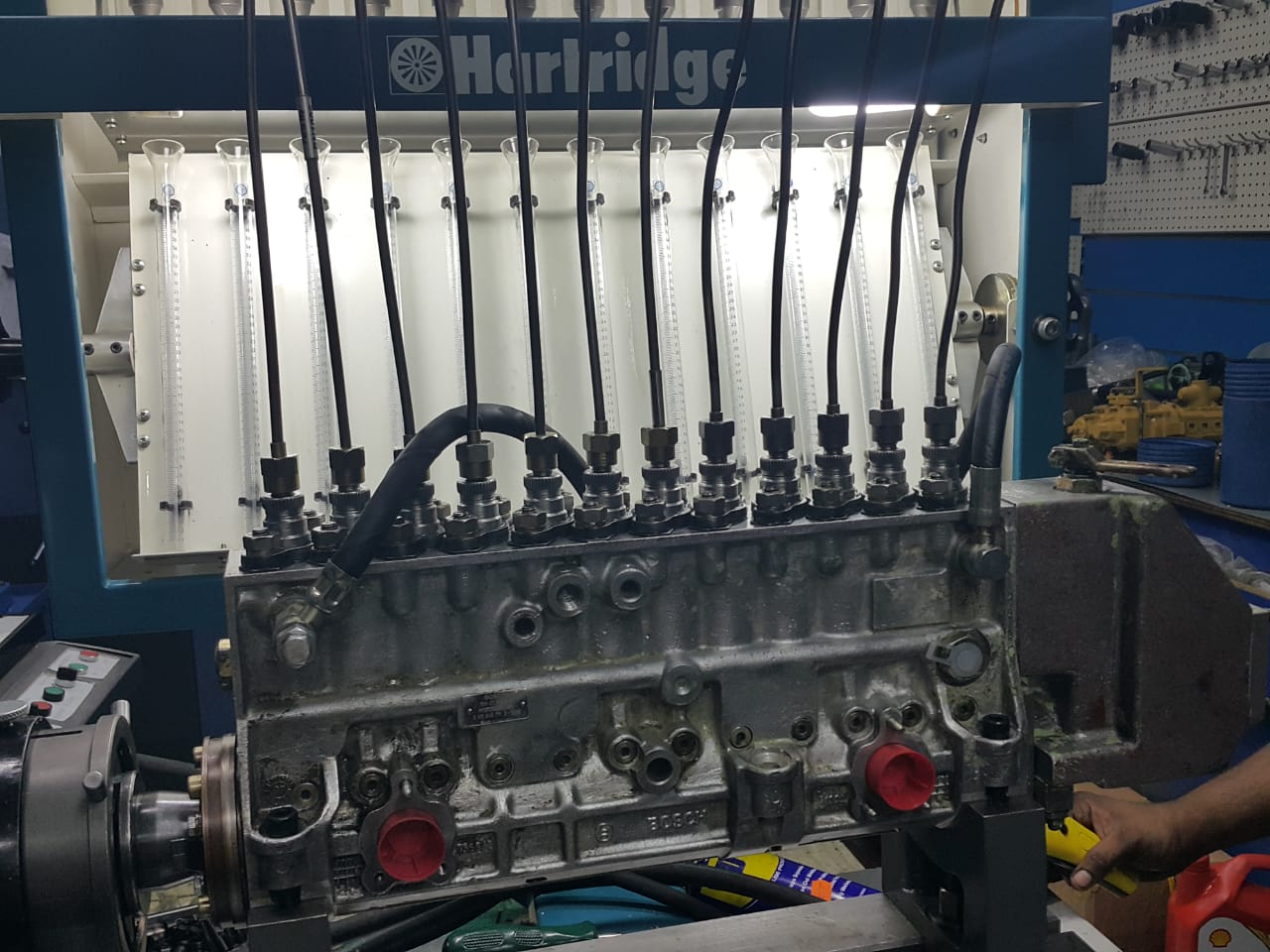
Marine work is a scheduling problem as much as an engineering one. A vessel has a sailing date, a survey window or a charter it cannot miss, and a fuel pump on the wrong side of that date costs far more than the repair. Everything below is organised around that.
Established 2011. Over 25 years of experience. ISO 9001:2015 certified.
Why in-house calibration is a marine argument, not a technical one
For a chief engineer or a superintendent, the whole value of a workshop that owns its calibration is measured in days.
The schedule belongs to us. A workshop that subcontracts its bench work cannot promise you a date, because the date is set by a queue it does not control and cannot expedite. Ours is one queue, in one building, and a vessel with a sailing date can be moved up it. That is a decision somebody here can make on the phone.
A set is finished as a set. A multi-cylinder engine's jerk pumps only perform as well as the worst unit, so the useful deliverable is a balanced set, not eight individually acceptable pumps. Balancing a set means running units against each other repeatedly — practical here, impractical when every test is a paid round-trip.
Progressive returns are possible. If the engine is being rebuilt in stages, units can be finished and returned in the order the ship needs them rather than all at the end. That only works when one workshop holds the whole job.
Fewer transfers of the units themselves. Marine fuel equipment is heavy, awkward and expensive to move. Every extra journey between workshops is time, cost and handling risk on parts with micron clearances.
One document, from the people who did the work. The report that goes into the engine's record is written here, from measurements taken here, and there is nobody to refer the surveyor's question to.
Component types handled: inline jerk pumps, individual unit pumps, fuel valves and injectors, and governors.
Marine fuel systems, and what goes wrong at sea
Most medium-speed marine main and auxiliary engines still use individual jerk pumps — one cam-driven plunger-and-barrel unit per cylinder, feeding one fuel valve through a high-pressure pipe. The design is old, robust and entirely rebuildable, which is exactly why it survives: every wearing part is a replaceable precision component and the pump body outlives several overhauls. Smaller vessels use inline multi-element pumps or rotary pumps, and newer engines use common rail.
The failure modes are the general diesel ones, plus a set that belong to the sea:
Water ingress. Bunker water, tank condensation and, occasionally, seawater. Water destroys the lubricating film between plunger and barrel and between needle and seat. In this climate a tank that breathes humid air all day will make its own water without any help.
Fuel quality and residual fuels. Heavier fuels demand higher injection pressures, hotter fuel and tighter maintenance of nozzle condition. Cat fines — the abrasive catalyst particles carried over in residual fuel — are the classic destroyer of plungers, barrels and nozzles, and they arrive from the bunker, not from wear.
Long idling and light-load running. Manoeuvring and standby running at low load leaves nozzles coking and fuel valves dribbling. The symptom appears later, at full away, as a hot exhaust on one unit.
Deferred overhaul intervals. Marine fuel equipment is overhauled on running hours, and equipment that misses its interval usually fails at the least convenient point in the schedule.
Auxiliary engines forgotten. The main engine gets the attention; the auxiliaries and the emergency genset get the failure.
The operations we perform
On jerk pumps and injection pumps — incoming bench test where the unit can be driven · full strip · ultrasonic clean · plunger and barrel measurement and replacement · delivery valve and seat replacement · tappet, roller and cam follower inspection and renewal · housing bore assessment · rack and control sleeve inspection · reassembly · delivery calibration against the engine builder's test plan · matching across the set unit by unit · final run and signed record.
On fuel valves and injectors — incoming pop and pattern test · strip and clean · nozzle and needle replacement as a matched pair · spring and shim replacement · opening pressure set to the engine builder's figure · spray pattern and chatter verification · seat tightness and back-leak measurement · seal and copper washer renewal · per-unit test record.
On governors — full mechanical-hydraulic overhaul, run-in and setting, detailed under governor repair and calibration.
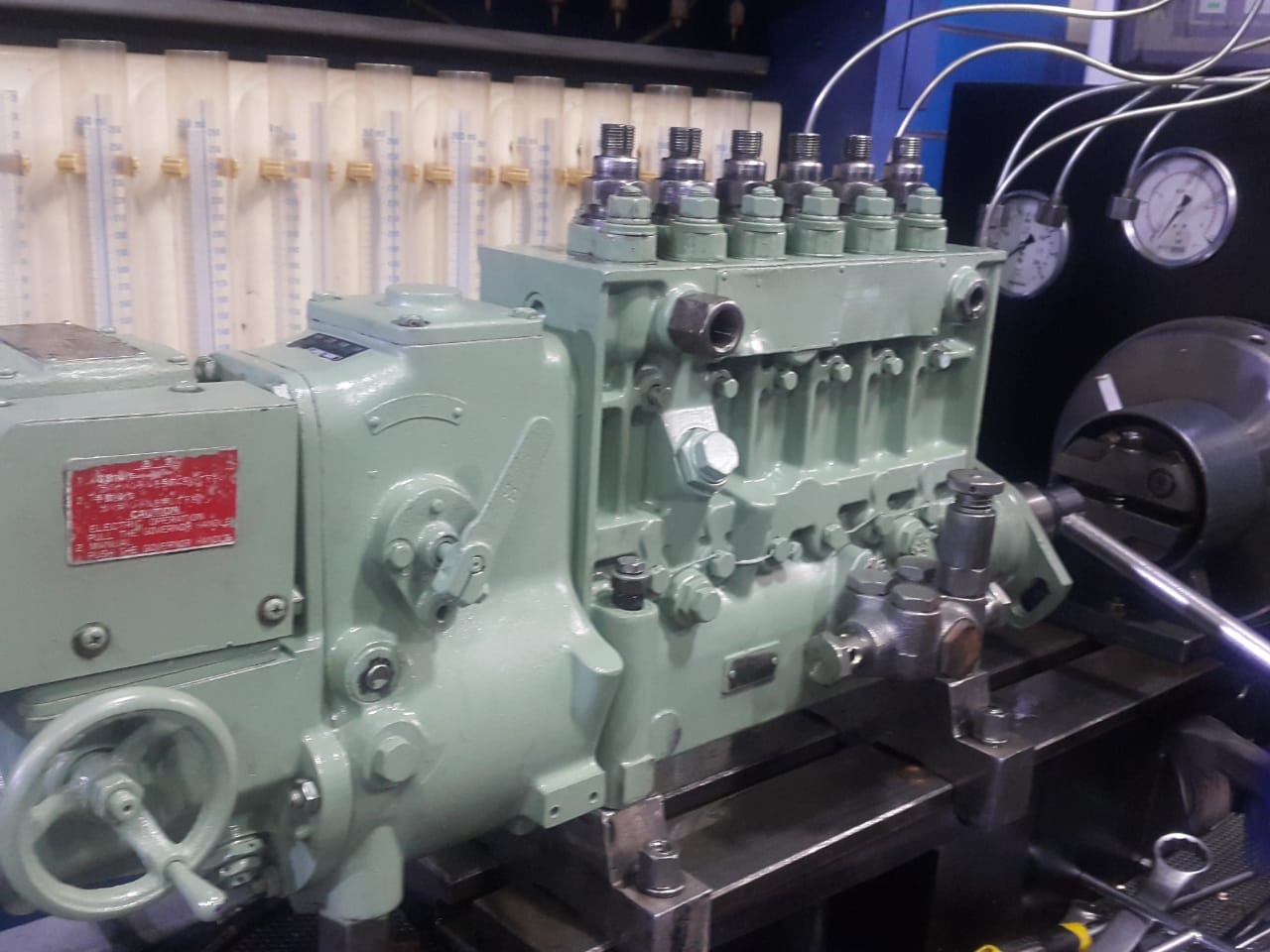
What we do
Fuel pumps. Incoming bench test where the pump can be driven, full strip, ultrasonic clean, measurement of plunger and barrel, delivery valve and seat, tappet, roller and cam follower, and the housing bore. Replace what is out of limit, rebuild, then calibrate on the bench against the manufacturer's test plan and record the delivery. For a multi-cylinder engine the whole set is matched, because a set of jerk pumps only performs as well as its worst unit. Process detail on diesel fuel pump repair and overhaul.
Fuel valves and injectors. Strip, clean, replace nozzle and needle as a matched pair, set opening pressure to the engine builder's figure, verify spray pattern, chatter and seat tightness, and record each unit. Detail on diesel injector repair and calibration.
Governors. Main and auxiliary engine governors — Woodward UG-8, UG-10, PSG, 3161 and RHD families among others — overhauled and set on the bench. See governor repair and calibration.
Matched sets, documented. For a marine engine the useful output is not "the pump is fixed" but a table showing every unit's delivery and every fuel valve's opening pressure, so the chief engineer can see the set is balanced. That document goes into the engine's record and it is the thing that is still useful three years later.
Engines we cover
Yanmar, Volvo Penta, Wärtsilä, Niigata, MAN, Caterpillar, Cummins and Jabsco, on main engines, auxiliary engines, emergency generators and fire pumps. Boats, workboats, barges, tugs and commercial vessels working out of the northern emirates.
Large-bore units are routine work rather than an exception. If you have an unusually large pump or a full set off a main engine, send the pump number, the element count and a photograph of the unit before you arrange transport, and you will get a straight answer on it rather than a general one.
If the engine is opened up while the fuel equipment is with us, the in-house machine shop handles liners, heads, crankshafts and rods in the same building — one supplier, one schedule. Wider vessel work is covered under marine engine repair.
Working to a sailing date
Tell us the date. Everything else follows from it: whether the units are collected or delivered, whether the strip happens the same day, and whether the job runs as a set or unit by unit so the engine can be reassembled progressively.
We do not publish a single turnaround figure, because a set of eight jerk pumps off a main engine and a pair of fuel valves off an auxiliary are not the same job and pretending otherwise helps nobody. What we can commit to is this: the work is not queued behind a third party, so the date you are given is one this workshop controls, and a vessel working to a deadline gets prioritised against one that is not. Say so when you call and you will be told plainly whether the date is achievable — including when the answer is no.
The key contact is available directly, including outside office hours, which for vessel work is usually what decides the job.
Overhaul or replace — measured, not estimated
Marine fuel equipment is the strongest case for repair in the whole diesel field, and it is also where guessing costs the most.
Replacement jerk pumps and fuel valves for medium-speed engines are long-lead imports, and for older or less common engines they may effectively not exist. The pump body, cam follower housing and valve body are the durable parts and they rarely fail. What wears is the plunger and barrel, the delivery valve, the nozzle and needle, the spring — every one of which is a replaceable precision component.
What decides whether your specific units are worth rebuilding is measurable: delivery per unit against the test plan, the spread across the set, housing bore condition, and whether cat-fine damage has gone beyond the replaceable parts into the body. We measure all of it and tell you which units are worth rebuilding and which are not, unit by unit — which on a set of eight is frequently a much smaller bill than the customer expected.
So the first step is a test, not a quote. Send the units in with the engine details and the sailing date, and you will get figures rather than an opinion.