An injection pump is a metering instrument, not a fuel mover. It exists to deliver the same measured volume to every cylinder, at the same instant in the cycle, at every speed and load. Once it stops doing that, the engine tells you in smoke, power and fuel burn long before it stops running.
Established 2011. Over 25 years of experience. Independent specialist, ISO 9001:2015 certified.
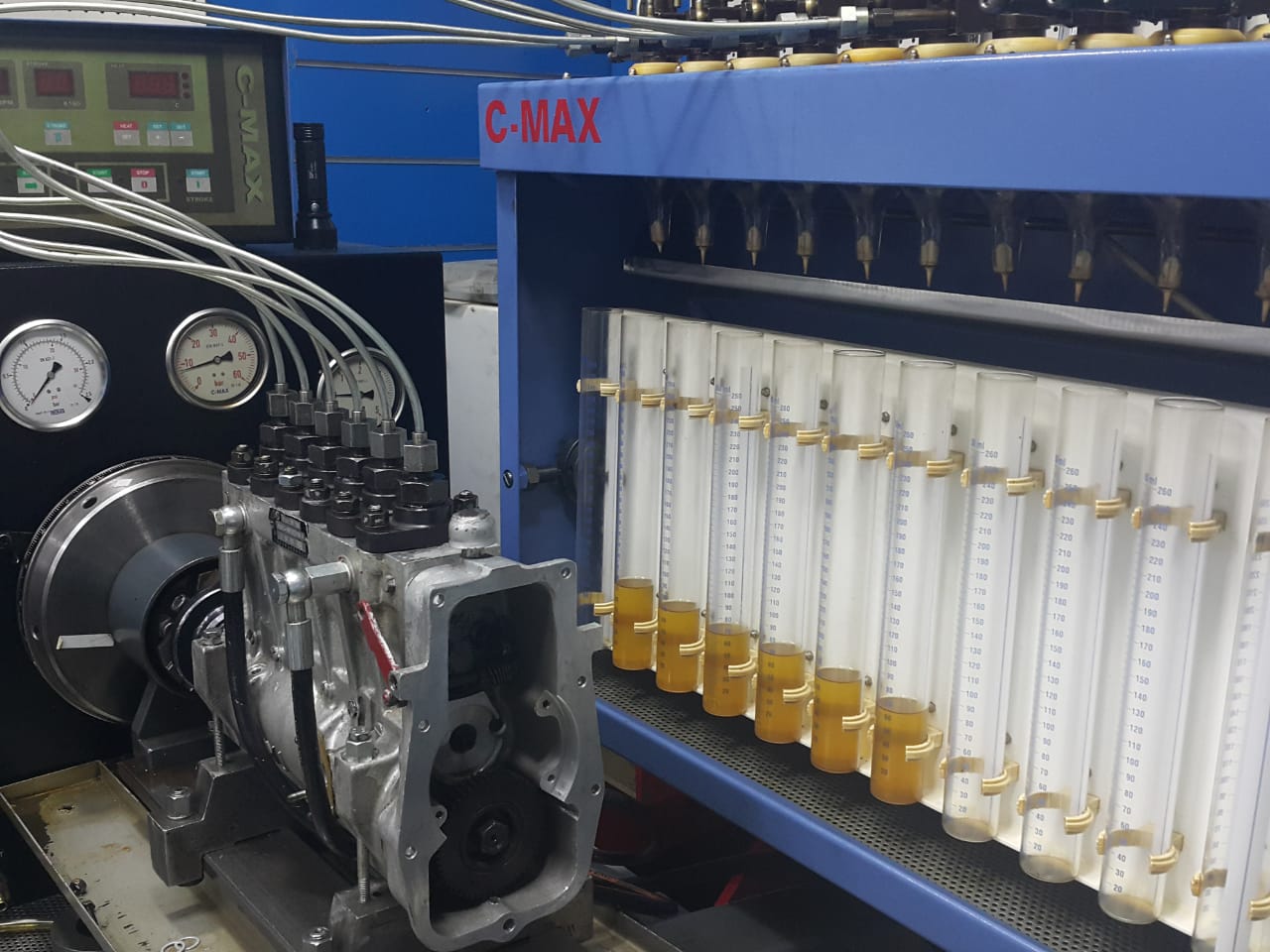
We strip, rebuild and recalibrate diesel injection pumps in Sharjah Industrial Area 15, and every pump goes back on our own bench before it leaves. If you are looking for diesel pump repair near me in the UAE, the question worth asking any workshop is whether the calibration is done in house or sent out. Ours is done here — so the pump is tested on arrival, tested again after rebuild, and handed over with the figures on paper.
What doing it in house actually gets you
| What we do differently | What it means for your engine |
|---|---|
| The pump is tested before it is stripped | You find out whether the pump is even the fault before you pay for a rebuild. A surprising number go home untouched with a report that points somewhere else |
| Calibration happens under our own roof | No third-party queue between the strip and the set-up, so the date we give you is a date we control |
| Adjust and re-test is a walk across the floor | The pump is not signed off at "close enough". It is run, adjusted and re-run until every element sits where the test plan wants it |
| The pump and its governor are set together | A pump and governor are one control system. Setting them on the same run means the delivery curve and the speed curve actually agree |
| The pump and its injectors can be set as a set | Delivery matched at the pump means nothing if it feeds worn nozzles. Bringing both lets us balance the whole delivery path |
| One building, one set of hands | Fewer transfers of a precision assembly means less dirt, less damage and no parts lost between workshops |
| The person who signs the report did the work | There is nobody to refer the awkward question to |
Pump types serviced: inline (multi-element), rotary/distributor, unit pump, and common rail high-pressure pumps.
The operations we perform on an injection pump
The specific named jobs, so you can ask for what you need:
Incoming "as received" bench test · full strip and component identification · ultrasonic and solvent cleaning · housing crack check · housing bore assessment · plunger and barrel element replacement · delivery valve and delivery valve seat replacement · camshaft inspection and replacement · tappet, roller and cam follower replacement · drive shaft run-out check · drive shaft bearing and seal renewal · control rack and rack travel inspection · governor weight, linkage and lever renewal · element phasing set individually · port-closing and static timing set · delivery calibration at each test point in the manufacturer's plan · idle and idle balance set · full-load delivery set · smoke-limit and boost (aneroid/LDA) compensator set · maximum-speed cut-off set · torque-control and excess-fuel device set where fitted · final verification run · signed test report.
Rotary and distributor pumps add: transfer pump vane and liner renewal · hydraulic head and rotor assessment · advance mechanism servicing · shut-off solenoid test. Electronically controlled rotary pumps add: separation of the electronic fault from the hydraulic fault before any parts are ordered.
When a pump needs work
These are the situations that bring pumps to us, and what they usually mean.
Hard starting, especially cold or after standing. Worn plunger-and-barrel elements let fuel bypass instead of being pumped. There is enough delivery to run a warm engine and not enough to start a cold one. On a rotary pump the same symptom comes from a worn rotor or a leaking transfer pump.
Power loss under load. The engine pulls fine unloaded and falls away on a hill or when the genset picks up block load. Delivery is down, or the governor is not reaching full fuel.
Black smoke. Over-delivery on one or more elements, or injection timing retarded. On an inline pump this is often a single element out of balance with the rest — the bench finds it in one run.
White or blue-white smoke on start-up. Late or uneven injection, poor atomisation, or fuel dribbling from a failed delivery valve.
Engine hunting or surging at idle. Usually a governor fault rather than a pumping fault. See governor repair and calibration.
Air lock — the engine runs, stops, and will not restart until bled. Air is entering somewhere on the suction side: a perished feed line, a failed lift pump diaphragm, a loose banjo, or a leaking pump shaft seal. Chasing this on the engine wastes days; a pressure-and-vacuum test of the suction circuit finds it.
Fuel in the engine oil, or oil level rising. A failed pump shaft seal on a pump that shares the engine's lubrication.
The pump running hot to the touch. Internal friction from a seizing rotor or a starved suction. Stop the engine — a rotary pump that seizes usually takes the drive with it.
Water in the fuel. The single most common root cause in this region. Water breaks the lubricating film between plunger and barrel; those parts are lapped as matched pairs to a few microns, so once they score they are replaced, not re-machined.
What we do
- Incoming test. Where the pump can still be driven, we run it on the bench as received and record delivery at test speeds. This is the baseline the finished job is measured against, and it often shows the customer that only one element is at fault.
- Strip and clean. Full disassembly, ultrasonic and solvent cleaning of every part, with the housing checked for cracks and the drive shaft for run-out and bearing wear.
- Measure and assess. Plungers and barrels, delivery valves and seats, cam or rotor, tappets and rollers, governor weights and linkages, and the housing bores. Anything outside limit is listed with the reason before we quote.
- Rebuild. New elements, delivery valves, seals, O-rings, gaskets and bearings as required. You are told before the work starts which parts are going in and where they came from — no pump leaves here with something fitted that the customer was not told about.
- Set on the bench. Phasing set element by element, then delivery calibrated against the manufacturer's test plan at each specified speed: idle, full load, maximum speed, and the low-speed and smoke-limit points. Governor cut-off and the aneroid or boost compensator are set at the same time.
- Verify and document. A final run, and the measured figures signed off. See what the calibration process measures in detail.
Because every one of those steps happens in this building, step 5 can be repeated as many times as the pump needs. That is the practical difference between a pump that is rebuilt and a pump that is set.
Pump types we handle
Inline (multi-element) pumps — Bosch PE/PES and P-series, Zexel, and the equivalents fitted to most industrial, marine and heavy truck engines. One plunger per cylinder, cam-driven, with a mechanical or electronic governor on the back. Serviceable almost indefinitely because every wearing part is replaceable.
Rotary / distributor pumps — Bosch VE and VP-series, Delphi/CAV DPA and DPS, Stanadyne DB2 and DB4, Denso. A single pumping element serving all cylinders through a rotating distributor. Compact and cheaper, but everything inside is lubricated by the fuel itself, which is why fuel quality decides their life.
Electronically controlled rotary pumps — Bosch VP44 and similar, where a pump-mounted control unit meters and times injection. These have two distinct failure paths: the hydraulic head, and the electronics. Diagnosing which one has failed before ordering parts is most of the value.
Unit pumps and unit injectors — one pump per cylinder, cam-driven off the engine, common on large industrial and marine engines.
Common rail high-pressure pumps — Bosch CP-series, Denso HP-series, Delphi. Different discipline, different cleanliness standard: see common rail injector and pump service.
Brands we work on
Fuel system component makers: Bosch, Denso, Delphi (and CAV/Lucas heritage units), Stanadyne, Zexel and Diesel Kiki.
Engine makes whose pumps come through the shop: Caterpillar, Cummins, Perkins, Yanmar, John Deere, Scania, MAN, Volvo Penta, Kubota, Deutz, Doosan, Daewoo, Mitsubishi, Hatz, ZF, Jabsco, Ingersoll-Rand and Clarke.
If your pump is not on that list, send the pump number. The list reflects what comes through the door most often, not a limit on what we will look at.
Repair or replace is decided by measurement
This is the question most customers actually arrive with, and it has an answer that does not depend on anyone's opinion.
A replacement injection pump for an industrial or marine engine is frequently a several-week import, and for older equipment it may not exist at all. The pump housing, cam and drive are the expensive castings, and they almost never fail. What wears is the set of replaceable precision parts inside. That is why an overhaul is usually a fraction of a new-pump price and available in days rather than weeks.
What decides it is measurable, and we measure it: delivery per element against the test plan, the variance between elements, housing bore condition, camshaft lobe condition, and whether the parts that are worn are parts that can be bought.
The honest boundary: if the housing bores are worn oval, the camshaft lobes are pitted through the hardened case, or an electronic head has failed on a pump whose control unit is no longer supplied, we will tell you to replace it. We would rather lose the job than hand back a pump that will not hold calibration.