
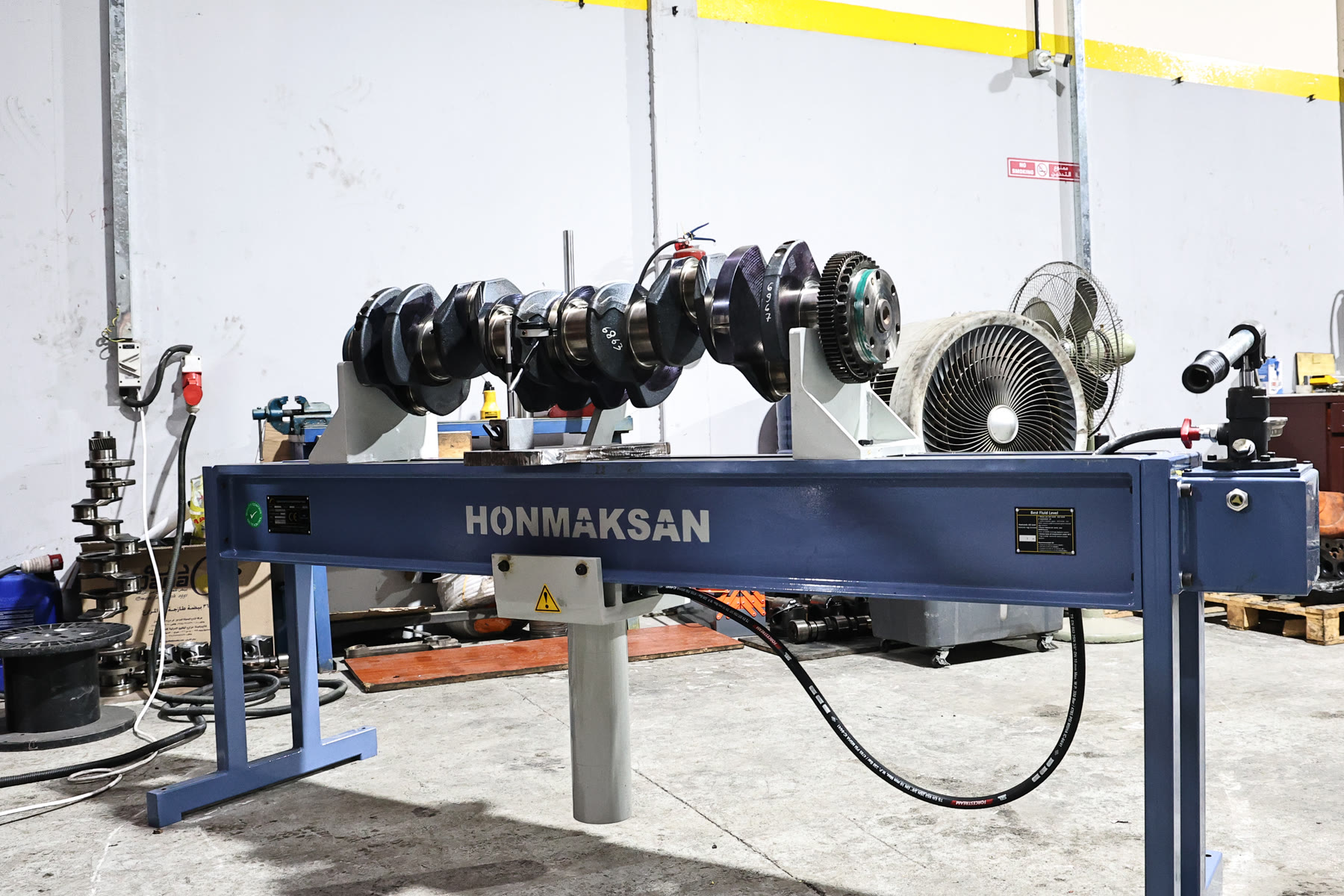
This page is for a shaft that has been measured and found bent: a run-out reading outside the engine maker's limit, a crank that will not turn freely in a rebuilt block, or an engine that vibrates through a range it never used to. Established 2011, over 25 years of experience.
What straightening in house changes
A bent shaft gets found before it is ground, not after. Grinding a bent crankshaft produces journals that are round, correctly sized, and in the wrong place relative to each other. The engine still knocks. Because straightening and crankshaft grinding happen in the same shop, the straightness check sits where it belongs — in front of the grinder, not behind it.
Correction is incremental, and it can be re-measured after every stage. Straightening a crankshaft is a sequence of small controlled movements with a dial gauge reading between each one. That loop only works when the press, the V-blocks and the operator are in one room. When any part of it is subcontracted, the shaft comes back with one number on a note and nobody to ask.
The shaft is not over-corrected. The commonest way to ruin a crankshaft is to push it too far and then push it back. Every reversal works the material and moves the shaft closer to a fatigue crack. We correct towards the limit deliberately and stop, rather than chasing a perfect zero that the engine does not require.
Cracks are looked for before force is applied and again after. A bent shaft has already been overloaded once. Magnetic particle inspection before straightening tells us whether the shaft is fit to be worked at all, and repeating it afterwards tells us whether the correction started something. A shop that straightens without crack testing is gambling with the customer's engine.
You leave with numbers, not reassurance. Run-out before, run-out after, taken at the same points on the same instruments. "It's straight now" is not a measurement. A figure on a sheet is.
Crankshaft alignment operations we perform
- Run-out measurement on V-blocks with a dial gauge, at every main journal
- Bend and its angular position located and marked
- Deflection and web assessment where the shaft is from an engine that specifies it
- Magnetic particle crack detection before any correction is applied
- Dye penetrant inspection where the geometry does not suit magnetising
- Cold straightening under controlled press load — see hydraulic press services
- Peening correction, applied to the web fillets, for shafts where press correction is not the right method
- Staged correction with re-measurement between stages
- Repeat crack detection after correction
- Journal grinding after straightening where the correction has moved a journal — see crankshaft grinding and regrinding
- Journal polishing to a bearing-ready finish
- Thrust face and flange face run-out check
- Spigot, keyway and flange bolt hole inspection
- Hardness verification where grinding follows
- Final run-out measurement and written report
Nothing on that list is priced in advance, because until the shaft is on V-blocks nobody knows which of those steps it needs.
When a crankshaft needs straightening
- Vibration that appeared after a rebuild. The commonest one. Everything was new, everything was torqued, and the engine shakes. A crank bent during handling or bent by a previous seizure will do exactly this.
- Seizure or a spun bearing. A journal that has picked up and welded itself to a shell takes the shaft with it. Heat plus a locked journal is how shafts bend.
- A dropped or badly slung shaft. Long shafts are astonishingly easy to bend in transport, and the damage does not show.
- The crank will not turn freely in the block. With the bearings correct and the housing bores in line, a shaft that binds as it rotates is bent. If the housing bores are the suspect instead, that is line boring territory, and the two are told apart by measurement.
- Uneven bearing wear across the mains. Shells worn heavily at one end of the block and lightly at the other point at a bend or a misaligned housing.
- Water ingress or hydraulic lock. A cylinder that filled with water bends what it does not break.
The measurement that decides all of this is total run-out at each main journal, taken with the shaft on V-blocks and rotated through a full turn. It is a five-minute reading once the shaft is clean, and it settles an argument that otherwise runs for weeks.
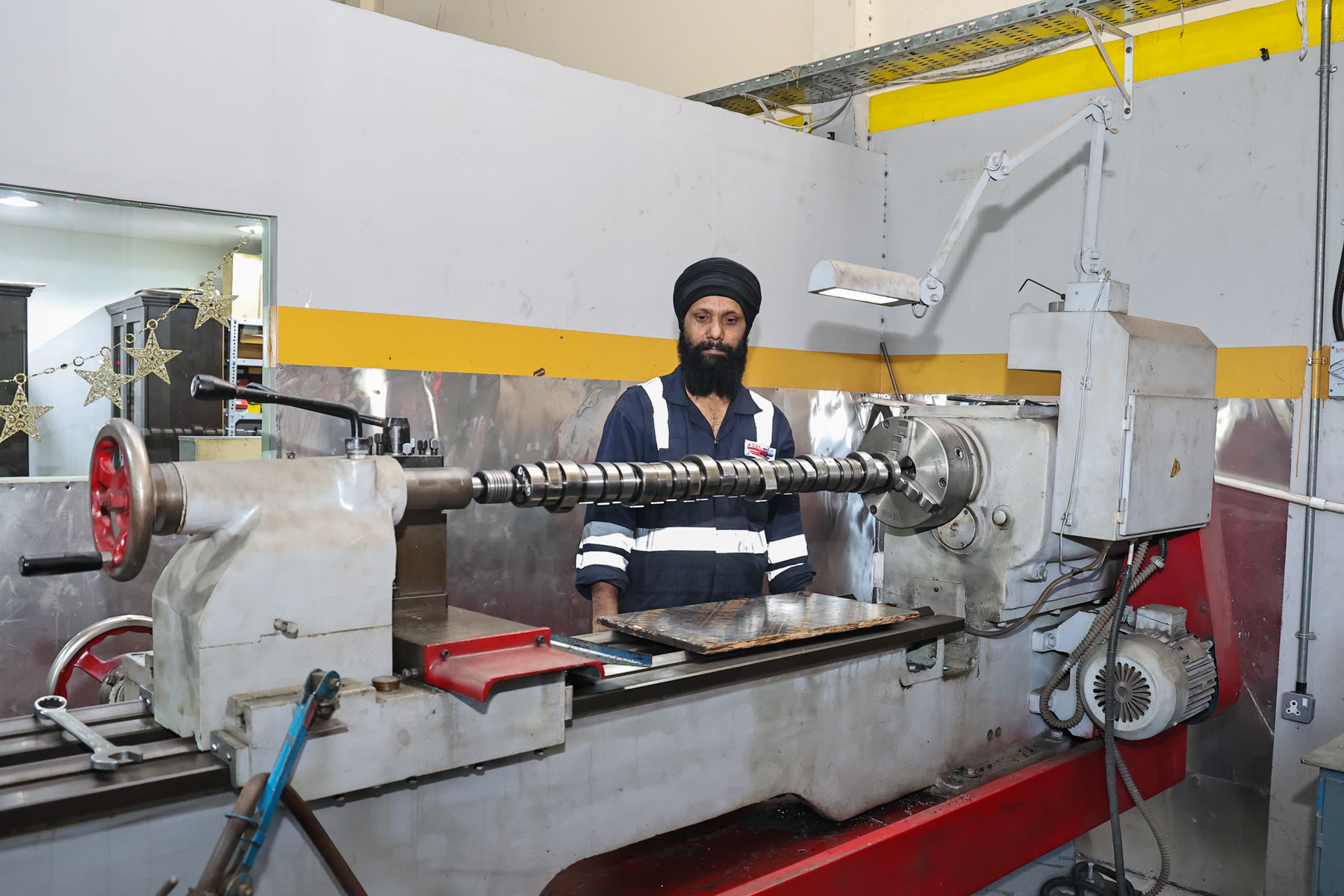
The process
- Clean and identify. Engine make, model and serial. Oilways cleared. Nothing is measured dirty.
- Measure as received. Run-out at every main, taken with the shaft supported at its end journals, plus thrust and flange face readings. This is the "before" column.
- Crack detection. Magnetic particle inspection, fillet roots included. An indication in a fillet or a web ends the job here — a cracked shaft is not straightened, it is condemned, and you are told so before you spend anything else.
- Locate the bend. Amount and angular position, marked on the shaft.
- Correct in stages. Controlled load applied at the correct point, released, re-measured. Repeated until the reading is inside the engine maker's limit. On shafts where press correction is not appropriate, peening of the web fillets is used instead — a cold method that works the material local to the bend rather than bending the whole shaft back.
- Re-inspect for cracks. The same method as step 3, after the shaft has been worked.
- Grind and polish if required. Correction sometimes moves a journal enough that it needs regrinding. If it does, you are told before the machine is started.
- Final measurement. Same points, same instruments, into the "after" column.
- Clean, oil, wrap and return with the report.
Nothing is pressed until you have seen the incoming readings and approved the work. If the crack test changes the answer, you get a phone call — not an invoice with a surprise on it.
What we return to you
The shaft, protected for transport, and a measurement sheet giving run-out at every main journal before and after, the crack test method and result, and a note of any journal that was ground as part of the correction with the undersize it now sits at. If bearing shells need to be ordered to a new size, that line is on the sheet so the order is right first time.
Straightening work is warranted. What the cover extends to depends on whether the shaft was also ground here and whether we did the assembly, so it is written on your quotation rather than promised as a slogan.
Repair or replace — the shaft decides, and it decides in numbers
Whether a bent crankshaft is worth saving is measurable, and there are only a handful of measurements involved: how far it is out, whether it is cracked, whether the journals are still above the lowest undersize bearing shells are made in, and whether the hardness is intact. All four can be taken in a morning.
We will tell you to buy a new shaft when:
- There is a crack in a fillet or a web. Straightening a cracked shaft is how a crankshaft ends up in two pieces inside a running engine. Replace it.
- The bend is severe enough that correcting it would exhaust the shaft's remaining undersizes. Correction and the regrinding that follows both consume material.
- The shaft has already been straightened repeatedly. Each correction works the metal. A shaft with a history of them is a shaft that will bend again.
- Hardness has been lost through the overheat that bent it in the first place. A soft journal will not hold, however straight the shaft is.
That verdict costs you the inspection and nothing else, and it is worth more than the straightening fee we would otherwise have taken.
Engines we straighten crankshafts for
Caterpillar, Cummins, Perkins, Volvo, Scania, Mercedes-Benz, Mitsubishi, Yanmar, Iveco, Wärtsilä, Niigata, Tata and Ashok Leyland — truck, bus, generator, industrial, marine main and auxiliary shafts.
Length is rarely the obstacle people expect. If you are unsure whether your shaft is one we can take, send its overall length, the largest journal diameter and a photograph, and you will have a yes or a no the same working day — before you pay to transport it.