
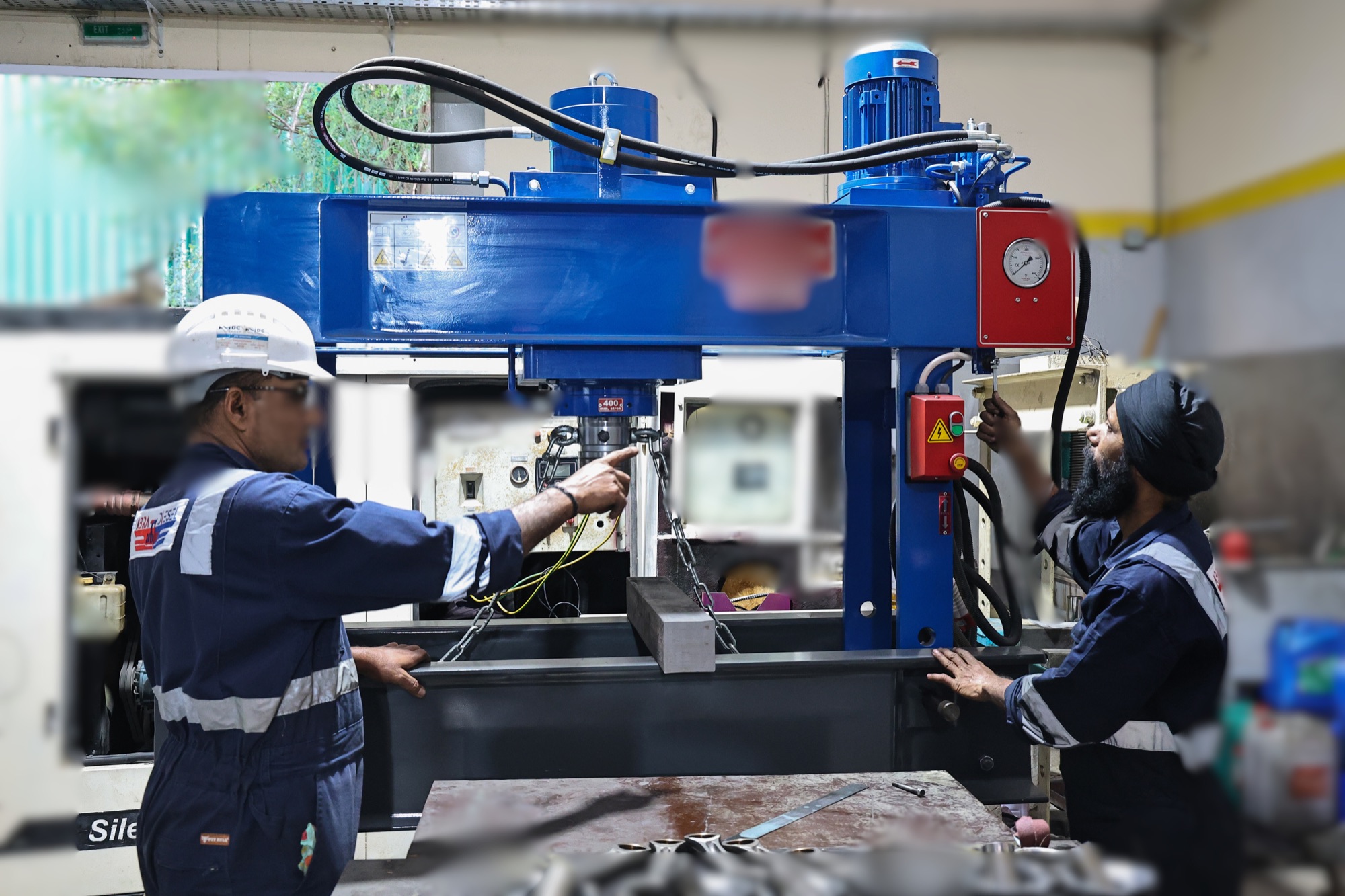
This page is for the jobs that need force applied accurately: something seized that must come out without damaging what it is in, or something that must go in square and stay there. Established 2011, over 25 years of experience.
What having the press next to the machines changes
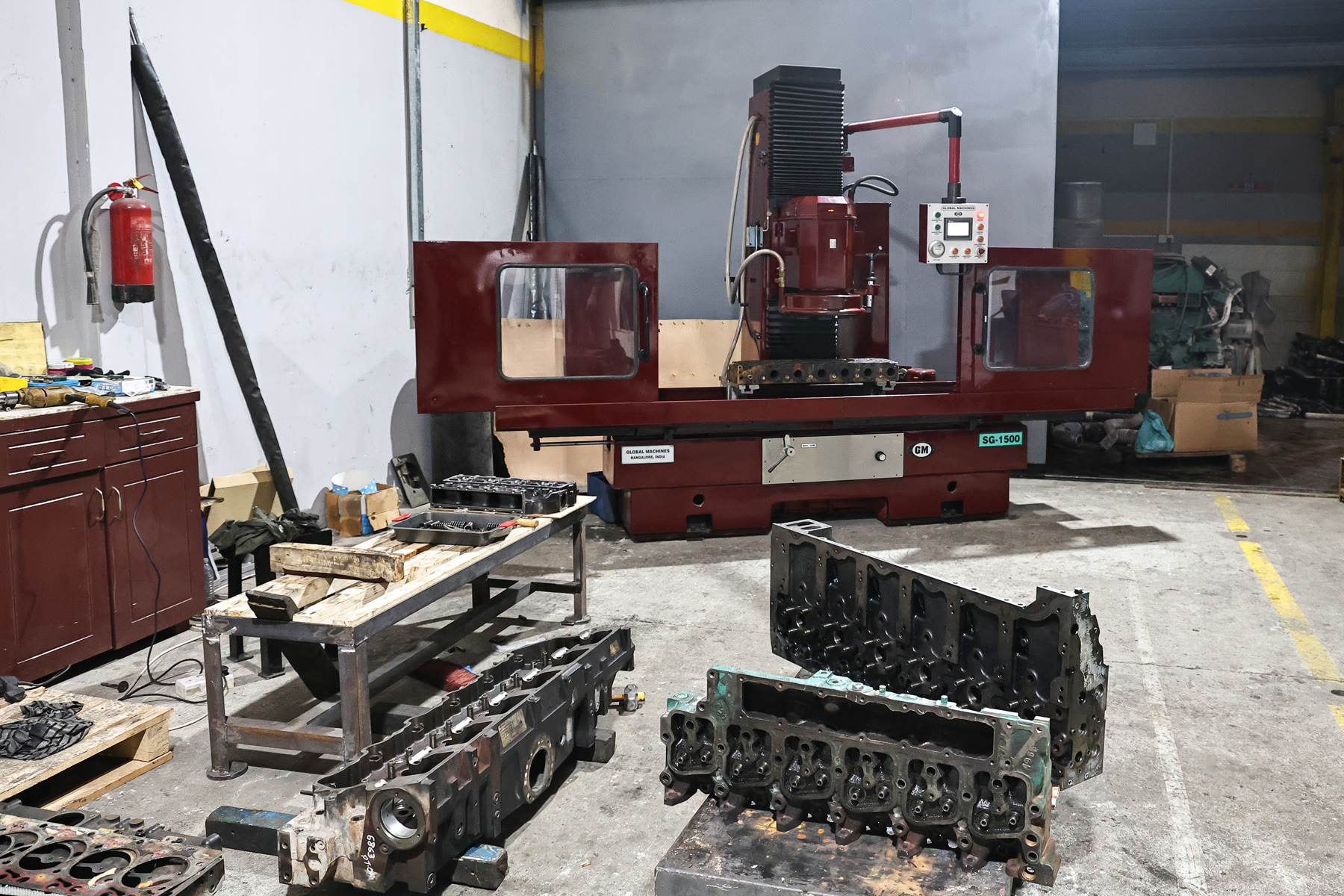
Force and measurement happen in the same place. Pressing a bush in is the easy half. The half that matters is knowing the bore it is going into, knowing the size of the bush going in, and knowing what the finished bore will measure once the bush has closed up on fitting — because it always does. Here the part is measured before and after, and finished to size on a machine afterwards if it needs it.
A part that will not come out does not go home unfixed. Seized liners, bushes that have picked up in their housings, pins welded into pistons, gears that have rusted onto shafts — these are the jobs that get refused elsewhere and turned into damaged castings by people improvising. Steady controlled load, correct support, and heat used only where it belongs, is how they come out.
We can make the part we could not press out of. Where a bush, sleeve, spacer or pin is not available, it is turned from bar on our own lathes and pressed in the same day. See lathe and turning works. A press without a lathe behind it can only fit parts somebody else supplies.
The component is supported properly. Most press damage is not caused by too much force. It is caused by force applied through the wrong path — a housing that flexes, a web that takes a load it was never designed for, a casting supported at one point instead of two. Fixturing is the job.
Load is applied progressively and watched. A press is not a hammer. Applied slowly, the pressure at which something moves tells you a great deal about whether it was fitted correctly in the first place.
Press operations we perform
Bushes and bearings
- Small-end bush removal from connecting rods, and fitting, with finishing to the actual gudgeon pin
- Bush removal and fitting in rockers, levers, linkages, idlers and pivots
- Camshaft bush removal and fitting
- Bearing pressing onto and off shafts
- Bearing removal from housings, blind and through
- Bush manufacture from bar where the part is not available, then fitting
Pins, shafts and gears
- Gudgeon pin removal and fitting on press-fit pistons
- King pin removal and fitting
- Pin, dowel and stud extraction
- Gear, sprocket, pulley and coupling removal from shafts
- Gear and coupling fitting to a controlled interference
- Shaft removal from housings and hubs
- Flange and hub pressing
Engine and driveline components
- Cylinder liner removal, including seized liners, and liner fitting — see cylinder liner fitting and installation
- Valve guide removal and fitting
- Seat insert removal and fitting
- Suspension and steering bush work
- Universal joint and yoke work
- Bearing and race work on gearbox and axle assemblies
Straightening and forming
- Shaft, rod and bar straightening under controlled load
- Crankshaft straightening as a measured, staged operation — see crankshaft straightening and alignment
- Connecting rod bend and twist correction after checking on the alignment fixture — see connecting rod boring and reconditioning
- Plate and bracket forming, bending and flattening
- Housing and flange face flattening
No prices are published for any of this. Press work is quoted on the job, because a bush that slides out and a bush that has been seized in a housing since 2009 are not the same job even though they are the same part.
When you need a press rather than a workshop
- Something is seized. Force is required and the component around it is worth more than the part being removed. That is precisely the case where hitting it is the expensive option.
- A bush or bearing has to go in square. Anything driven in with a hammer goes in at a small angle, and a small angle on a bush is a bore that has to be finished afterwards or a bearing that runs hot.
- The old part is destroyed and the new one is not available. Get it out, measure what is left, and have a replacement turned from bar.
- A bore has to be right afterwards. Bushes close up as they are pressed. If the finished internal size matters — and on a small end or a rocker it always does — the part needs a machine after the press, not just a press.
- A shaft or a rod is bent. Correction under gauge, in stages, is press work. Bending it back by eye is how a shaft ends up worse than it started.
- You do not have the fixturing. Most workshops own a press. Fewer own the tooling and the supports to use it on an awkward casting without breaking it.
The process
- Look at it first. What is being removed, what it is fitted into, what the fit was meant to be, and what happens to the surrounding component if the load goes wrong.
- Measure what matters. Housing bore, part diameter, and — where the finished internal size is critical — the mating part it will run on. Fits are set against real components, not nominal figures.
- Fixture and support. The load path is planned so the force goes through the part being moved and not through something that was never designed to carry it.
- Apply load progressively. Watched, not walked away from. Where heat or cold is the right tool alongside force, it is used deliberately — differential temperature does more of this work than brute pressure does.
- Inspect the housing. Once the old part is out, the bore it came from is measured and inspected. A bush that spun in its housing has usually damaged the housing, and fitting a new bush into a worn bore repeats the failure.
- Fit the new part to a controlled interference, square, with the correct lubrication or the correct differential temperature.
- Finish to size. Bores machined, reamed or honed after fitting where the finished size matters.
- Measure and record.
Nothing is pressed until you have agreed what is being done. If what we find when the old part comes out changes the job — a scored housing, a cracked casting — you get a phone call before anything else happens.
What we return to you
The component with the new part correctly fitted, finished to size where the fit matters, and the readings that show it: housing bore, the fitted part's size, and the finished internal dimension against the mating part. For a small-end bush that means the pin clearance; for a liner it means the protrusion; for a bearing it means the interference it was fitted to.
Press work is warranted, and what the cover extends to depends on whether we also supplied the parts — so it is confirmed in writing with your quotation rather than promised loosely.
Jobs this shop takes that other workshops turn away
The reason a press page exists at all is that a lot of press work is refused elsewhere. The jobs that come to us as a second attempt look like this:
- A liner that will not move in a block somebody has already tried to shift. Recoverable more often than the customer expects, because the damage from a failed attempt is usually to the liner rather than to the block.
- A bush someone has driven part way in and jammed. It comes out, the housing gets measured, and a new one goes in — or gets made.
- An obsolete bush or sleeve with no supplier. Turned from bar to the housing you actually have. This is where owning lathes and a press in the same building stops being a convenience and starts being the difference between a repair and a scrapped assembly.
- A gear or coupling that has to come off a shaft that must survive. The shaft is worth more than the gear, so the load path is planned around the shaft.
- Non-diesel and general industrial work. Bushes, bearings, shafts and brackets from any industry are normal here. Press work does not care what the assembly is bolted to.
Repair or replace is a measurement here too
Press work is usually the cheap end of a much bigger decision, and it is worth pointing out where the numbers land.
A connecting rod with a worn small end is not a scrap rod; it is a rod that needs a bush and a bore. A rocker with a slack bush is not a scrap rocker. A shaft with a spun bearing is a shaft that needs its journal measured — sometimes machined and sleeved, sometimes replaced. Repairability depends on measurable condition: how much material is left in the housing, whether the bore is round, whether the shaft is within size, and whether the casting is cracked.
Where the housing is damaged past a sensible fit, we say so. Pressing an oversize bush into a bore that will not hold it is a repair that fails on the road, and it is not one we will sell you.