
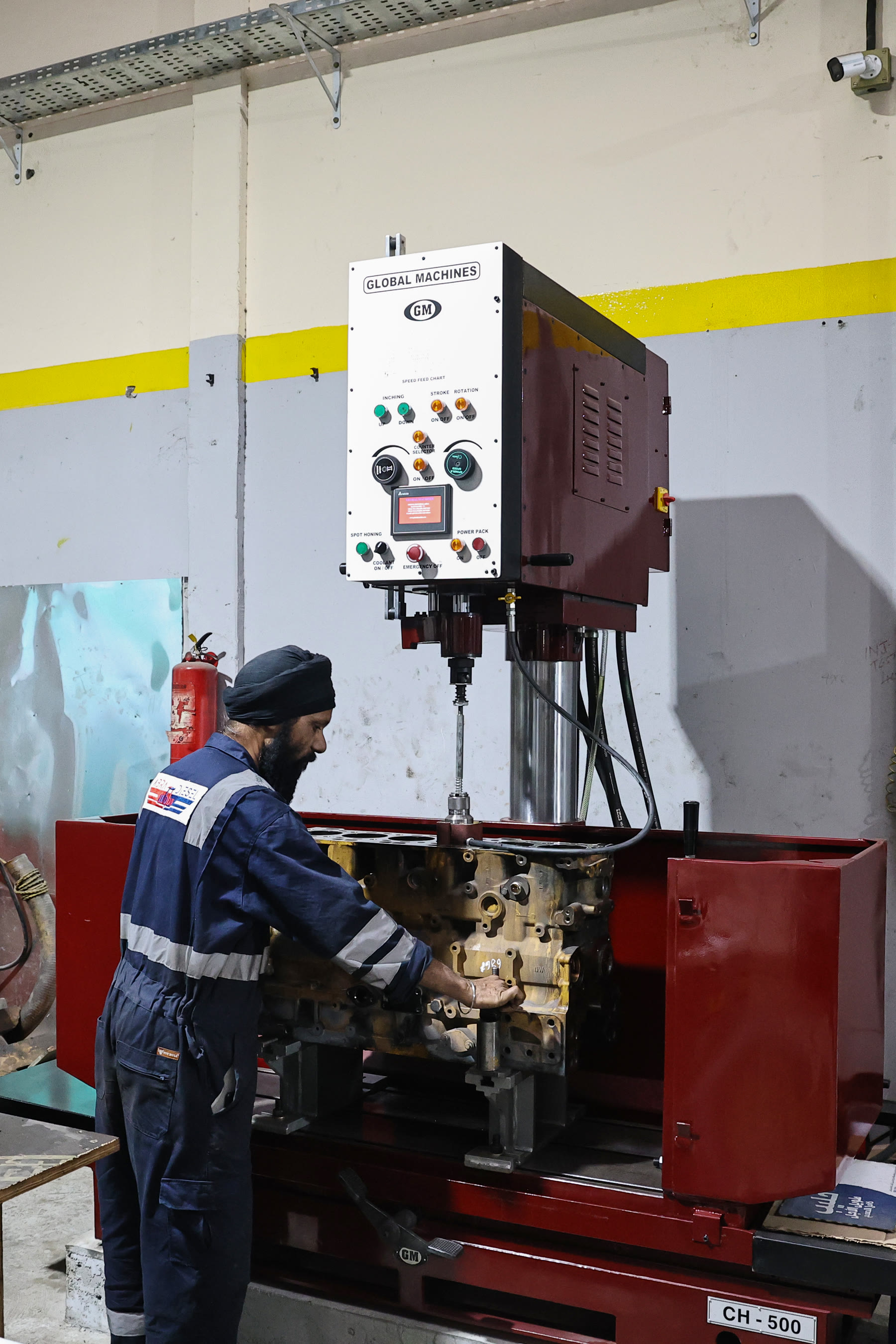
Established 2011, over 25 years of experience, and independent: we hold no engine brand dealership, so we have no reason to sell you a block you do not need.
Boring and honing under one roof
Reboring is half an operation. The other half is honing, and what happens between them decides the rebuild.
The block does not leave the building between the bore and the hone. Boring sets the size, the position and the squareness; honing produces the roundness, the straightness and the crosshatch that seats the rings. A block that travels between those two steps arrives at the second one having been lifted, strapped and set down again, and nobody re-checks the datum.
The bores are cut to your actual pistons. Pistons are measured on the bench here and the bore is finished to give the maker's clearance on the piston that is going in — not to a nominal oversize dimension from a table. That is only possible when the shop that bores also hones and also has the pistons in front of it.
One oversize decision, made once, by the people cutting it. The largest measured bore in the block sets the oversize for all of them, and that decision has to survive to the machine. Split the work and it becomes a note on a delivery docket.
Sending a block out to be bored adds a week and a second set of handling risks to the longest-lead item in the engine. It also means the shop that finally hones it inherits somebody else's bore and somebody else's word for what size it is.
You can come and see it in the machine. Ask when you call.
Boring operations we perform
- Bore measurement — diameter, taper and ovality, at several depths and two axes, per cylinder
- Block indicated off the main bore centreline before boring
- Cylinder boring to standard oversize
- Boring to a customer-supplied piston, with clearance set to that piston
- Single-cylinder boring for sleeve fitting
- Counterbore cutting for liner installation
- Sleeve and liner fitting, then boring back to standard size — see cylinder liner fitting
- Rough boring with stock left for honing
- Honing to final size, roundness and crosshatch — see cylinder bore honing
- Piston-to-bore clearance measurement against the actual pistons
- Piston and ring groove measurement — see piston reconditioning
- Block cleaning to a rebuild standard after machining
- Full written measurement report
No prices are published. Reboring is quoted after the bores are measured, because the oversize required is the whole job and nobody knows it in advance.
When an engine needs reboring
- Measured bore wear beyond the service limit. Taper at the top of ring travel is the usual killer: the top ring reverses there, oil film is thinnest, and the bore wears into a step.
- Out-of-round bores. Rings cannot follow an oval bore. Compression escapes and oil is pumped past.
- Scoring. From a broken ring, a seized piston, a dropped valve fragment, or dirt through a failed air filter.
- High oil consumption and blow-by with good rings and good valve stem seals.
- Piston slap and heavy piston skirt wear.
- Any block coming apart for a major overhaul where the bores measure past the maker's limits.
The measurement that matters is not one diameter. It is diameter taken at several depths and at two axes — thrust and across — so that taper down the bore and ovality across it are both known. Bore taper, ovality and wear are cumulative: use most of the allowance in taper and there is less room left before the next oversize is forced.
The process
- Measure every bore with a dial bore gauge at top, middle and bottom, in both axes. The largest measured dimension across the whole block sets the oversize the whole block must go to — all cylinders are bored to the same size.
- Confirm pistons are available at that oversize before cutting anything. An oversize that no piston maker supplies is a scrapped block. Where pistons are already in hand, the bores are cut to those specific pistons and the piston-to-bore clearance is set to the maker's figure.
- Check the block for cracks and pressure test it. No point boring a block that will not hold water. See engine block machining and repair.
- Quote and approval. You see the readings and the oversize proposed before anything is cut.
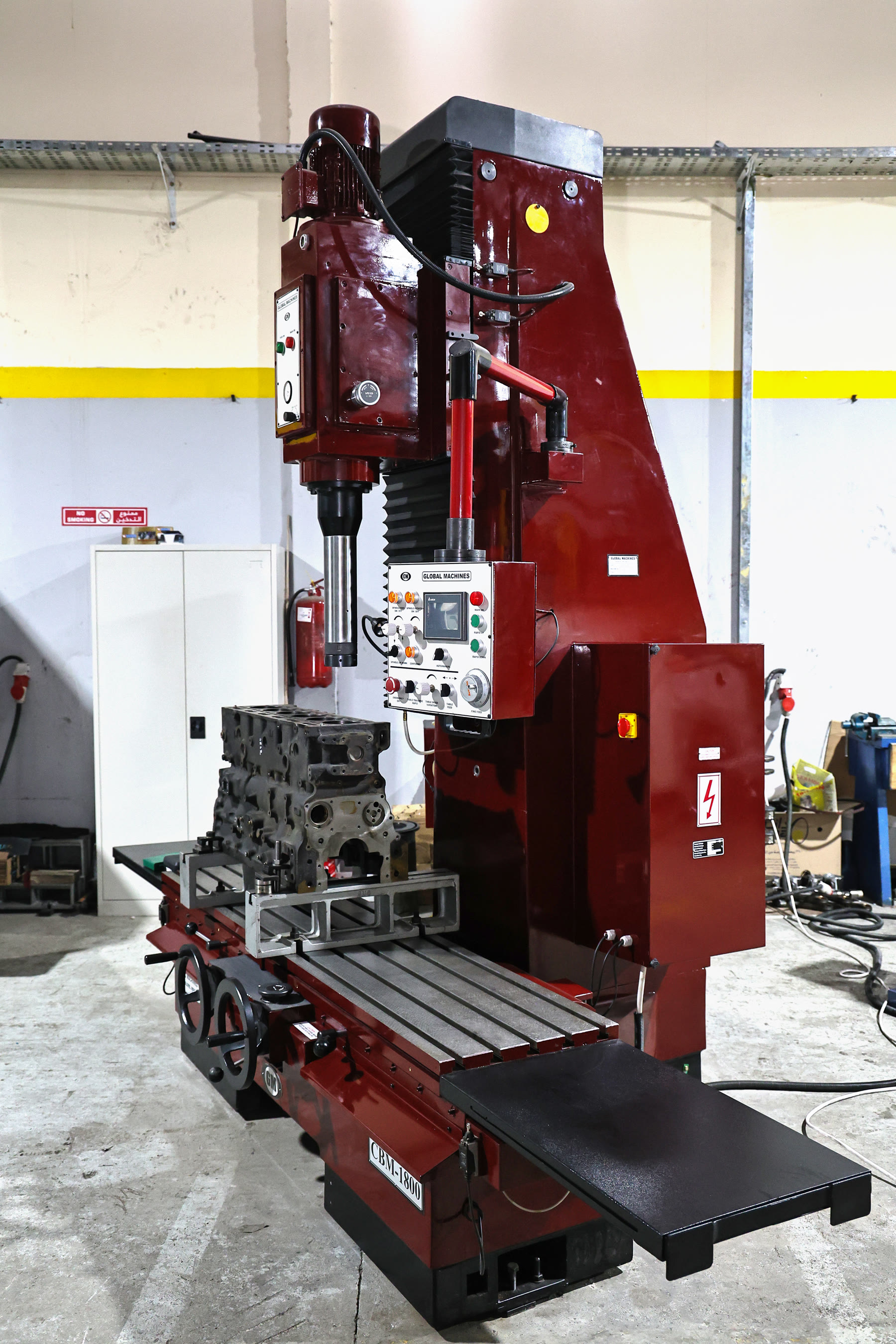
- Fixture and indicate. The block is set so the bores are cut square to the crankshaft centreline, not merely square to the deck. A bore that is out of square puts the piston in a permanent rock.
- Rough bore, leaving stock for honing. The boring bar establishes the size, the position and the squareness; it does not produce the final surface.
- Hone to final size and finish. The last few hundredths of a millimetre come out on the hone, which is where roundness, straightness and the crosshatch that seats the rings are actually produced. Detail on cylinder bore honing.
- Measure again. Diameter, roundness and taper on every bore, and piston-to-bore clearance checked against the actual pistons.
- Clean the block thoroughly — bores scrubbed until a clean cloth stays clean — then oil and protect.
Boring versus sleeving
Not every worn block is a reboring job, and this is a decision made on wall thickness and piston availability, not on preference.
Rebore when there is enough wall thickness left to take the next oversize and matching pistons exist. It is cheaper and it is the normal answer.
Sleeve (fit a liner) when the block is already at maximum oversize, when a single cylinder is damaged and the rest are good, or when you want the block back at standard bore size so standard pistons can be used. Sleeving a block that is out of oversizes is often the difference between a usable engine and a scrapped casting. See cylinder liner fitting and installation.
Replace the block when wall thickness is gone, when there is a crack through structure, or when the block has been bored oversize and sleeved before and there is nothing left to work with.
We measure and tell you which of the three you are in, with the numbers.
What we return to you
Bored and honed cylinders at a stated oversize, with a measurement sheet giving each bore's diameter, taper and ovality before and after, the finished bore size, the piston oversize required, and the piston-to-bore clearance measured on your actual pistons. Reboring is warranted; the cover is set out in writing on your quotation and depends on whether we also supplied the pistons and rings.
Engines we rebore
Cummins, Caterpillar, Perkins and Volvo reboring are the requests we see most, alongside Scania, Mercedes-Benz, Mitsubishi, Yanmar, Iveco, Wärtsilä, Niigata, Tata and Ashok Leyland — in truck, bus, generator, industrial, fire pump and marine forms. Small four-cylinder blocks through to large genset and marine blocks are all normal work.
If you want that confirmed before you load a block, send the engine model, the standard bore size and a photograph. Same-day answer, no charge, and it has saved customers a wasted transport bill.
Repair or replace — the wall decides
For most diesel engines in the UAE, reboring plus a set of oversize pistons and rings is a fraction of the cost of a replacement block or a replacement engine, and it is available in days rather than on an import lead time. The saving is largest exactly where the engine is largest — the big generator and marine blocks that nobody stocks in this country.
Whether it is possible is measurable. Bore diameter, taper and ovality against the service limit; how much material the next oversize takes; the wall thickness that leaves; whether the block holds pressure; and whether pistons exist at that oversize. Five checks. They take a day and they replace an argument.
The case against reboring is honest and short: if the wall will not carry the cut, or the block will not hold pressure, no amount of machining fixes it. You will be told that with the readings attached, and it will have cost you the inspection.