
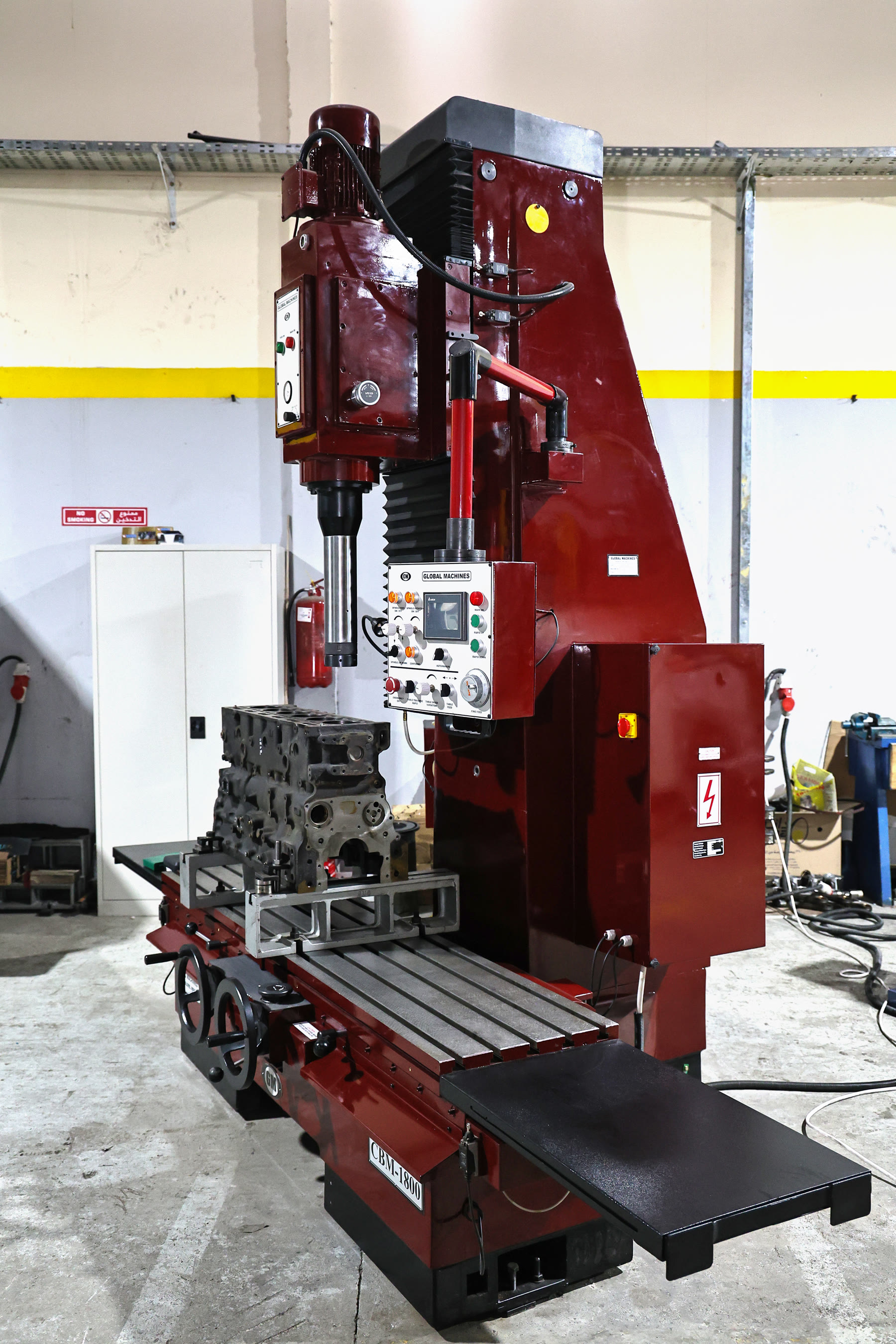
A block is the most expensive casting in the engine and the one with the longest replacement lead time in this region. It is also, more often than people are told, repairable.
Why a block should not be split across three shops
Block work is the clearest case in the whole trade for keeping the machining in one building.
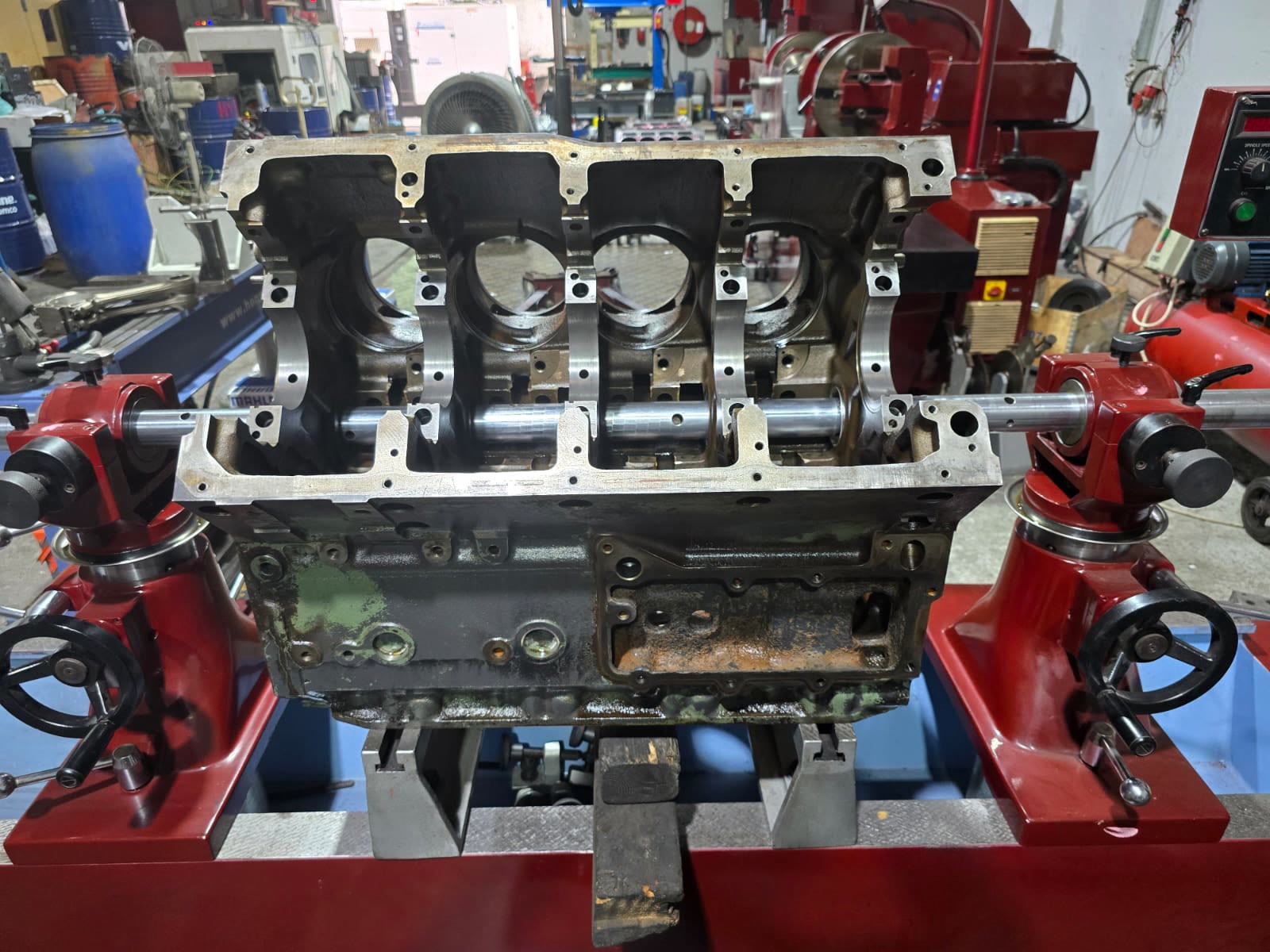
Every operation refers to the same datum. The crankshaft centreline is established by line boring; the deck is cut square to it; the cylinders are bored square to it. Send those three operations to three suppliers and each one re-establishes a datum from scratch, using whatever it can find, and the errors add up.
The block is fixtured once, transported once, lifted once. A bare block is heavy and awkward, and every additional lift is a chance to damage a machined face or a counterbore. Customers who have had a block come back from a subcontractor with a chipped deck edge know exactly what this sentence is about.
Pressure test before machining, and again after repair — in the same shop. This is the sequence that stops money being spent on a casting that will not hold water. When testing and machining sit with different companies, it is the step that gets skipped.
Boring and honing in one visit. They are two halves of one operation. Splitting them across two workshops means the block sits half-finished in somebody's yard while the size it was left at slowly stops being the size on the paperwork.
Subcontracting a block adds a week at each hand-off and a third party who never speaks to you. Here, the answer to "what did the pressure test show" is a person, in this building, holding your block.
Block operations we perform
Inspection and testing
- Block cleaning, degreasing and gallery clearing
- Core plug removal and replacement
- Dimensional survey — bores, deck, main bores, counterbores, all recorded
- Magnetic particle crack detection
- Dye penetrant inspection where geometry requires it
- Block pressure testing, with pressure and hold time recorded
- Re-testing after crack repair
Machining
- Deck resurfacing to flatness and gasket-correct finish
- Deck cleanup cut, minimum removal
- Cylinder boring to oversize — see engine reboring
- Cylinder and liner honing, including plateau finishing — see cylinder bore honing
- Line boring of main bearing bores — see line boring
- Align honing to final size
- Main cap grinding and replacement cap machining
- Camshaft tunnel and bush bore machining
- Liner counterbore cutting and liner protrusion setting
- Cylinder liner removal and fitting — see cylinder liner fitting
Repair
- Crack repair by metal stitching and locking — see metal stitching and crack repair
- Welded repair where the casting and the location allow it
- Head bolt and stud thread repair with inserts
- Broken stud and bolt extraction
- Water passage and erosion repair
- Sleeving a single damaged cylinder back to standard bore
We publish no prices for any of these operations. Block work is quoted per block, after inspection.
Can this block be saved? Answer it with measurements
That is the question most people arrive with, and it is usually answered by somebody's opinion. It should be answered by readings.
Usually yes when the problem is: a worn or scored bore, a distorted or eroded deck, a spun main bearing, a damaged liner counterbore, a stripped head bolt thread, a crack in a water jacket wall away from the main structure, or a broken-off external boss.
Usually no when the problem is: a crack running through a main bearing web or a bulkhead, a hole blown through a cylinder wall by a rod, a bore already at its maximum oversize with no sleeving room, general wall thinning from long-term corrosion, or a block that has been in a fire.
It depends when the problem is: a crack across a deck between bores, a crack into a cylinder bore, or a block that has already been repaired once. These are decided by a pressure test after repair, not by opinion before it.
The readings that settle it are bore diameter, taper and ovality; deck flatness; main bore size, roundness and alignment; crack location and depth; wall thickness where corrosion has been working; and whether the jacket holds pressure and for how long. None of that requires a decision from you. It requires a bench, a set of instruments and a day.
We give the verdict in writing with the measurements attached, and we would rather lose the machining job than take money to repair a block that is going to come back.
The process on a typical block
- Strip and clean. Core plugs out, galleries cleaned through, deck and bores degreased. Nothing is measured or crack tested dirty.
- Measure as received. Bore diameter, taper and ovality at top, middle and bottom of each bore. Deck flatness across length, width and diagonals. Main bores with caps torqued. Liner counterbore depth and diameter. All recorded.
- Pressure test and crack detection. Before any machining, because a crack found afterwards means the machining was wasted.
- Quote and approval. You see the measurements and the recommendation, including a replace-instead verdict where that is the answer. Nothing is cut until you say yes, and if the scope changes you get a phone call, not a bigger invoice.
- Repair. Cracks stitched, threads inserted, counterbores cut.
- Machine. Line bore first where required — the crank centreline is the datum everything else refers to — then deck, then bores.
- Hone to the specified finish.
- Re-test. Pressure test again after crack repair. Re-measure everything machined.
- Final clean and protective oiling. Swarf left in a gallery ruins the rebuild.
- Report.
What we return to you
A machined block, and a report giving the before and after figures for every bore, the deck flatness and the material removed, main bore alignment where line bored, liner counterbore depths, the pressure test pressure and hold time with the result, the crack test result, and the piston oversize the block now takes. That last figure is what you order pistons against, and getting it in writing from the shop that cut the bores removes the commonest ordering mistake in an overhaul.
Block machining and crack repair are warranted. Because a stitched repair and a bored cylinder are very different pieces of work, the cover for each is set out in writing on your quotation rather than as a single blanket claim.
Blocks we machine
Caterpillar, Cummins, Perkins, Volvo, Scania, Mercedes-Benz, Mitsubishi, Yanmar, Iveco, Wärtsilä, Niigata, Tata and Ashok Leyland — truck, bus, generator, industrial, fire pump, marine main and auxiliary.
The large Cummins families come up constantly in this market: KTA19, KTA38, KTA50, NTA855. Those are regular work here, as are large genset and marine blocks. Before you pay to move a block, send the engine model and a photograph of it on the stand and we will confirm the same working day that it is a job for this shop.
Engine block repair cost — what drives it
engine block repair cost is a real query, and the honest answer is that we publish no prices and quote per block after inspection. What moves the number:
- Which operations are needed. A deck skim is not a line bore is not a full bore-and-hone.
- Number of cylinders and the physical size of the block.
- Whether cracks are found, how many, how long, and where. A crack in a water jacket wall is a different job to one across a deck.
- Whether liners are involved — dry, wet, or a block being sleeved for the first time.
- Parts. Liners, pistons, rings, core plugs, thread inserts.
- Setup sharing. Doing the deck, the bores and the mains in one visit is substantially cheaper than three separate jobs, because the block is fixtured, lifted and transported once. This is the single largest saving available on a block, and it only exists because the machines are all here.
Against that sits the replacement cost. A new or reconditioned block for a large diesel is a major purchase with a lead time measured in weeks, during which the engine earns nothing. The inspection that tells you which side of that comparison you are on costs a fraction of either.