
This is the page for a machine that vibrates, or for a rebuilt assembly that must not. Established 2011, over 25 years of experience.
What unbalance actually is, and why one weight is not enough
A rotor is unbalanced when its mass is not distributed evenly about its axis of rotation. The heavy spot throws a force outwards, and that force grows with the square of speed: double the rpm and the force is four times larger. It is why a flywheel that felt fine at idle shakes the engine off its mounts at rated speed.
There are two ways a rotor can be out, and they need different corrections.
Static unbalance is a single heavy spot in one plane. Roll the part on knife edges and it settles with the heavy point down. Correct it in one plane and it is gone.
Couple unbalance is two equal heavy spots on opposite sides at opposite ends. Statically it balances perfectly — it will sit at any angle on knife edges — but spinning it produces a rocking couple that tries to wobble the shaft about its centre. Nothing you do in a single plane will remove it.
Real components have both, in combination, and that combination is what dynamic balancing means: measuring the unbalance in two correction planes at once, with the part turning, and correcting each plane by the right amount at the right angle. A crankshaft, a long rotor or a wide flywheel cannot be sorted out any other way. Static balancing on knife edges — still offered in some workshops as "balancing" — cannot see a couple at all.
What balancing in house changes
The correction and the re-spin happen in the same afternoon. Balancing is a loop: measure, remove metal, measure again. Each pass gets closer. That loop is cheap when the machine is twenty paces from the drill and expensive when the part has to be carried across an industrial area between passes — which is why subcontracted balancing usually stops at the first acceptable reading rather than the best one available.
The assembly is balanced as an assembly. A crankshaft, its flywheel, its damper and its clutch or coupling all turn as one object, and the engine feels their combined unbalance, not each part's individually. Balancing them together — or balancing components onto an already-balanced shaft in the right order — is the difference between a smooth engine and three individually acceptable parts that fight each other.
Balancing sits next to the machining that caused the imbalance. A crankshaft that has just been reground, a flywheel that has just been resurfaced, a rotor that has just had a new shaft fitted — all have had metal moved, and all may need re-balancing afterwards. Here that is the next operation, not a second supplier and a second collection.
You get the numbers, before and after. A balance job with no readings is an assurance. With readings it is a record, and it tells the next person who touches the machine what was actually done.
We tell you when vibration is not unbalance. A good proportion of the vibration complaints that arrive here are misalignment, a bent shaft, worn bearings, a loose mounting or a resonance — none of which balancing will cure. Diagnosing that costs you an inspection and saves you a balance job that would not have worked.
Balancing operations we perform
- Two-plane dynamic balancing of rotating assemblies
- Single-plane balancing of discs, pulleys and fans where the geometry suits it
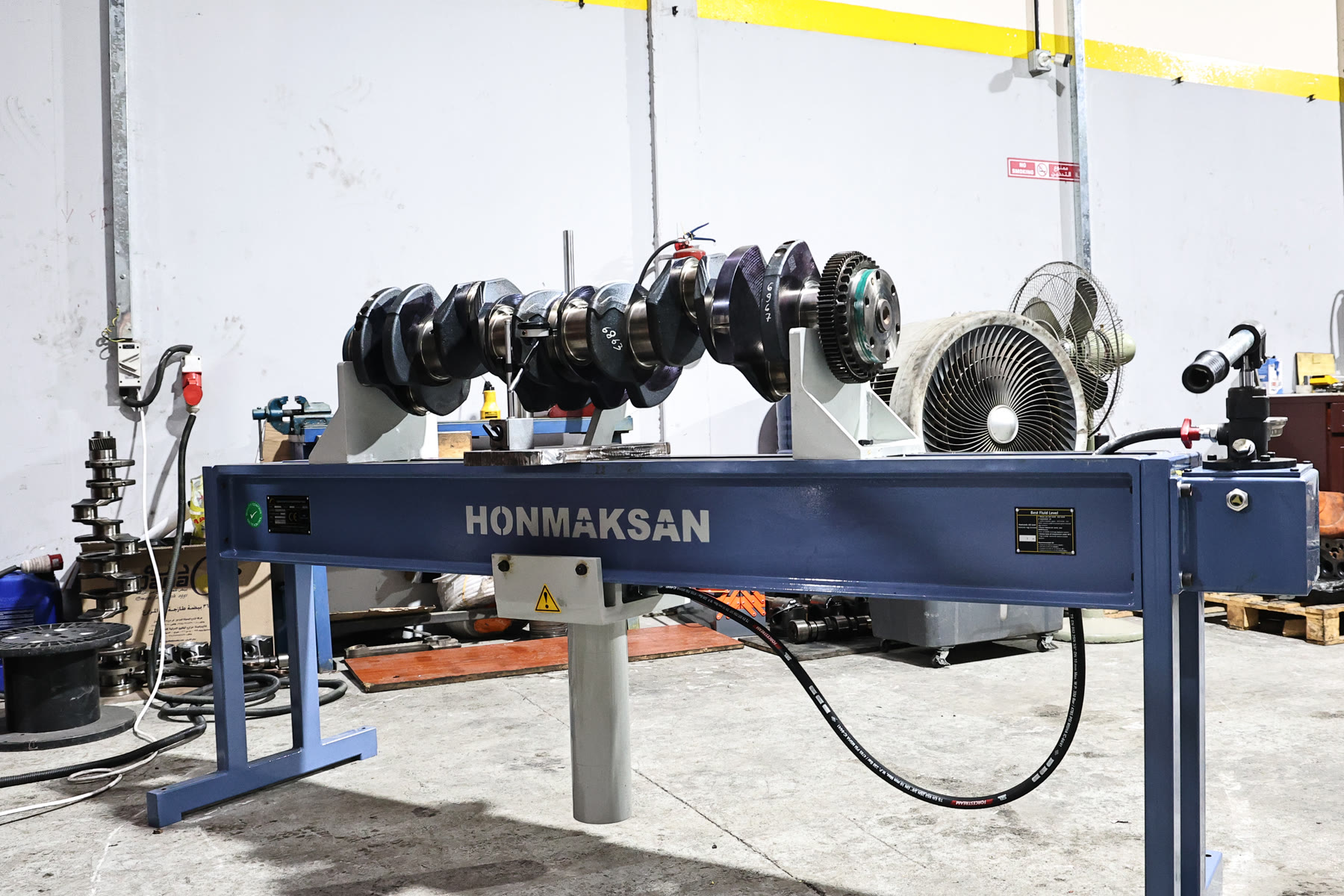
- Crankshaft balancing, including with bob weights fitted to represent the reciprocating mass on V-configuration engines
- Balancing of the crankshaft, flywheel, damper and coupling as a complete assembly
- Flywheel and flexplate balancing, including after resurfacing
- Clutch cover and pressure plate assembly balancing
- Torsional damper and pulley balancing
- Alternator, generator and electric motor rotor balancing
- Fan, blower and impeller balancing
- Pump rotor and impeller balancing
- Drive shaft and propeller shaft balancing
- Turbocharger rotating assembly work — see turbocharger repair
- Correction by drilling, milling or machining metal away
- Correction by adding balance weights where removal is not appropriate
- Run-out and straightness check before balancing
- Written before-and-after balance report
Nothing on that list is priced before the part has been seen and run. Until a component has been spun, nobody knows how far out it is or where the correction has to go.
How balance quality is specified
Balance is never absolute. Every rotor is left with some residual unbalance; the question is how much is acceptable, and that is set by the international balance quality grades — the G-grade system, familiar from ISO 1940-1 and its successor ISO 21940-11.
The idea is straightforward. Permissible residual unbalance is expressed relative to the rotor's mass, and it tightens as running speed rises: the same component turning twice as fast is allowed half the unbalance. A slow-turning, heavy, inherently unbalanced item like a large marine engine's crank drive sits in a very different grade band from a high-speed turbine rotor, and correctly so — chasing a turbine-grade figure on a slow-speed crankshaft is wasted money.
So the useful conversation at the start of a balance job is not "how accurate are you", it is what does this component do, and how fast does it turn. That decides the grade the job is worked to, and that grade goes on the report with the readings, so the number means something.
When something needs balancing
- Vibration that gets worse with speed and disappears when the machine slows down — the signature of unbalance rather than a bearing or a mounting fault.
- After a crankshaft regrind, particularly where the shaft was also straightened or where counterweights were dressed. See crankshaft grinding and regrinding.
- After a flywheel is resurfaced or a ring gear is replaced.
- After a rotor is rewound, re-shafted or has a damaged fan replaced.
- After any repair that removed or added metal off-centre — a built-up journal, a welded fan blade, a replacement coupling.
- Repeat bearing failures at one end of a machine with no other explanation. Unbalance loads bearings continuously and they fail early and repeatedly.
- A new or overhauled assembly going into service where downtime is expensive — a standby genset, a fire pump, a vessel's auxiliary — where balancing is cheap insurance rather than a repair.
The process
- Inspect and clean. Loose scale, old paint, packed-in dirt and a missing balance weight all read as unbalance. The part is cleaned first, and anything already loose is noted.
- Check run-out and straightness. A bent shaft is not an unbalanced shaft, and balancing one will not straighten it. Run-out is measured first, and a bend is corrected before balancing — see crankshaft straightening and alignment.
- Mount and set the correction planes. The part is supported on its own journals or on proper mounting, and the two correction planes are decided from the geometry — where metal can actually be removed or added without weakening the part.
- Spin and measure. Unbalance is measured in both planes: how much, and at what angle.
- Correct. Metal is drilled or machined away at the heavy point, or weights are added at the light point, depending on the component. On a crankshaft the correction goes into the counterweights, in positions and depths that do not compromise the shaft.
- Re-spin and verify. The measurement is repeated. If it is not where it should be, the loop runs again. This is where the time goes and it is where the result comes from.
- Record. The as-received readings, the corrections made, and the final readings in both planes go on your report.
Nothing is drilled into your component until you have agreed to it. Where correction requires removing metal from a part you may want to keep untouched, you are told first and the alternative is discussed.
What we return to you
The balanced component and a balance report giving the as-received unbalance in both planes, what was corrected, where, and the final measured unbalance — plus the balance grade the job was worked to and the speed it was assessed against. That last detail is the one that makes the report usable by anybody else later.
What we balance for
Crankshafts, flywheels and dampers from truck, bus, generator, industrial and marine diesel engines. Alternator and motor rotors from generator sets and plant. Pump rotors and impellers, fans and blowers, drive shafts and couplings. Caterpillar, Cummins, Perkins, Volvo, Scania, Mitsubishi, Yanmar, Deutz and Wärtsilä components are all routine work here, and so are industrial rotors that came off nothing with a badge on it.
Size is rarely the obstacle people expect. If you are unsure whether we can take your rotor, send its overall length, its largest diameter, its approximate weight and a photograph — you will have a yes or a no the same working day, before you pay to move it.