
You do not need to be a diesel customer. A shaft, a bush, a flange, a pulley, a threaded adaptor — bring it in, and if it is a job for us you will know within the hour.
What a job shop with its own lathes gives you
If you are looking for a lathe workshop near you in Sharjah or Dubai, what you actually want is short and specific.
Bring the part in and talk to the person who will machine it. Not a counter, not a broker, not a quotation department. The measurements are taken while you are standing there, and the scope is agreed in the same conversation.
A single part is a real job here. Job shops that also run production work treat one-off repairs as an interruption. This shop exists to repair things, so a one-off is the normal case and it is priced and scheduled as one.
We fit to the mating part, not to a drawing. Bring the shaft with its housing, or the pin with its rod, and the bush is made to the clearance the assembly actually needs. That is worth more than any tolerance figure, because a nominal dimension does not know what your worn housing measures.
Obsolete parts get made, not sourced. When a component is out of production, there is no replacement price — only a re-manufacture price, and that is a lathe job. Most of the interesting work in this shop arrives that way.
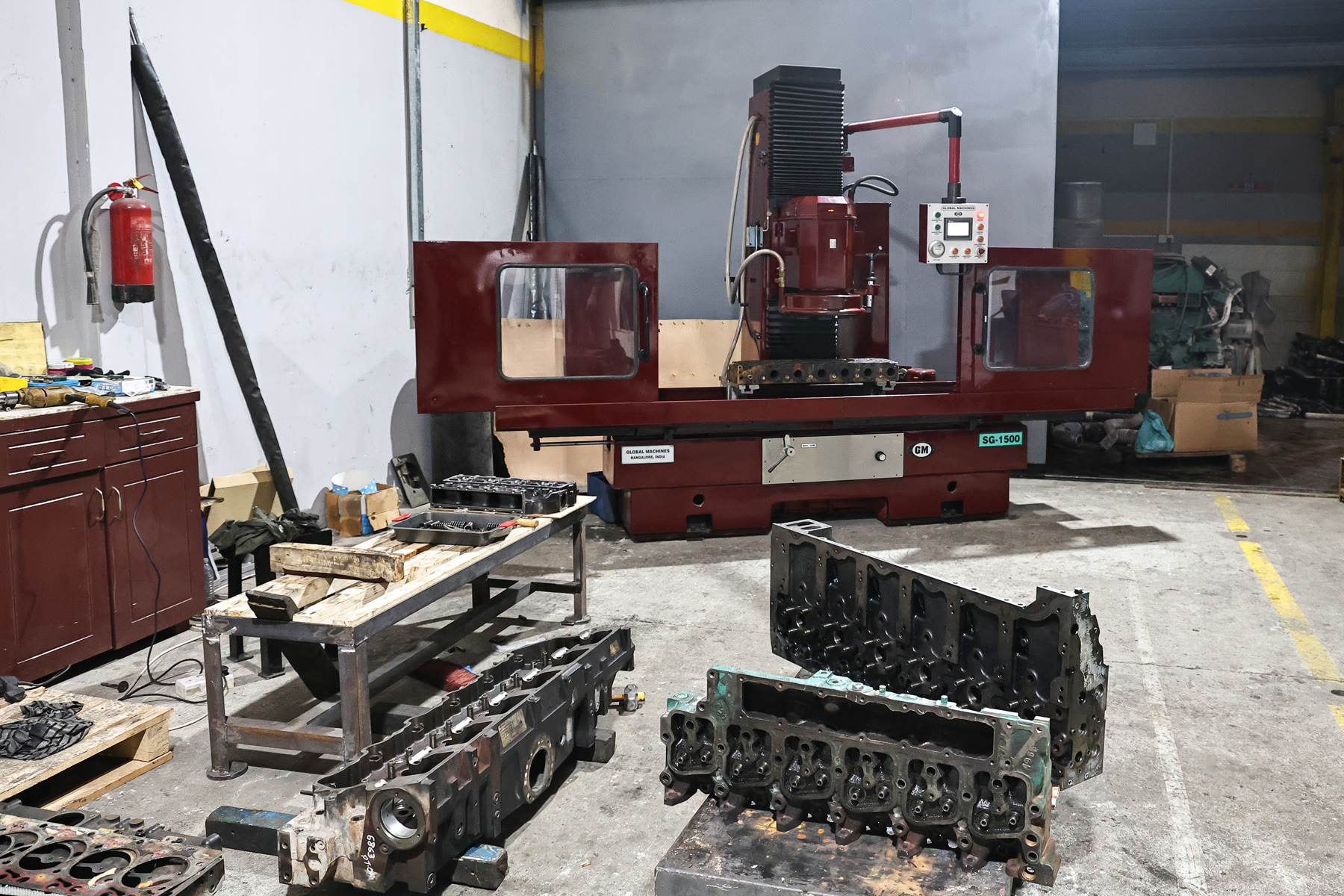
Turning sits alongside the engine machining. The same floor does crankshafts, blocks and heads, so a turned part that has to fit an engine assembly is checked against the assembly rather than against a note.
Turning operations we perform
Shafts
- Worn shaft journal repair and re-turning
- New shafts made from bar to sample or drawing
- Keyway re-cutting and new keyways
- Shaft straightening and run-out correction
- Pump, gearbox, propeller and drive shaft repair
- Thread repair on shaft ends
Bushes, sleeves and housings
- Bush and sleeve manufacture in bronze, steel and cast iron
- Bushes bored and finished to the actual mating shaft
- Housing boring and sleeving where a bore has gone oval
- Wear ring and spacer manufacture
Threading
- Internal and external threading, metric and imperial
- Non-standard and obsolete pitches cut from the sample
- Pipe and tapered threads
- Repair of damaged threads on large existing components
General turning
- Facing, parallel work, flanges, end caps and spacers
- Boring of large internal diameters
- Knurling
- Taper turning
- Parting, grooving and undercutting
Engine-related turning
- Flywheel machining and ring gear work
- Pulley, hub and adaptor manufacture
- Injector and pump component turning
- Small turned parts made during an overhaul
Working from
- A sample part — the most reliable input we can be given
- A hand sketch with dimensions
- A drawing, printed or electronic
- The worn part plus its mating component, which beats both of the above
Prices are not published. Work is quoted per job once we have seen the part or the drawing.
Who uses the lathe shop
Marine and workboat operators, generator and plant maintenance teams, truck and heavy equipment workshops, factory maintenance departments, pump and compressor servicers, and other workshops that need one part turned and do not own a lathe big enough for it. Walk-in and small-batch work is normal.
The process
- Bring the part, the sample, or the drawing. A worn part plus the mating component tells us more than most drawings do.
- Measure and agree the scope. What is to be made, from what material, to what fit, and how it will be checked.
- Quote. Fixed price where the job is defined; agreed scope where it is exploratory repair work. Nothing is started until you have approved it, and if the job turns out to be different once the part is on the machine, you get a phone call before anything else is cut.
- Material. Common bar stock in the usual steels, stainless and bronzes is held or bought in quickly; unusual materials and larger sections are ordered against the job, and we will tell you the lead time before you commit. You are welcome to supply your own material.
- Machine.
- Check. Dimensions verified with micrometers and gauges against the agreed figures, and against the mating part where one is available. Fitting a new bush to the actual shaft it will run on beats fitting it to a nominal dimension every time.
- Collect, or ask about delivery — most turned parts are small enough that a courier or a driver is straightforward.
What we return to you
The finished part, and the measured dimensions on request. For a repaired component, the original and finished sizes. Where the part is a fit — a bush, a sleeve, a shaft into a housing — we will tell you the clearance or interference achieved, not just the diameter. That is the number that determines whether the assembly works, and it is the one most workshops never quote.
Capacity, honestly
Capacity here is broad rather than narrow. Small turned components through to substantial shafts and large-diameter housings are routine, and the lathe shop backs an engine machining floor that handles marine and genset assemblies, so large is not unusual.
Genuinely tiny precision work — instrument-scale parts — is not what this shop is for, and we will say so rather than take it on. At the other end, very large work is accepted and, where it serves you better, arranged with support.
The reliable way to find out is not a capacity table. It is a photograph: send a picture of the part with a tape measure or a hand in frame, plus the length and the largest diameter, and you will have a yes or a no the same working day, before you drive anywhere.
Repair or replace — with a lathe, this is the plainest case in the shop
A worn shaft in an obsolete pump, a stripped thread on a large casting, a bush housing that has gone oval — each of these can condemn an assembly worth many times what the machining costs. A part that is out of production has no replacement price at all; it has a re-manufacture price.
And the question is measurable. How much material is left on the journal, how deep the damage runs, whether the shaft is straight, whether the housing is round, and what the mating part measures. Five readings with a micrometer and a dial gauge. They take twenty minutes and they decide whether you are buying a part or booking machine time.
The usual comparison: a turned repair takes days. Importing the equivalent new part, where it still exists, takes weeks. On plant that is down, the lead time is normally the more expensive of the two — and on plant where the part no longer exists, there is no comparison to make.
Where the part genuinely should be replaced — a shaft worn past what can be built up and re-turned, a casting cracked through a load path — we will tell you that instead, which is the whole reason to ask a machinist rather than a parts counter.