
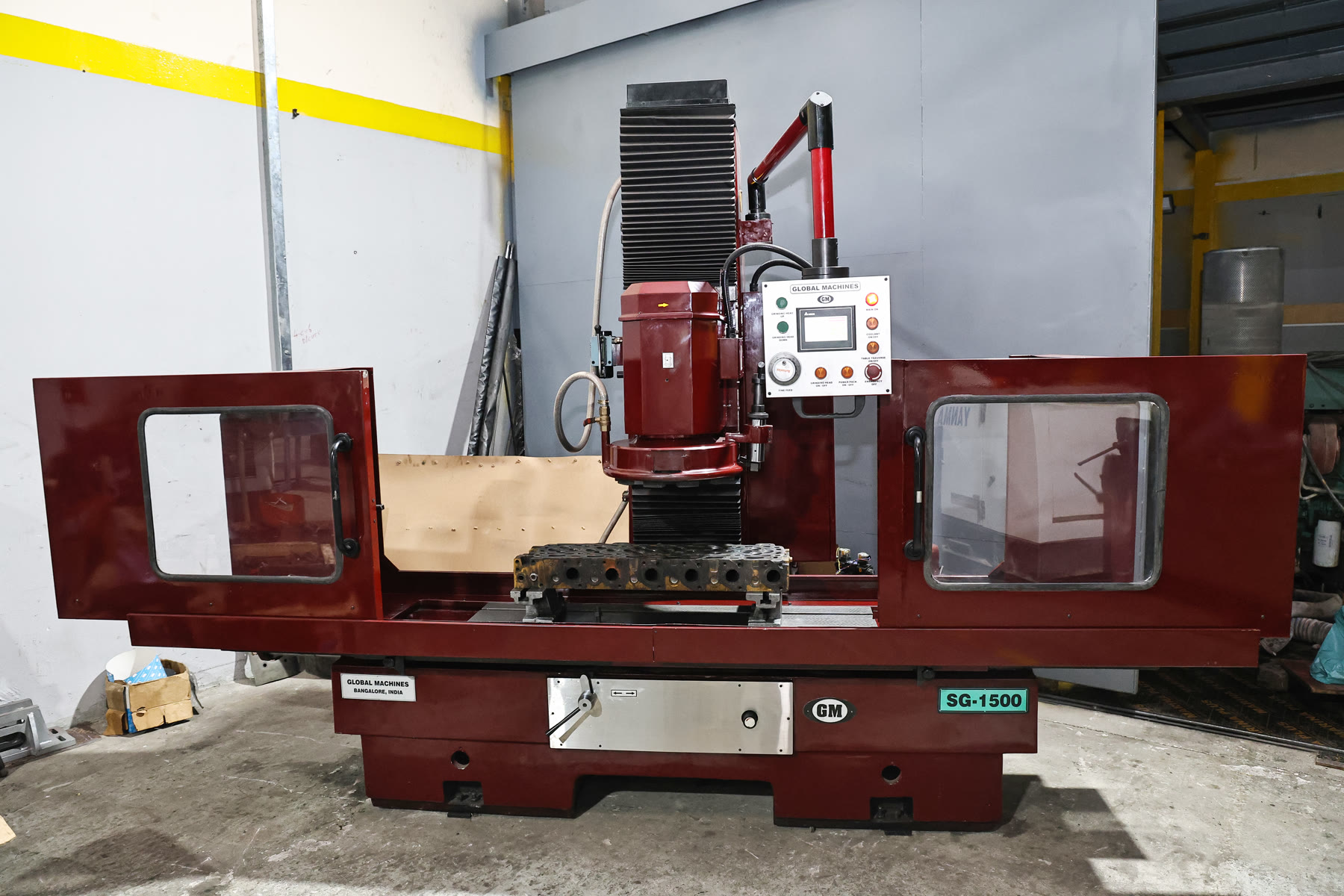
Most of what arrives here is one of two jobs: a mating face that has distorted, corroded or been damaged and now will not seal, or a part that has to be made or modified because the original is obsolete. Established 2011, over 25 years of experience.
Milling and surface grinding are two different answers
They are often written as if they were the same service. They are not, and choosing the wrong one wastes material and time.
Milling removes metal with a rotating cutter carrying inserts. It takes stock off quickly and in a controlled depth, it handles large faces and heavy cuts, and it is the right operation for a soft or moderately hard casting — cast iron, aluminium, steel. Cutter geometry matters more than most people expect: cast iron and aluminium want different insert materials, and a cutter that is right for one leaves a poor finish on the other.
Surface grinding removes metal with an abrasive wheel. It is slow by comparison and it does not enjoy heavy stock removal, but it will cut material that is too hard to mill, it will hold a face flat and parallel to another face, and it produces a finish a cutter cannot. Hardened steel, ground plates, jig and fixture work, thin sections that would lift or chatter under a mill — all of that is grinding work.
So the honest answer to "mill it or grind it?" is that it depends on the material's hardness, on how much has to come off, and on the finish the face has to end up with. Bring the part in and you will be told which, and why.
What having both under one roof changes
The measurement decides the method, not the machine that happens to be free. A shop with only a mill mills everything, including the parts that should have been ground. Here the part is measured first, and the operation is chosen to suit it.
Roughing and finishing happen in one setup sequence. Where a face needs bulk material removed and then a fine finish, it can be milled and then ground without leaving the building or being refixtured by a stranger. Split that between two suppliers and the second one begins by guessing at the first one's datum.
Nothing sits in a queue you cannot see. When flat work is subcontracted, your lead time is somebody else's workload plus two van journeys, and nobody in that chain answers your phone. Ours is a walk across the floor.
A damaged face and the assembly it belongs to can be dealt with together. A pump housing, a gearbox cover, a manifold flange and the engine it came off can all be here at once, which is how you find out that the face was not the whole fault.
Nothing is cut until you say yes. The part is measured, the scope is quoted, and if the cut needed turns out to be deeper than the first look suggested, you get a phone call before the machine is started again.
Operations we perform
Milling
- Facing and squaring of flat mating surfaces
- Manifold, housing and cover flange refacing
- Slot, groove and pocket milling
- Keyway cutting in shafts, hubs, pulleys and couplings
- Step and shoulder machining to a drawing or a sample
- Angle and chamfer milling
- Flat-face repair of corroded or fretted joint faces
- Modification of existing components where a replacement is not available
Surface grinding
- Grinding of hardened and heat-treated components
- Flat and parallel grinding of two faces to one another
- Thin plate and shim grinding
- Finishing of faces already milled, where a finer surface is required
- Restoring worn wear-plates, guides and slides
- Dressing of damaged sealing and seating faces
Engine-related flat work
- Head and block deck surfacing — covered in full under cylinder head surfacing and resurfacing
- Flywheel and clutch face machining
- Exhaust and inlet manifold face truing
- Bearing housing and cap face work in support of engine block machining and connecting rod reconditioning
No prices are published for any of it. Flat work is quoted after the part has been measured, because until it has been measured nobody knows how much has to come off.
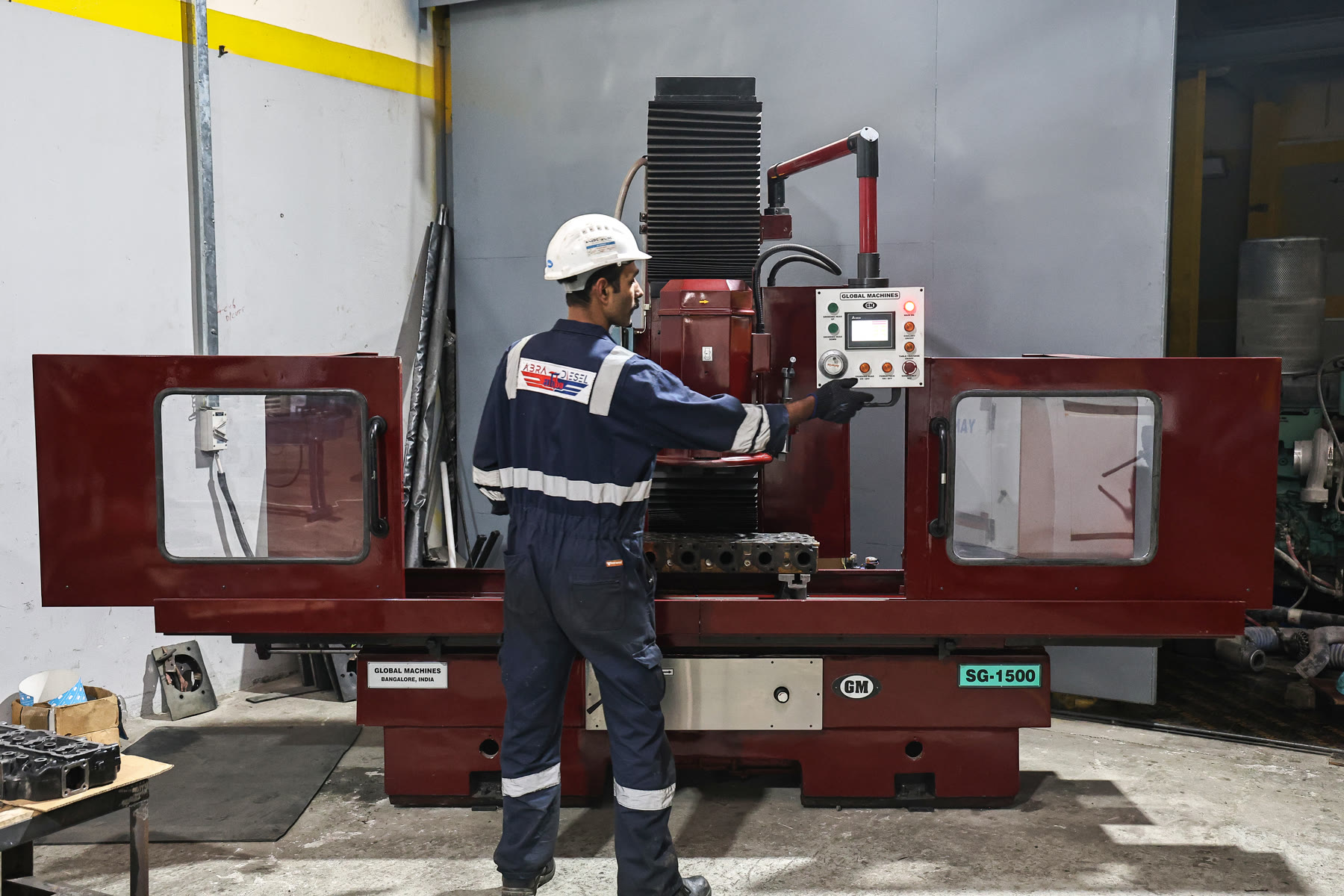
Head and block faces — and where this page stops
head surface grinding is what a lot of people type when a head gasket has failed, and it is worth being precise about what that job actually is. A cylinder head face is not simply made shiny. It is brought back to a measured flatness across its full length and diagonals, and then given the surface finish that the gasket in front of you is designed to seal against.
That distinction matters. A soft composite gasket tolerates — and to a degree wants — a slightly coarser surface to grip. A multi-layer steel gasket seals through the elasticity of thin steel and needs a noticeably smoother face; a finish that would have been fine under a composite gasket will weep under an MLS. Getting that wrong produces a head that was machined properly and still leaks, and it is one of the more common repeat failures we see arriving from elsewhere.
There is also a limit to how much can come off. Every cut lowers the head, which changes valve depth, injector protrusion and compression ratio. Past a certain point the head is finished, whatever the surface looks like. The full workflow — crack testing, flatness measurement, the cut, the finish and the total-removal limit — is on the cylinder head surfacing page, and that is the page to start from if what you have is a leaking head rather than a general machining job.
What we work on
Engine components: heads, decks, manifolds, covers, flywheels, bearing caps, pump and compressor housings. General industrial parts: base plates, mounting faces, wear plates, guides, dies, jigs and fixtures, couplings, hubs, gear blanks and shafts needing keyways. Materials worked routinely include cast iron, mild and alloy steel, hardened steel, stainless, bronze and aluminium.
Work reaches us from marine engineering, generator and power plant, construction and heavy plant, oilfield services, steel and fabrication, food and process plant, and other workshops that need one operation done properly rather than a whole rebuild.
Will my part fit on the machine?
That is the right question and there is a fast way to answer it. Send a photograph with the overall length, width and thickness, and say what the material is and roughly how hard it is. You will get a yes or a no the same working day, before you pay to move it. Very small precision work we decline; large components are normal, and where a job genuinely needs support beyond our floor we arrange it and tell you that is what is happening.
Repair or replace is a measurement
A distorted face and an obsolete part have the same two options behind them: buy new, or machine what you have. On a current production part with a short lead time, buying new is sometimes the right answer and we will say so. On a housing, a cover or a face belonging to an engine that has been out of production for twenty years, replacement is a long import at a price that makes the whole machine look uneconomic — and a face that is out by a measurable amount is usually a morning's work.
What decides it is the numbers: how far out of flat the face is, how much material remains before the part loses function, whether the metal underneath is sound. Those are readings, not opinions, and they can be taken while you wait.