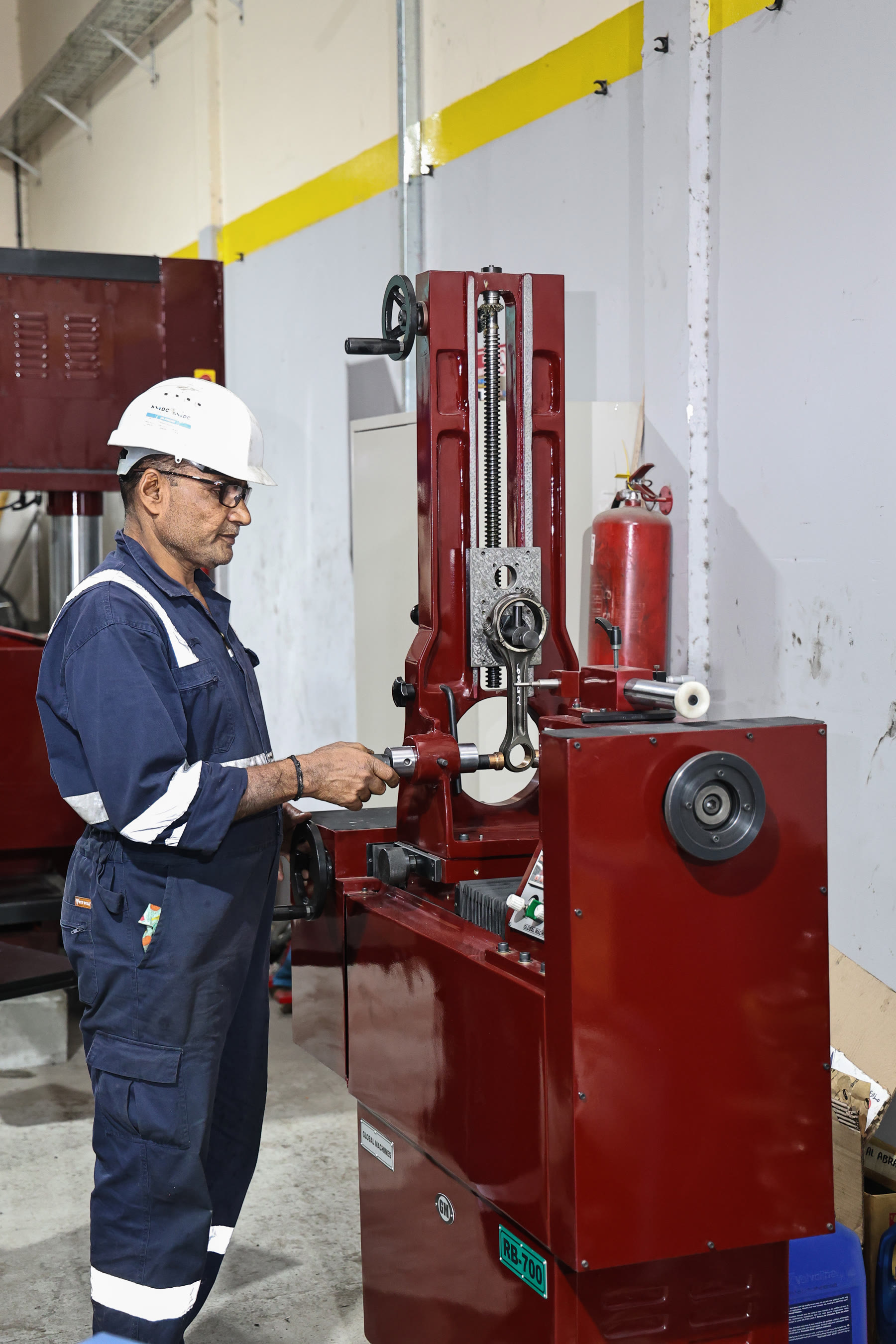
A rod that is stretched, oval or bent will destroy the crankshaft that was just reground for it.
Why the rods should be done where the crank is
Rods are the component most often waved through in an overhaul, because they look fine and nobody has a fixture to check them.
The rods and the crankshaft are measured against each other, here. Big-end bore size, journal size and the shell thickness together give the running clearance. Two suppliers each report that their own half is within limits, and the engine still wipes a bearing. One shop with both parts on the bench gets the actual number.
Every rod in the set is checked, not the one that failed. A hydraulic lock or an overspeed bends more than one rod, and the ones that are only slightly bent are the ones that come back later as oval piston pin bores. Checking a set takes a morning here; it takes a fortnight and a courier if the fixture is somebody else's.
Bushes are finished to your actual gudgeon pins. The pin is measured and the bush is honed to give the maker's clearance on that pin. A bush reamed to a nominal size in another workshop is a clearance nobody has verified.
The set stays together and stays identified. Rods and caps are matched pairs and must never be mixed. A set that never leaves the building never comes back with two caps swapped, which is a failure that does not show up until the engine is running.
One lead time. Sending rods out adds a week and two handling legs to a job where the crank, the block and the head are all already in progress here.
Rod operations we perform
- Rod and cap identification, marking and set control
- Big-end bore measurement with the cap torqued to the maker's figure
- Small-end bore measurement and pin fit assessment
- Centre-to-centre length measurement
- Magnetic particle crack detection on beams and bolt bosses
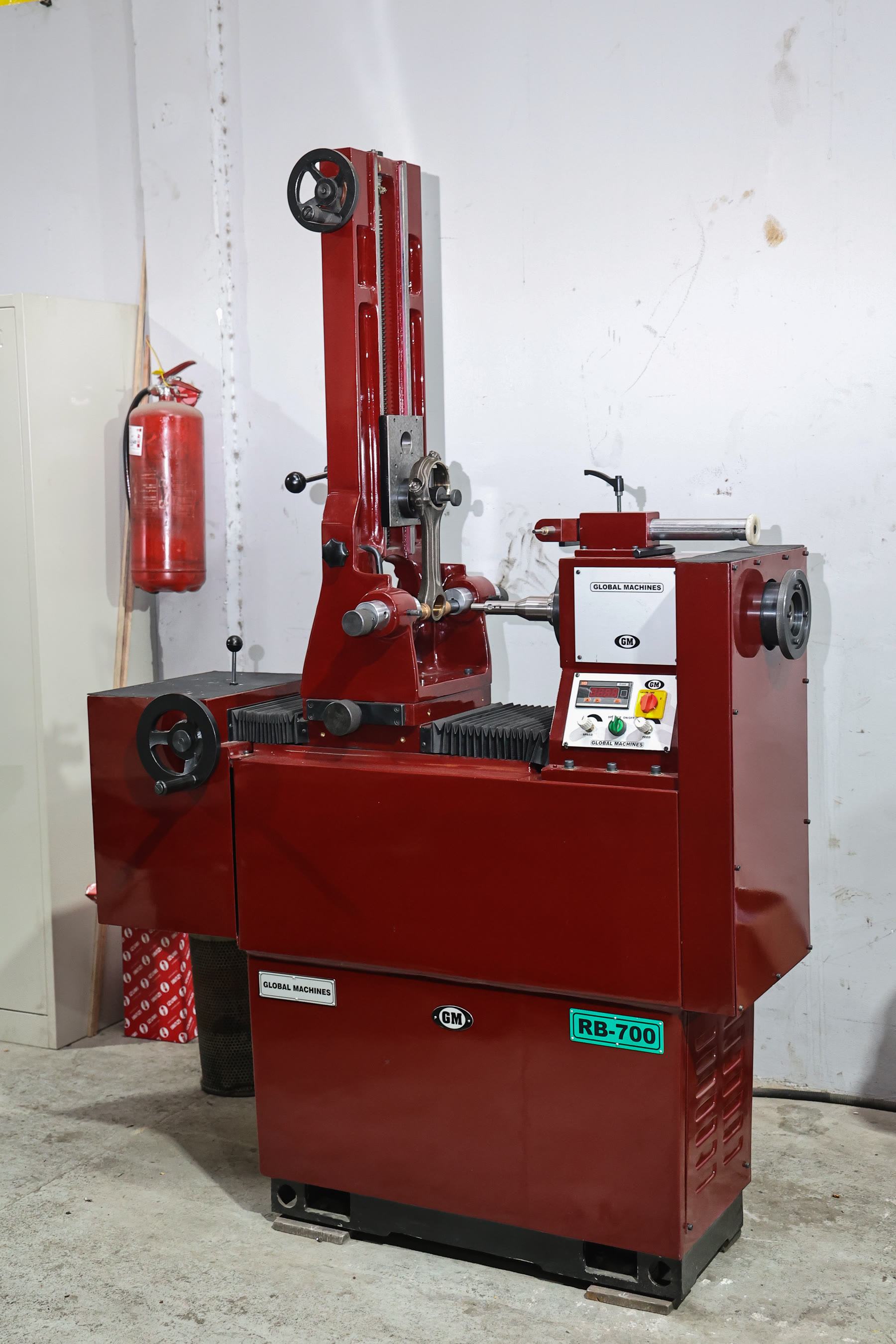
- Bend and twist checking on an alignment fixture
- Cap parting face grinding to restore bore stock
- Big-end resizing to standard bore size and roundness
- Big-end bore finishing to the correct surface for shell contact
- Small-end bush removal by press
- Small-end bush fitting and finishing to the actual gudgeon pin
- Pin-to-bush clearance set to the engine maker's figure
- Re-check of alignment after machining
- Rod set weight matching
- Rod bolt inspection and replacement
- Written report, per rod
We publish no prices. Rod work is quoted per set after the rods have been measured.
When connecting rods need work
- A spun or wiped big-end bearing. The shell turns in the rod and machines the bore oversize and out of round. New shells in that bore will do the same thing again.
- A hydraulic lock or a dropped valve. Bends the rod, sometimes without any visible sign.
- Overspeed or over-fuelling. Stretches the rod and pulls the big-end bore out of round along the axis of the stress.
- Piston skirt worn hard on one side, or the gudgeon pin bore worn oval. Both are classic symptoms of a bent or twisted rod, not of a bad piston.
- A block with one bore worn out of round. A bent rod wears its own cylinder unevenly, so the rods are checked whenever engine block machining turns up a bore that is oval on its own.
- A rebuild of an engine of unknown history. Every rod is checked as a matter of course; a set of rods is cheap to inspect and expensive to get wrong.
- Small-end bush wear. A knock at the top of the stroke, worst at idle, easing under load.
Why the big-end bore has to be round
The big-end bore holds the bearing shell by interference — the shell is very slightly larger than the housing, so torquing the cap squeezes it into intimate contact with the bore. That contact is how heat gets out of the bearing.
If the bore is oval or oversize, the shell loses contact where the housing has grown. The bearing cannot shed heat where it is not touching, the oil film breaks down at that point, and the shell fails there. Fitting a thicker bearing does not fix it: the fault is the housing, not the shell.
Engine-building practice quotes very small allowable out-of-roundness on a bare big-end bore — figures around half a thousandth of an inch are typical, tightening for smaller bores. Which figure applies to your engine comes from its manual; the practice on our bench is to bring the bore back to the maker's size and roundness, and to record what it measured before and after.
The process
- Identify and mark. Rods and caps are matched pairs and must never be mixed. Cylinder numbers and orientation are recorded before anything is disassembled.
- Measure as received. Big-end bore diameter and ovality with the cap torqued to the maker's figure; small-end bore diameter; centre-to-centre length; and the bolts inspected.
- Crack detection. Magnetic particle inspection on the rod beam and around the bolt bosses. A cracked rod is scrap, not a machining job, and finding that out now is the cheapest possible outcome.
- Check bend and twist. The rod goes on an alignment fixture with a pin through the small end: bend is measured in one plane, twist in the other. General practice limits bend to roughly a thousandth of an inch per inch of rod length; the engine maker's figure governs. The result is recorded per rod.
- Quote and approval. You see the readings per rod and decide the scope before anything is machined.
- Resize the big end. Material is taken off the cap parting faces — as little as will make the bore round — the cap is refitted and torqued, and the bore is machined back to standard size. The point is to restore the housing, not to enlarge it.
- Small-end bush. The old bush is pressed out, a new one pressed in, and the bore finished to give the correct clearance on the actual gudgeon pin. The engine maker's figure, measured against the real pin, not a nominal size.
- Re-check alignment after machining. Pressing a bush can move a rod.
- Weigh and match where the set requires it.
- Final measurement and report.
What we return to you
Resized rods with a report per rod: big-end bore diameter and ovality before and after, small-end bore and the pin clearance achieved on your actual pins, bend and twist measured, crack test result, and weights where the set was matched. Rod reconditioning is warranted; the terms are stated on your quotation and depend on whether we also supplied the bushes, shells and bolts.
Rods we recondition
Caterpillar, Cummins, Volvo, Wärtsilä, Perkins, Scania, Mercedes-Benz, Mitsubishi, Yanmar, Iveco, Niigata, Tata and Ashok Leyland — truck, generator, industrial and marine.
Large marine and genset rods are regular work here alongside truck sets. If you want that confirmed before shipping a crate of rods, send the engine model, the rod centre-to-centre length and a photograph with something in frame for scale. Same-day answer.
Repair or replace — the fixture decides
A new connecting rod for a large diesel is a serious part with a serious lead time, and it usually has to be bought as a matched set to keep reciprocating weights even. Resizing the rods you already have costs a fraction of that and returns a set whose weights already match, because they always have.
The decision is a measurement, and there are five of them: big-end bore size and ovality with the cap torqued, bend, twist, crack indication, and centre-to-centre length after resizing. Every one is taken on a fixture with a gauge, and together they say repair or replace without anybody needing an opinion.
Replacement is the right call when:
- the rod is cracked, anywhere;
- the beam is bent beyond the limit — a heavily bent rod can sometimes be straightened, but a rod that has yielded once has already used part of its fatigue life, and on a hard-working diesel we would rather replace it;
- the big-end bore has grown so far that squaring it up would take the centre-to-centre length outside specification;
- the bolt holes or bolt seats are damaged.
You get that per rod, in writing, and it costs you the inspection.