If the crankshaft keeps failing bearings after a rebuild, the housing bore is the first thing to suspect.
Why this operation is the one to ask about
When you ring round for a line bore, most of the quotes you get will be for somebody else's machine. That matters more on this job than on any other in the shop.
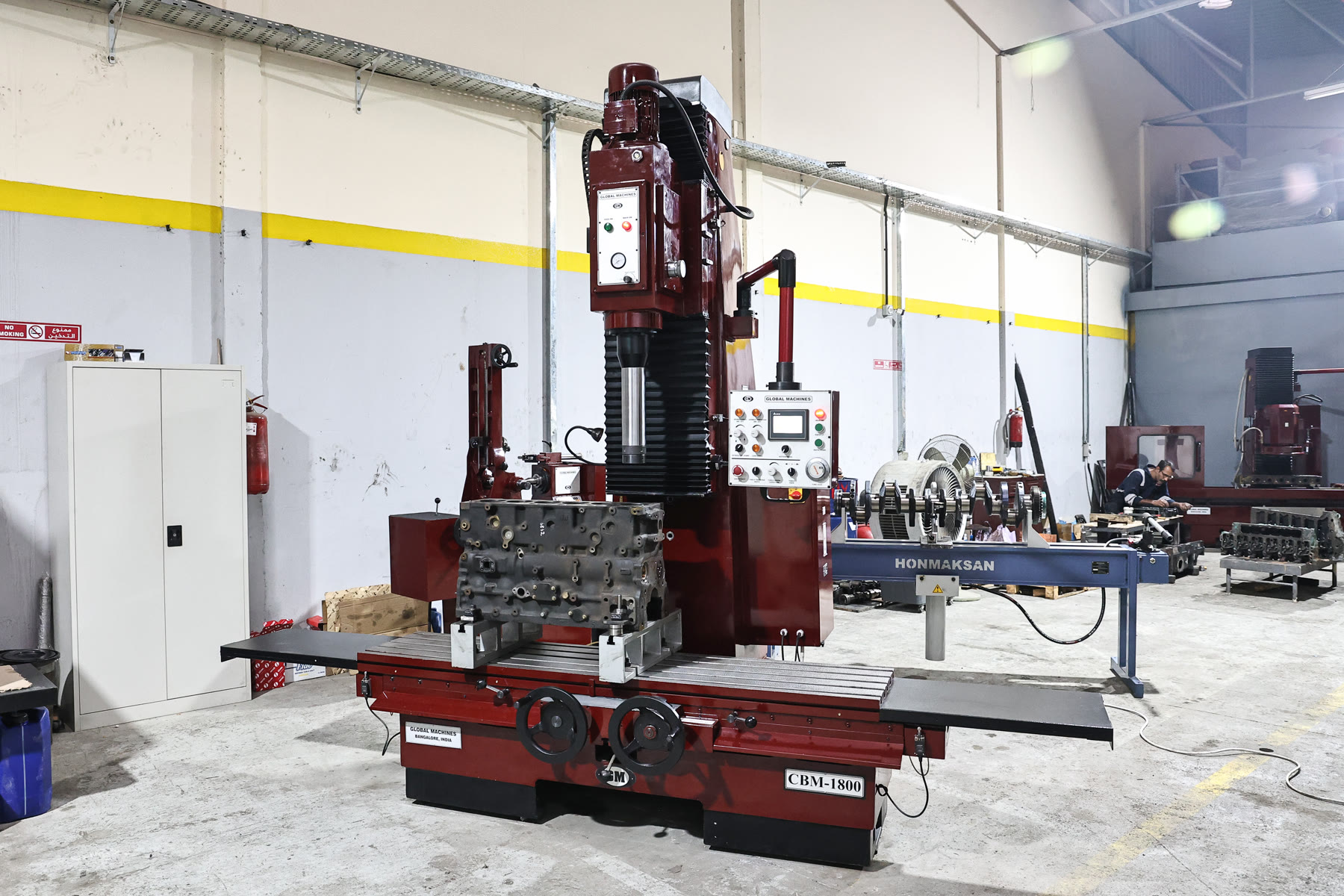
All the main bores are cut in one pass, on one bar, in one setup. That is the entire reason the operation produces a straight line. It only works if the block stays fixtured, and the block only stays fixtured if it never leaves the building.
A subcontracted line bore adds a week and two transport legs to the longest-lead job in the engine. A bare block is heavy, awkward and slow to move. The shop that owns the bar starts on Monday; the shop that brokers it starts when somebody else's table is free, and cannot tell you when that is.
The crank and its housing are measured together, here. A main bearing that failed usually has two suspects — the journal and the bore — and they are measured against each other on the same job card. Split them between two suppliers and each will report that its own half is within limits.
The block goes from line bore to deck to cylinders without moving. Line boring establishes the crankshaft centreline, and that centreline is the datum the deck and the bores are then cut square to. Doing all three under one roof, in the right order, off one datum is the difference between a rebuilt block and a re-machined one.
You can come and see the bar in the block. Ask when you call.
Line boring operations we perform
- Main bore measurement, each bore, with caps torqued to the maker's figure
- Centreline alignment measurement end to end
- Cap register and parting face inspection
- Crack detection on main webs and bulkheads
- Main cap grinding to restore stock before boring
- Replacement cap fitting and machining to the block
- Align boring of main bearing bores to standard size on a true centreline
- Align honing to final size and surface finish
- Camshaft tunnel and bush bore line boring
- Bare-crank turning check with caps torqued, as the practical confirmation
- Final measurement and written report
We publish no prices for these operations. Every one of them is quoted after the block has been measured.
When a block needs line boring
- Repeat main bearing failure. New shells, correct clearance on paper, and the bearings still wipe. A bore centreline that wanders means the crank is being bent through its own housing every revolution.
- A spun main bearing. The shell rotates in the housing and machines the bore oversize and out of round. The bore, not the shell, is now the fault.
- Overheat or a dropped valve that distorted the block.
- New or replacement main caps fitted. A cap is machined to match its own block. Fit another one and the bore must be resized and re-aligned to the centreline.
- A crank that will not turn freely with all caps torqued and no bearings fitted — the classic bare-block check for misalignment.
- A rebuilt engine of unknown history. On any high-hour block coming apart for a major overhaul, the housing bores are measured as a matter of course.
The general engineering rule for a hard-working diesel is that misalignment between adjacent main bores should be a fraction of a thousandth of an inch, and total misalignment across the whole centreline no more than a couple of thousandths — passenger-car practice quotes about 0.002" total and 0.001" adjacent, and diesels are held tighter than passenger cars. The engine maker's own service manual is what we actually work to; we do not substitute a rule of thumb for the figure in the book, and the figure we worked to is written on your report.
Line boring versus align honing
They are not the same operation and they are not interchangeable.
Align boring cuts with a single-point tool on a bar running the length of the block on its own centres. It removes real material, it establishes the centreline, and it is what you need when the bores are oversize, badly out of round, or when caps have been replaced or ground.
Align honing uses abrasive stones on a mandrel. It removes very little, corrects small errors, and produces the bore's final size and finish. It is the finishing operation, not the correcting one.
In practice, a block whose caps have been ground to restore stock is align bored to bring the bores back to standard size on a true centreline, then honed to size and finish. A block that is only slightly out gets honed alone. Which route your block takes is decided after measurement, not before — and because both operations are ours, the answer is not influenced by which one we happen to be able to do.
The process
- Strip and clean the block, remove all main caps, inspect the cap registers and the parting faces.
- Measure. Each main bore for diameter and roundness with the caps torqued to the maker's figure, and the centreline checked end to end. Cap register fit is checked separately — a loose cap makes every other measurement meaningless.
- Crack check. Main webs and the bulkheads around the bores. A crack found here changes the job — see engine block crack repair and metal stitching.
- Restore cap stock if needed. Where the bore has grown, material is taken off the cap parting faces so that boring returns the bore to standard size on the correct centreline rather than simply making it larger.
- Set up on the bar. The block is fixtured, the bar aligned to the intended centreline, and the bore diameters set on the tool.
- Bore. All main bores in one pass on one bar — which is the entire reason the operation produces a straight line, and the reason a portable single-bore repair does not.
- Hone or finish to final size and surface finish where honing is part of the specification.
- Verify. Bore diameter, roundness and centreline alignment measured again, caps torqued, and a bare crank turned in the block by hand as the practical confirmation.
- Clean, oilways blown through, and report issued.
You approve the scope after step 3, with the measurements in front of you. Nothing is cut before that, and if the crack check changes the job you get a call rather than a surprise on the invoice.
What we return to you
A block with main bores on a straight centreline at a known size, plus a measurement sheet giving each bore's diameter and roundness before and after, the alignment measured across the full length, the crack test result, and the bearing shell size the block now takes. Line boring is warranted; the terms are confirmed in writing with your quotation, and they depend on whether we also fitted the shells and assembled the engine.
Engines and blocks we line bore
Caterpillar, Cummins, Perkins, Volvo, Scania, Mercedes-Benz, Mitsubishi, Yanmar, Iveco, Wärtsilä, Niigata, Tata and Ashok Leyland — truck, generator, industrial and marine blocks. The large Cummins families that come through the UAE constantly — KTA19, KTA38, KTA50 and NTA855 — are the ones customers ask about first, and they are regular work here, as are marine and large genset blocks.
If you want certainty before you load a block onto a lorry, send the engine model and a photograph of the block on its stand. You will have an answer the same working day. That call is free and it has saved customers a wasted transport bill more than once.
Repair or replace — measured, then decided
A cylinder block is the most expensive single casting in an engine and the one with the longest lead time in this region. Replacing a block because two main bores are a few hundredths of a millimetre out of line is an enormous amount of money spent on a problem that is measured in microns and fixed with a boring bar.
Whether it is fixable is a measurement, not an opinion. Bore diameter and roundness with the caps torqued, alignment across the full centreline, cap register fit, crack depth if a crack is present, and how much material is left in the caps and saddles — five readings, and between them they settle the question. Take them before you price a replacement block, not after.
Line boring is the cheaper answer in almost every case where the casting itself is sound. The cases where it is not:
- A crack through a main web or a bulkhead that cannot be reliably stitched and pressure tested.
- Bores so far oversize that returning them to standard size would leave insufficient material in the caps or the saddles.
- A block already line bored oversize with bearings no longer available at that size.
We give that verdict in writing with the measurements attached, and it costs you the inspection.