
This is the page for an engine that is already stripped and a crank that has measured out of tolerance — scored, tapered, out of round, or run on a spun bearing. Established 2011, over 25 years of experience.
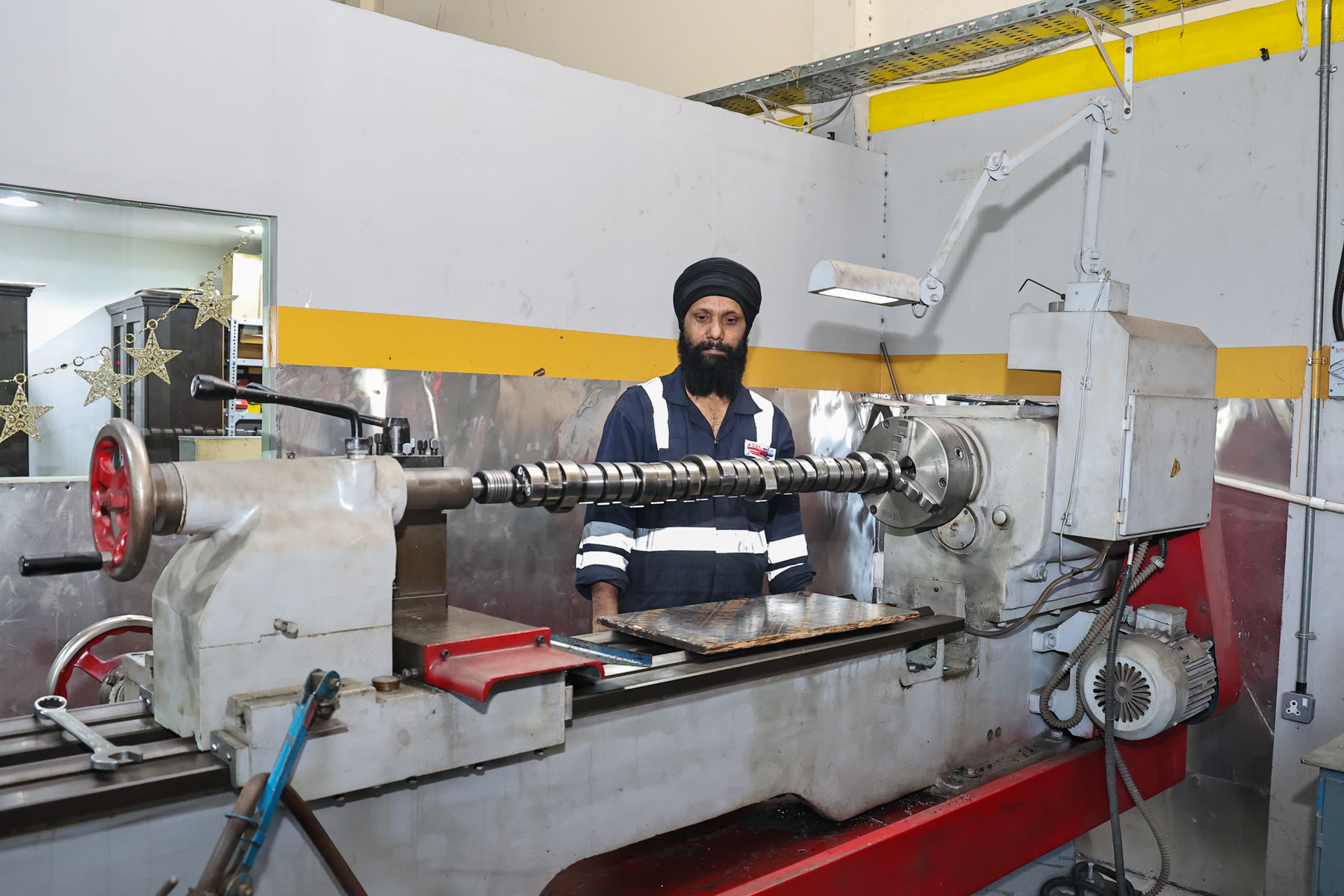
We grind crankshafts on our own machines behind Yerevan Steel Factory in Industrial Area 15, Sharjah — journals cut to a standard undersize, fillet radii respected, journals polished, and every dimension measured before and after. Many workshops in the UAE that quote crankshaft grinding are subcontracting it. We are not, which is why we can tell you where your shaft is in the queue and let you look at it in the machine.
What grinding in house changes
The specification that matters here is not on a machine plate. It is what happens to your crankshaft between the day it leaves your engine and the day it goes back in.
The shaft is measured, ground and polished under one roof, and it comes back with its measurements. One shop takes the readings, decides the undersize, cuts it and verifies it. Nobody hands a shaft to a third party with a note attached and hopes.
Sending a crankshaft out adds a week and a second set of handling risks. A crank is long, heavy and easy to damage in a sling. Every extra journey is another chance to knock a journal or bend a shaft that was straight when it left. Ours do not make those journeys.
The crack test and the grind happen in the same building, in the right order. Magnetic particle inspection before grinding is what stops a cracked shaft being machined and returned as good. When inspection and machining sit in different companies, that sequence is the first thing to slip.
You can watch. The shaft is in a machine in this building, and you are welcome to come and see it set up on centres before you commit to the job. That is not a claim a broker can make.
We grind to the size shells are actually made in. The undersize is chosen for the bearing shells available for your engine in this market, and the size cut is written on your report so you order the right set first time. A journal ground to a size nobody sells shells for is a scrapped crankshaft, and it happens.
Crankshaft operations we perform
- Full journal measurement — diameter, taper, ovality, run-out, on mains and crankpins
- Magnetic particle crack detection, including fillet roots
- Dye penetrant inspection where the geometry does not suit magnetising
- Straightness check on V-blocks and run-out correction before grinding
- Crankshaft straightening — see crankshaft straightening and alignment
- Main journal grinding to standard undersize
- Crankpin grinding to standard undersize
- Fillet radius reproduction to the engine maker's radius, checked with a radius gauge
- Thrust face regrinding and thrust width restoration
- Journal polishing in the correct rotational direction
- Hardness verification after grinding
- Oilway cleaning, plug removal and refitting
- Keyway, flange face and spigot inspection
- Dynamic balancing of the assembly where the engine requires it — see dynamic balancing
- Final measurement and written report
No prices are published for any of these. Grinding is quoted after the shaft has been measured, because until it has been measured nobody knows what the job is.
When a crankshaft needs grinding
- Bearing failure. A spun or wiped bearing transfers material and heat into the journal. The journal is scored and usually undersized and out of round in one spot.
- Measured wear at overhaul. The engine comes apart on schedule, the journals are miked, and one or more is past the service limit for diameter, taper or ovality.
- Low oil pressure that returns after a bearing change. New bearings in an oversized bore give clearance that is still too large. The clearance is a function of the journal, not the shell.
- Knock under load. A big-end or main knock that changes with load and oil temperature.
- Rebuild of an engine of unknown history. Everything gets measured; the crank usually decides the budget.
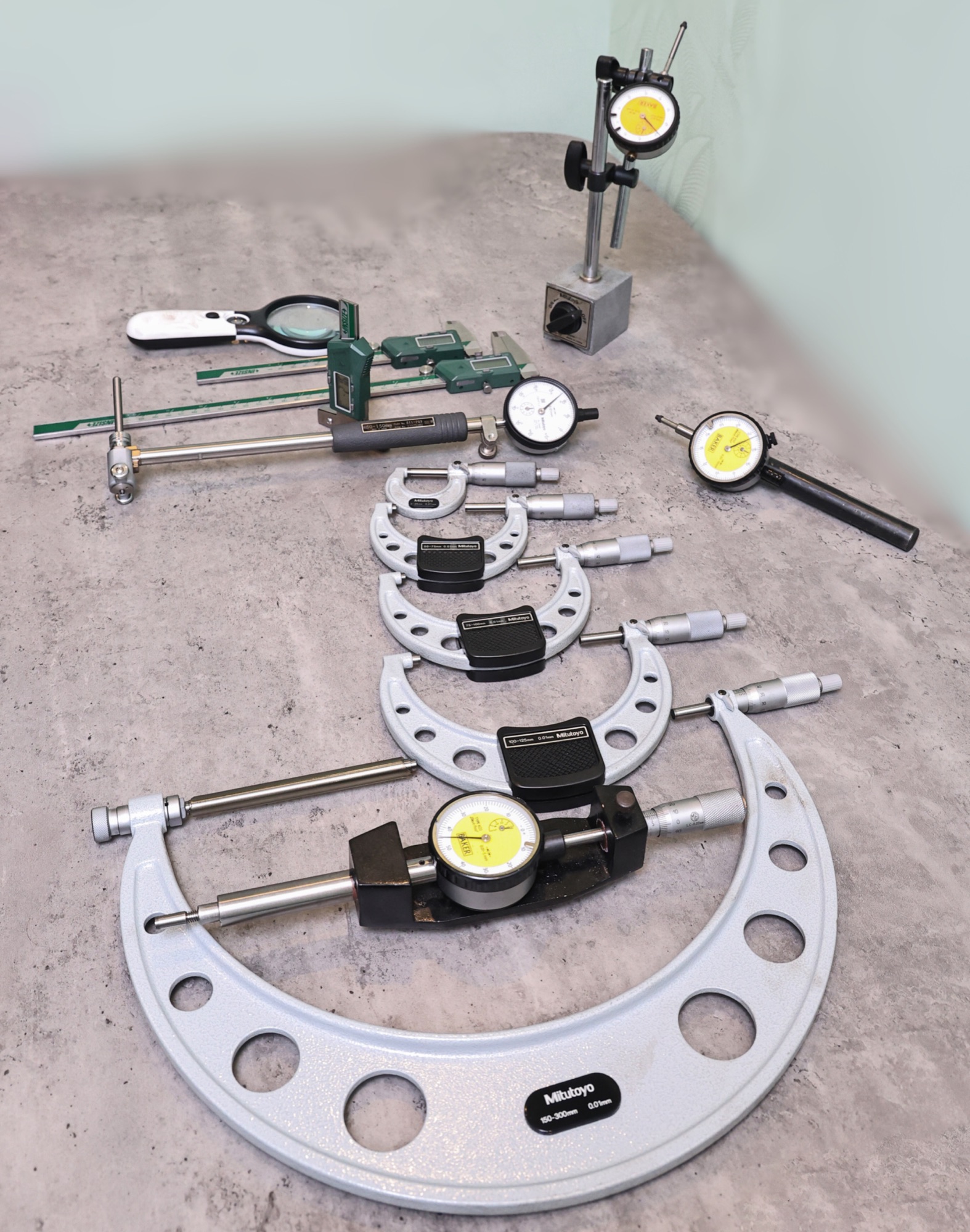
The measurements that matter are diameter, taper along the journal, out-of-roundness across it, and run-out on the shaft as a whole. Journal roundness and taper are what actually control the oil film. A bearing running on an out-of-round journal sees a clearance that varies once per revolution, so the film thickness varies once per revolution, and the shell wears in a pattern that a new set of bearings will simply repeat.
The process
- Clean and identify. Oilways are cleaned through; plugs are removed where the design allows.
- Measure as received. Every main and every crankpin: diameter at several points, taper end to end, ovality at 90°, and run-out on V-blocks with a dial gauge. These become the "before" column on your report.
- Crack detection. Magnetic particle inspection is the correct method for a steel crankshaft: it reveals cracks in the fillet roots and just under the surface, where the shaft actually fails and where a dye penetrant test would show nothing. Fillet-root indications are the ones that end the conversation — a shaft cracked at a fillet is not ground, it is condemned.
- Straightness check. Run-out outside the maker's limit is corrected before grinding, not after. See crankshaft straightening and alignment.
- Grinding to undersize. The shaft is set up on centres, indicated true, and the journals ground to the next standard undersize for which bearing shells are actually available for that engine.
- Fillet radii. The radius where the journal meets the web is the highest-stressed feature on a crankshaft. Grinding a sharp corner into that transition, or cutting the radius undersize, creates a stress raiser exactly where fatigue cracks start. The radius is reproduced to the engine maker's specification, and checked with a radius gauge.
- Polishing. Journals are polished in the correct rotational direction to a bearing-friendly finish. A ground-but-unpolished journal will chew a shell.
- Hardness re-check. Grinding generates heat. On a nitrided or induction-hardened shaft, excessive heat draws the temper locally, and a soft journal will fail regardless of how accurately it was ground. Hardness is checked after grinding.
- Final measurement. The same dimensions, on the same instruments, into the "after" column.
- Clean, oil, wrap and return with the report.
Nothing is cut until you have seen the measurements and approved the scope. If the crack test or the straightness check changes the job, you get a phone call before the machine is started.
What we return to you
The ground shaft, oiled and protected, and a measurement sheet giving before-and-after diameter, taper, ovality and run-out for every journal, the undersize each journal was cut to, the crack test result, and the bearing shell size you now need to order. That last line is the one that saves an ordering mistake, and it is the reason the sheet travels with the shaft rather than sitting in a filing cabinet here.
Reground crankshafts are warranted. What the cover runs to depends on whether we also supplied the shells and did the assembly, so it is stated in writing on your quotation rather than as a slogan.
Engines we grind crankshafts for
Caterpillar, Cummins, Perkins, Volvo, Scania, Mercedes-Benz, Mitsubishi, Yanmar, Iveco, Wärtsilä, Niigata, Tata and Ashok Leyland — truck, bus, generator, industrial, marine main and auxiliary engines.
Shaft size is rarely the obstacle people expect it to be. Truck and bus cranks, generator and industrial cranks, and large marine and auxiliary shafts are all normal work here. If you are unsure whether your shaft is one we can take, send its overall length, the largest journal diameter and a photograph — you will have a yes or a no the same working day, before you pay to transport it.
Repair or replace — the shaft decides, and it decides in numbers
A new crankshaft for a large diesel is rarely a stock item in the UAE. It is a factory order, priced accordingly, with a lead time during which the engine earns nothing. Grinding uses the shaft you already have and starts the day it lands on the bench.
But the honest position is that the shaft decides, not us and not you. Repairability depends on measurable condition: ovality, hardness, bend, crack depth, and how much material remains above the lowest undersize bearing shells are made in. All five are numbers. All five can be taken in a morning. Until they have been taken, "regrind it" and "replace it" are both guesses.
The conditions under which we will tell you to buy a new shaft:
- The shaft is at its last undersize. Bearing shells are only made down to a certain size. Past that, grinding produces a shaft nobody can supply bearings for.
- A crack in a fillet or a web. Not repairable by grinding. Replace.
- Journal hardness already lost, from a previous overheat or a previous bad grind. Regrinding a soft journal buys you months, not years, unless the shaft can be re-hardened — which is specialist heat treatment, arranged separately, and worth doing only on a shaft that justifies it.
- Damage deeper than the available undersize. A journal ground away by a seized bearing can need more material removed than the undersize steps allow.
You get that verdict in writing with the readings attached, and it costs you the inspection and nothing else.