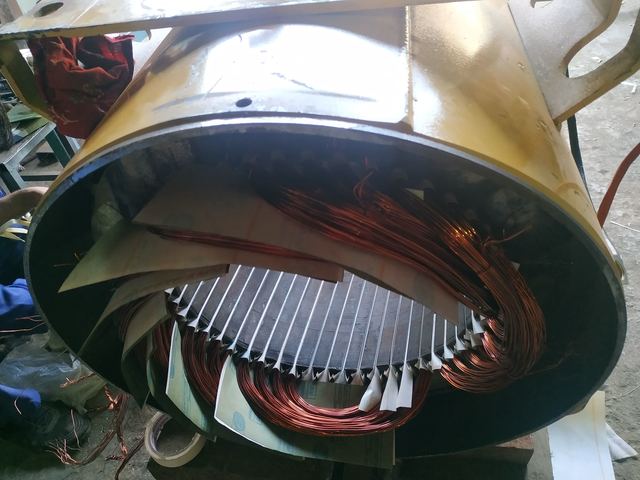
Our own winding bay · Industrial Area 15, Sharjah
Alternator repair, rewinding & dynamo service
When the engine runs perfectly and no usable power comes out, the fault is at the alternator end. We measure it before anyone condemns it — and we rewind it here, not at a third party.
The chain
How a brushless alternator works
You cannot diagnose one without this. Four parts in series — and the fault-finding order writes itself from them: sensing, AVR, exciter field, rotating diodes, rotor, stator.
1. Excitation source
- A shunt machine takes excitation from its own output, so it depends on residual magnetism to start
- A PMG — permanent magnet generator on the shaft end — supplies the AVR independently
- PMG machines start reliably from cold and hold short-circuit current for discrimination; shunt machines are cheaper and commoner on small sets
2. AVR
- Senses output voltage against setpoint and controls the DC fed to the exciter stator field
- Stamford uses the SX460 and SX440 families on shunt sets, MX341 (two-phase sensing) or MX321 (three-phase RMS sensing) on PMG sets
- AS440 and equivalents on other frames; Leroy Somer, Mecc Alte and Marathon each have their own
3. Exciter
- A small alternator running backwards — stationary field, rotating armature
- Its AC output is on the shaft
4. Rectifier & main rotor
- A diode bridge on the shaft rectifies the exciter output and feeds the main rotor field
- The rotating field induces the output in the main stator; a varistor across the bridge protects the diodes from transients
Symptom to cause
The faults we see
A great many "the alternator is finished" calls turn out to be a two-dirham sensing fuse or a failed AVR. We check that chain before we quote a rewind, and we tell you which it was.
| Symptom | Usual cause |
|---|---|
| No output at all, engine running normally | Blown AVR sensing fuse; failed AVR; lost residual magnetism on a shunt machine; open excitation circuit |
| Very low output that will not build | Weak excitation, failed PMG, open circuit in the exciter field, or engine running below speed |
| Output high, or rising uncontrolled | AVR failed in the fully-excited state, or a lost sensing lead |
| Output unstable, hunting | AVR stability setting, loose sensing connection, or an engine speed problem the AVR is chasing |
| Voltage collapses when a large motor starts | Excitation cannot support the inrush — weak PMG, failing diode, or the set is simply undersized |
| Output present but ripples, or one phase low | One or more rotating diodes failed; open or shorted stator coil |
| Overheating windings, burnt smell, blackened varnish | Sustained overload, blocked ventilation, contamination, unbalanced load, or a bearing failure that let the rotor rub |
| Low insulation resistance to earth | Moisture ingress, oil and dust contamination, or aged and cracked insulation |
| Noise and vibration at the alternator end | Bearing wear, misalignment, or a failed rotor |
Related: generator not producing power and generator voltage problems.
Before anything is stripped
Inspection and testing
Insulation resistance
Stator, rotor and exciter, at a stated test voltage with the winding temperature recorded. Insulation resistance is strongly temperature-dependent, and a reading without a temperature is not evidence.
Polarization index
Where the machine and its condition justify it — to distinguish a merely damp winding from a degraded one.
Winding resistance
Phase to phase, checked for balance. An imbalance points to a shorted turn or a bad joint.
Surge comparison
Where equipment allows. It is the only test that reliably finds a turn-to-turn short that a megger will pass.
Diodes and mechanical
Rotating diode bridge tested; bearing condition, air gap, fan, ventilation paths, terminal box and the state of the varnish.
They decide between a clean-and-varnish, a partial repair and a full rewind. A machine is measured before anything is touched and again before it leaves, at stated test voltages with the winding temperature recorded — so you receive a comparison rather than an assurance. It also means we can tell you, with figures, when a winding does not need rewinding. That is the outcome for a great many of the alternators sent to us as scrap.
In the winding bay
The rewinding process
- Strip and recordTurns per coil, wire gauge, connection, pitch, parallel paths and lead arrangement, recorded before anything is removed. A rewind that does not match the original data produces a machine with different characteristics — which is where rewinds got their bad reputation.
- Burn-off and core inspectionOld windings removed, core cleaned, laminations checked for damage, burning and inter-laminar shorts. A damaged core destroys a new winding, so this is where a rewind is confirmed or advised against.
- Slot preparation and insulationSlot liners fitted and the insulation class matched to the original machine, not to what is on the shelf. A lower-rated system passes every test on the day and fails early at Gulf ambient. The class used is recorded on the report.
- Coil forming and windingCoils formed to the recorded data and inserted, phase insulation and wedges fitted, end windings laced and blocked so they cannot move under short-circuit forces.
- Connection and initial testConnection checked against the original diagram, insulation and winding resistance tested, polarity and phase sequence verified, surge tested before varnish.
- ImpregnationPre-heat to drive off moisture, then varnish — dip or vacuum pressure impregnation — and oven curing, with insulation resistance monitored until it holds.
- ReassemblyBearings replaced, air gap checked, rotor balanced where the work requires it, fan and guards refitted.
- Test runNo-load build-up, voltage set on the AVR, then on-load testing where the application allows — best proved with a load bank test.
The varnish and oven cycle cannot be shortened without producing a machine that will fail early, so we quote a date once the machine is stripped and the core inspected — not before. What does shorten the job is that no part of it leaves the building: no third-party winding shop, no waiting on a subcontractor's oven, no handling risks in transit. Faults that turn out not to be winding faults — a sensing fuse, an AVR, a diode bridge — are normally done on site on the first visit, because the parts are carried.
The honest version
Rewind or replace
We will say when a rewind is not the right answer. A rewind on a burnt core is money spent on a machine that will fail again.
Points towards rewind
Repair it
- Core is sound; only the winding has failed
- Frame, shaft, housings and terminal box in good condition
- Original winding data recoverable, or the machine can be measured
- Replacement is a long lead time and the set is needed back
- Larger frame sizes — the cost gap widens with size in favour of rewinding
- The set is otherwise sound with years of service left
Points towards replacement
Replace it
- Core laminations burnt or shorted by the failure
- Frame or shaft damaged, or the rotor has rubbed badly
- Obsolete machine with no data and no drawings
- An identical replacement is on the shelf locally and cheap
- Small alternators where a new unit costs little more than the labour
- The engine is also at end of life — then it is a whole-set decision
Not every fault is a winding fault
Diodes, varistors and AVRs
Rotating diodes fail open or short. Open gives reduced, rippled output; a short overloads the exciter and can cook its armature. Both are replaceable as a bridge on the shaft. The varistor protects them from spikes, and a failed varistor takes the diodes with it.
AVRs fail in both directions — no excitation, or full excitation — and are frequently blamed for faults that belong elsewhere, particularly engine speed problems, because voltage follows frequency. Panel and controller work is on control panel and AVR repair.
We hold the AVR families fitted to the alternators that dominate this market, and the diode bridges with them, so this class of fault is a one-visit repair. Photograph the AVR label and the alternator nameplate before you call and we can confirm the right part is on the shelf before an engineer leaves.
- Alternators we work on
Stamford sits under a large proportion of UAE gensets, as does Leroy Somer. Also Mecc Alte, Marathon, and the OEM-badged machines fitted to Caterpillar, Cummins, FG Wilson, Kohler and Onan sets.
- Other rotating machines
The same bay handles motors, dynamos and welding generators. Large frames are accepted as readily as small; very small work is what we decline.
- Unsure whether yours fits?
Send the nameplate and the frame dimensions and you get a straight answer the same day.
Deliverables
What we return to you
- A written report with the fault found, the measurements before and after, and the work done
- Insulation resistance and winding resistance results, with test voltage and winding temperature stated
- Polarity and phase sequence confirmation
- No-load voltage build-up result and, where tested, on-load results
- The failed components, if you want them
- The cover that applies to the rewind, written on your quotation and repeated on the invoice — it depends on the machine and on what the core inspection found, so ask for it before you accept, from us and from anyone else you are comparing
Common questions
Rewinding, answered
The engine runs but there is no output. Is the alternator finished?
Usually not. Sensing fuses, then residual voltage at the terminals, then the AVR, then the rotating diodes. A shunt machine that has stood a long time can lose its residual magnetism and needs the field flashing. A winding failure is the last thing on that list, not the first.
How long does a generator rewind take?
On frame size and on whether the core needs work, because the varnish and oven cycle cannot be rushed. The date comes after the core is inspected — and because the winding bay is ours, it does not depend on somebody else's oven.
Do you rewind Stamford alternators?
Yes. Stamford is the most common alternator we see on UAE gensets, along with Leroy Somer, Mecc Alte, Marathon and OEM-badged machines. We hold no dealership with any of them — we are an independent repairer.
Is a rewound alternator as good as a new one?
If the core is sound, the original winding data is followed, the insulation class matches and the impregnation is done properly, it performs to the original specification. Those four conditions are where a cheap rewind cuts corners. Ask any rewinder for the before-and-after test results.
Can you repair it on site, or does it come to the workshop?
AVRs, diodes, sensing faults, connection repairs and testing are done on site. Rewinding cannot be — it needs the winding bay, the varnish and the oven, so the alternator or the whole set comes to our Sharjah workshop.
Do you repair dynamos and motors too?
Yes — the same winding bay covers rotating electrical machines generally. What this page does not cover is small automotive alternators and starters, which are a different job for a different buyer.
Get it measured before anyone condemns it
If somebody has already told you the machine is finished, ask them for the insulation resistance reading, the test voltage and the winding temperature it was taken at. If those three numbers are not available, the machine has not been tested — it has been guessed at.