
This page is for an engine that is already apart and a cam that has measured out of specification — worn lobes, a scored or undersized journal, or run-out that will not let the shaft turn freely in its bearings. Established 2011, over 25 years of experience.
Why a small amount of camshaft wear matters more than it looks
A camshaft is a timing device with a very unfavourable gearing between wear and effect. A lobe that has lost a small amount of height does not just open the valve less far — it opens it later and closes it earlier, so the valve event is shortened at both ends. Do that on the inlet and the cylinder gets less air; do it unevenly across the engine and the cylinders stop matching each other, which shows up as uneven exhaust temperatures long before it shows up as a diagnosis.
On a diesel with a cam-driven injection pump, the same logic applies to the pump lobes, and there the effect is on injection timing and delivery rate rather than on airflow. That is why a mechanically sound engine that has quietly lost power and gained fuel consumption is sometimes a camshaft problem being blamed on the fuel system.
Wear is also self-accelerating. The moment the hardened case on a lobe is broken through, the softer material underneath goes quickly, and it takes the follower with it.
What camshaft work in house changes
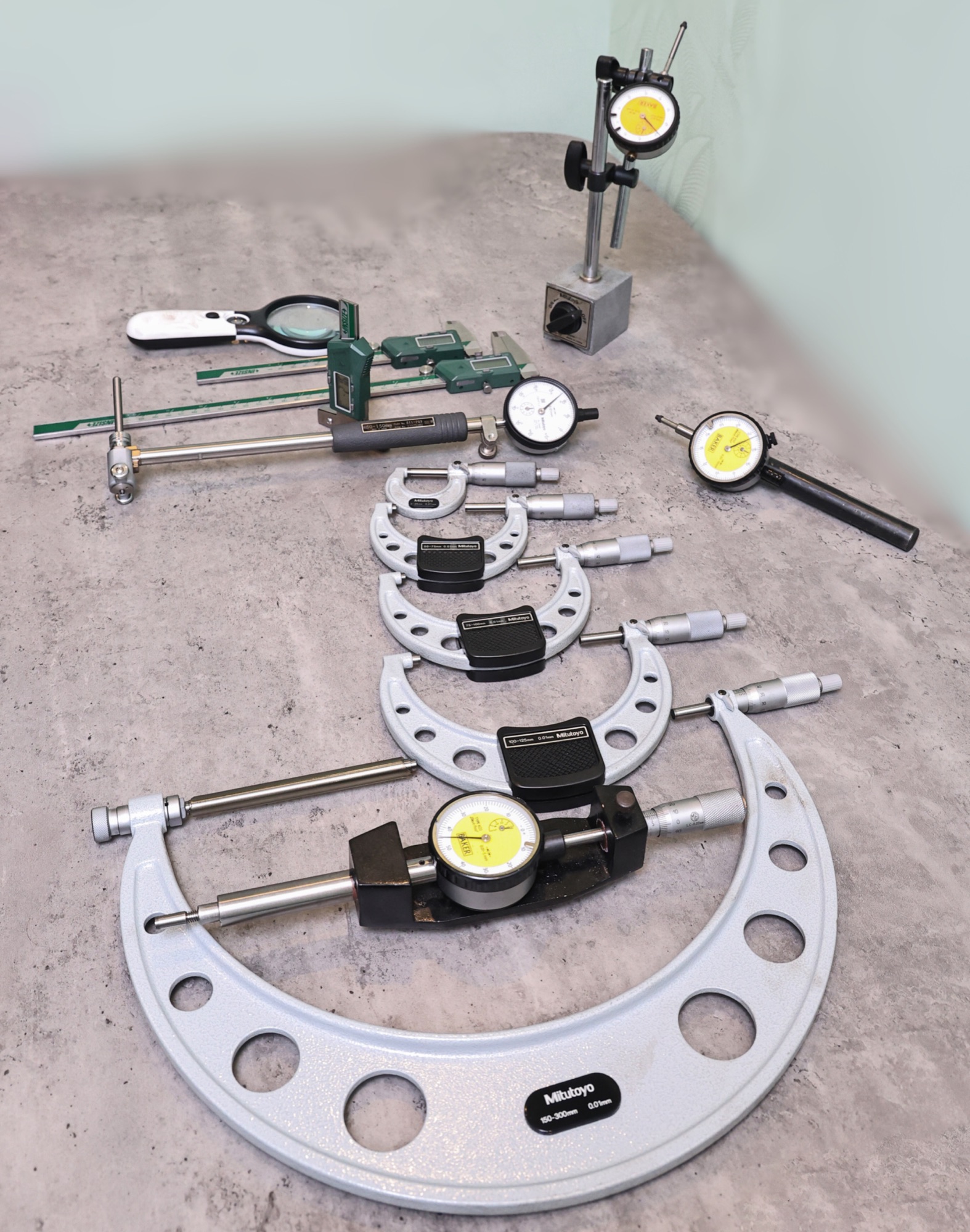
The cam is measured properly before anyone decides anything. Lift at every lobe, journal diameter, taper and ovality, run-out on V-blocks. Most camshafts are condemned on the strength of a visual inspection and a shrug. Measurement gives a different answer surprisingly often.
Journals and lobes are treated as separate questions. A shaft with perfect lobes and one scored journal is a repairable shaft. A shaft with good journals and a lobe worn through its case is usually not. Treating the cam as one pass/fail item throws away shafts that could have been saved.
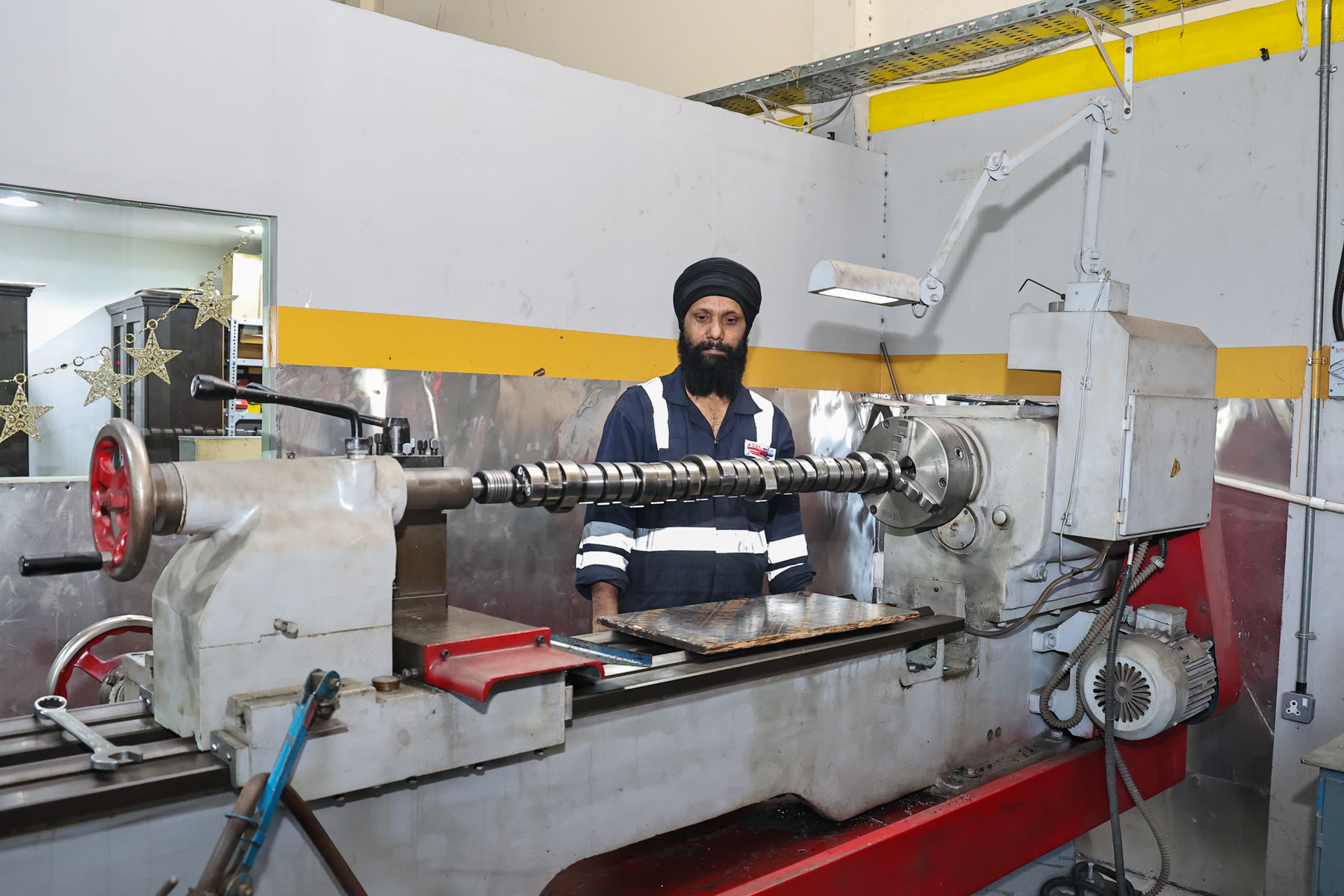
Straightening and grinding sit in the same building. A bent cam that is ground without being straightened comes back straight-sized and still bent. The correct sequence is the same as it is for a crankshaft, and it only happens reliably when both operations are under one roof — see crankshaft straightening and alignment.
Hardness is checked after grinding. Grinding puts heat into a hardened surface. On an induction-hardened or nitrided shaft, too much local heat draws the temper and produces a journal that is dimensionally perfect and mechanically soft. That is checked, not assumed.
You are told when the honest answer is a new shaft. A cam worn through its case is not repairable by grinding, and we will say so with the lift readings attached rather than take the job.
Camshaft operations we perform
- Full incoming measurement — lobe lift at every lobe, inlet, exhaust and injection
- Base circle and lobe profile assessment, and comparison lobe to lobe across the shaft
- Journal measurement — diameter, taper and ovality at every journal
- Run-out measurement on V-blocks with a dial gauge
- Magnetic particle crack detection
- Dye penetrant inspection where the geometry does not suit magnetising
- Camshaft straightening and run-out correction
- Journal grinding to standard undersize where bearings are available in that size
- Journal building and regrinding to standard size where undersize bearings are not made for the engine
- Thrust face regrinding and end-float restoration
- Journal polishing to a bearing-ready finish
- Lobe polishing and dressing where the case is intact
- Hardness verification after grinding
- Drive gear, key, keyway and flange inspection
- Camshaft bush and bearing supply and fitting, including line-bored bushes where the housing requires it
- Follower, tappet and roller inspection — a worn cam and a worn follower always arrive together
- Final measurement and written report
Nothing on that list is priced in advance. The shaft is measured, then it is quoted.
When a camshaft needs work
- Power loss and rising fuel consumption with a healthy fuel system. The pump and injectors test correctly on the bench and the engine still will not pull. Check the cam.
- A noisy valve train, or clearances that will not stay set. Wear at the lobe and at the follower face changes the clearance, and it comes back after every adjustment.
- Metal in the oil, or in the filter. Case material coming off a lobe is a specific and recognisable kind of debris, and it circulates.
- A collapsed or spalled follower. Followers and lobes destroy each other. If one has failed, the other is damaged, and fitting a new follower to a worn lobe simply repeats the failure at speed.
- A scored or seized camshaft journal, usually after an oil supply problem.
- The cam will not turn freely with the bearings fitted. Either the shaft is bent or the bearing bores are out of line.
- Routine overhaul. The cam comes out with everything else and gets measured with everything else. It is cheap to check while the engine is apart and expensive to check afterwards.
The process
- Clean and identify. Engine make, model and serial. Oilways cleared where the design allows.
- Measure as received. Lift at every lobe, journal diameter, taper and ovality at every journal, run-out on V-blocks. This is the "before" column and it is the basis of every decision that follows.
- Crack detection. Magnetic particle inspection. An indication at a lobe root or a journal fillet ends the conversation — that shaft is replaced, not repaired.
- Assess the lobes honestly. Lift is compared against the engine maker's figure and lobe against lobe across the shaft. Wear through the hardened case is a scrap verdict and we say so; wear within the case with the profile intact is a shaft that can be returned to service.
- Straighten if required. Run-out corrected before grinding, never after, in controlled stages with a gauge reading between each.
- Grind the journals. To the undersize for which bearings exist for that engine, or restored to standard size where undersize bearings are not made — which on many diesel camshafts is the only route, because the bearing is a bush rather than a shell.
- Polish. Journals polished to a bearing-ready finish; lobes dressed where the case is sound.
- Hardness re-check after grinding.
- Final measurement. The same readings, the same instruments, into the "after" column.
- Clean, oil, wrap and return with the report.
Nothing is cut until you have seen the incoming measurements and approved the work, and if the crack test or the lift readings change the answer, you get a phone call rather than a bill.
What we return to you
The shaft, protected for transport, and a measurement sheet giving lift at every lobe before and after, journal diameters with taper and ovality, run-out before and after, the crack test result, and the size any journal was ground to along with the bush or bearing you now need to order. Where we recommend replacement, that recommendation is on the same sheet with the readings that produced it.
Camshaft work is warranted. What the cover extends to depends on the operation and on whether we supplied the followers and bushes and did the assembly, so it is written on your quotation.
Repair or replace — the shaft decides, in numbers
The camshaft is unusual in that the repair-or-replace boundary is sharper than it is on most components, and it is worth being plain about where the line sits.
Journals are usually recoverable. A scored, tapered or undersized journal is a grinding job, and camshaft journals are among the most reliably repairable features on a diesel engine.
Bend is usually recoverable. Run-out is corrected in stages and re-measured, exactly as on a crankshaft.
Lobes are the limit. Camshaft lobes are hardened at the surface, and once wear has gone through that case the material underneath will not hold a profile. Grinding a worn lobe removes lift permanently and cannot restore the profile. A shaft with lobes worn through the case is replaced.
A crack anywhere is a replace.
So the useful question is not "is the cam worn?" — it is "which part of it is worn, and by how much?" Repairability depends on measurable condition: lobe lift remaining, journal diameter and ovality, run-out, hardness and crack depth. Every one of those is a number and all of them can be taken in a morning.
Engines we recondition camshafts for
Caterpillar, Cummins, Perkins, Volvo, Scania, Mercedes-Benz, Mitsubishi, Yanmar, Iveco, Wärtsilä, Niigata, Tata and Ashok Leyland — truck, bus, generator, industrial, and marine main and auxiliary engines. Both valve-train camshafts and the cam-driven injection pump shafts fitted to large industrial and marine engines are normal work here.
Shaft length is rarely the obstacle people expect it to be. If you are unsure whether your camshaft is one we can take, send its overall length, the largest journal diameter and a photograph, and you will have a yes or a no the same working day.