
This page is written to be useful even if you never call us. If you can read a symptom here and take one measurement yourself, you will make a better decision about what to spend.
White smoke in a diesel engine
White smoke is the symptom we are asked about most, and the first question is always: does it clear once the engine is hot, or not?
White smoke that clears as the engine warms up is usually unburnt fuel from cold. On an older engine it can be normal on a cold morning. If it takes longer to clear each month, combustion quality is drifting — injectors, injection timing or compression.
White smoke that persists when hot is a fault. The main causes, roughly in order of how often we find them:
- Injector faults. Poor atomisation, a dripping nozzle or wrong opening pressure puts raw fuel into the cylinder that does not burn properly. Confirmed on an injector test bench, not by eye — see fuel systems and calibration.
- Injection timing retarded. Fuel injected too late burns incompletely. Timing checked and reset.
- Low compression in one or more cylinders. Worn rings, worn liners or leaking valves. Confirmed by compression test and cylinder cut-out.
- Coolant entering a cylinder. Head gasket, cracked head or cracked liner. This white smoke is more of a sweet-smelling steam, and it comes with coolant loss without an external leak, pressurisation in the header tank and often emulsified oil. It is the one cause on this list that gets worse quickly, so test for it early.
- Water in the fuel. Common enough in this market to check first because it costs nothing to check.
The distinguishing test between (3) and (4) is a cylinder leak-down or a combustion-gas test on the coolant. Both are quick. Guessing between them is not.
Other symptoms and what they usually mean
Black smoke — too much fuel or not enough air. Restricted air filter, failing turbocharger, dirty charge air cooler, over-fuelling from an injection pump or governor fault, or the engine being asked for more load than it has.
Blue smoke — oil burning. Worn rings, worn liners, worn valve stem seals or guides, or oil coming through a failed turbo seal. If it appears mainly on overrun, look at the turbo before the engine.
Knocking — a knock that changes with load points at the bottom end: big-end or main bearing clearance. A knock that changes with speed more often points at injection timing, an injector, or valve train. This distinction is worth making before anyone opens the sump.
Hard starting or no start — fuel supply, compression, or cranking. Check cranking speed and battery/cable voltage drop before condemning anything expensive; a slow crank looks exactly like a fuel fault from the outside.
Overheating — cooling system, and on marine engines usually the seawater side: fouled heat exchanger, failing pump impeller, blocked strainer. See cooling system and heat exchanger repair.
Loss of power — turbo, fuel, or compression. Boost pressure and exhaust back pressure readings separate the first two from the third quickly.
Rising oil consumption with pressure at the breather — blow-by past rings or liners, which is a bottom end conversation. See engine overhaul.
Vibration — misfire on one cylinder, an unbalanced or failing turbo rotor, mounting failure, or driveline alignment. Cylinder cut-out testing settles the misfire question first because it is the cheapest to rule out.
The tests we run
| Test | What it tells you |
|---|---|
| Compression test | Per-cylinder sealing. Consistency between cylinders matters more than the absolute figure — a significant spread between cylinders is the flag |
| Cylinder leak-down | Where compression is going: rings, valves, or head gasket into the coolant |
| Crankcase pressure / blow-by | Ring and liner condition, measured at rated load rather than idle |
| Cylinder cut-out | Which cylinder is not contributing |
| Exhaust temperature survey | Deviation between units on multi-cylinder marine and genset engines — fuelling or combustion faults per unit |
| Boost pressure and exhaust back pressure | Turbo and air path health, exhaust restriction |
| Fuel pressure and return flow | Supply restriction, lift pump, filters, injector leak-off |
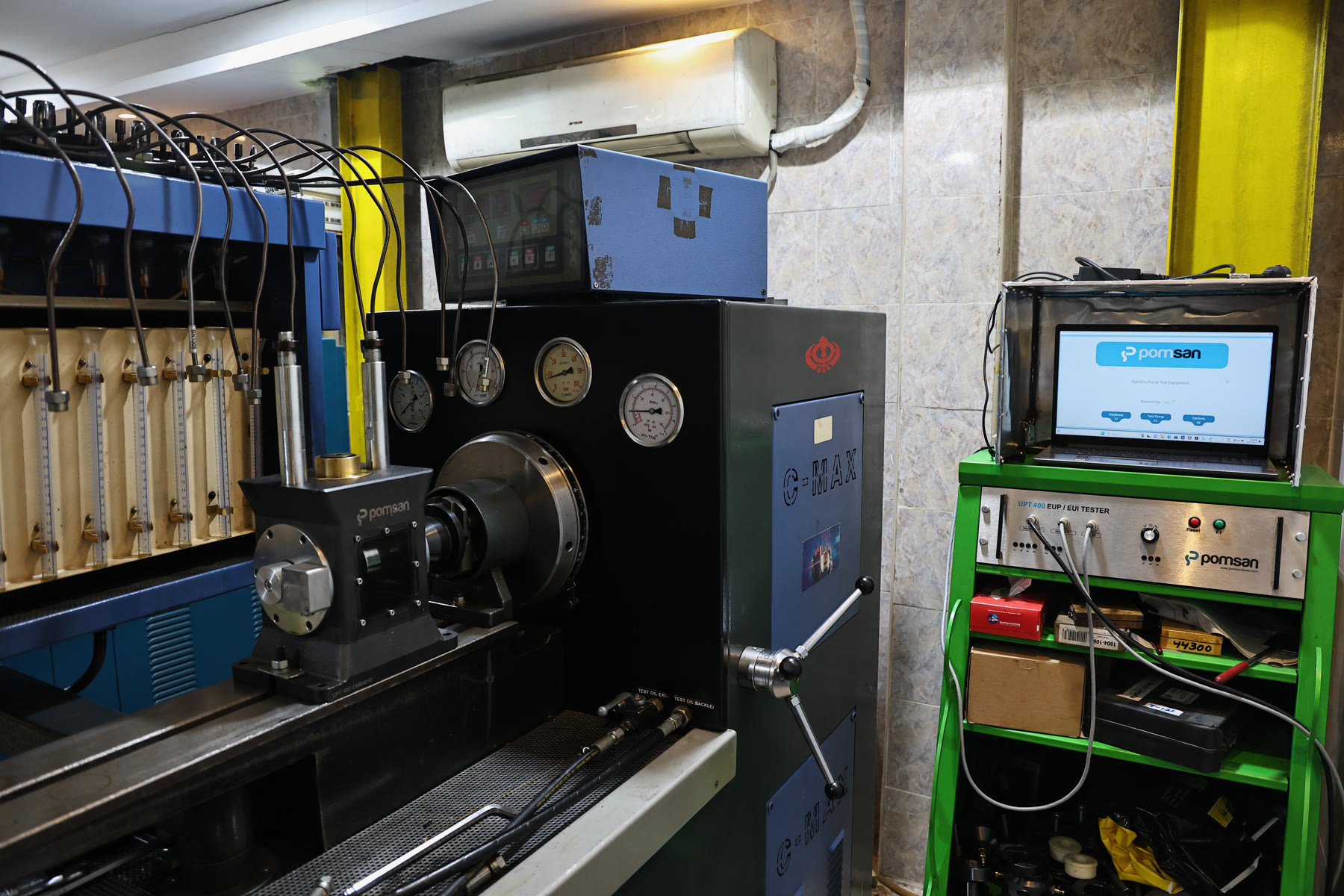
| Injector bench test | Opening pressure, spray pattern, leak-off, chatter |
| ECM fault code reading and live data | Sensor, actuator and control faults on electronic engines |
| Oil analysis | Wear metals, fuel dilution, coolant ingress — trends, not single samples |
| Coolant combustion-gas test | Head gasket, cracked head or liner |
| Insulation and voltage-drop testing | Charging and starting circuit faults — see alternator repair |
Most of that list can be run at your machine; injector and pump testing needs the bench. The value is not in owning the instruments, it is in what the readings let you refuse to buy. A cylinder leak-down test costs a fraction of a cylinder head, and it is the difference between replacing the head that is leaking and replacing the head that happened to be nearest.
Electronic engines: fault codes are a starting point
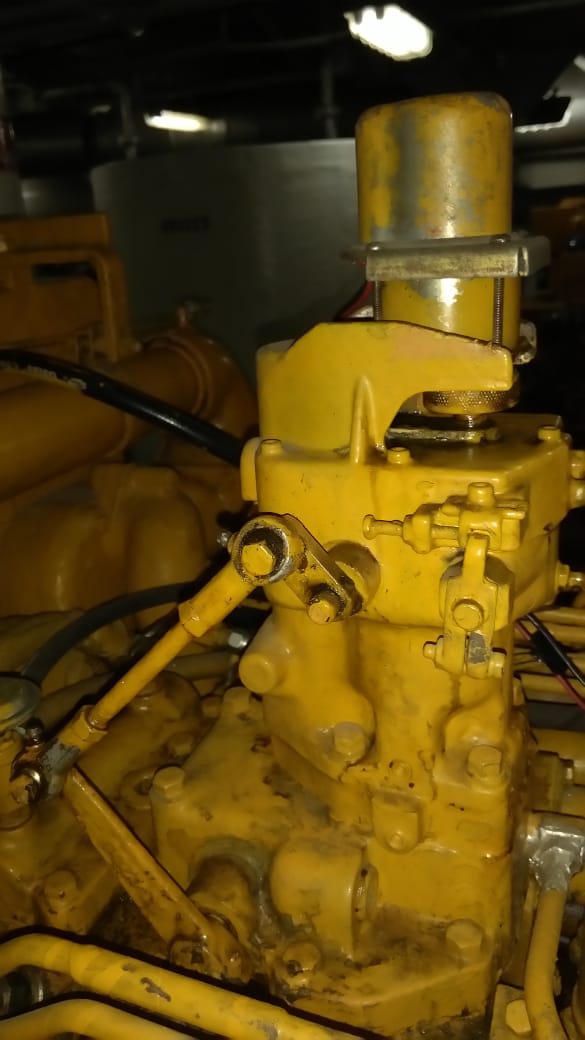
On electronic engines a fault code names a circuit, not a broken part. A code for injector cylinder 4 can be the injector, the harness, the connector, or the ECM driver. Replacing the injector on the strength of the code alone is how people spend money twice.
We read codes and live data, then verify the circuit before condemning the component. Where the fault genuinely is the control unit or the governor, see ECM, ECU and governor repair.
How a diagnosis is written up
A diagnosis is only worth what its record is worth, so each one is written up in the same form — and it is the form the job records we publish take:
- Equipment — engine make, model, rating, application and hours
- Reported symptom — in the operator's own words, because that is often the most useful sentence in the file
- Tests run, in order — with the reading each one produced and the manufacturer's limit beside it
- What was ruled out, and by which test
- Root cause
- The fix, and what it displaced — the part that would have been replaced on the strength of the symptom alone
That last line is the one customers keep. A fault that presents as an injector and turns out to be a voltage drop is a very different invoice, and the record is what proves which one you had.
What you get
- The readings, written down, with the manufacturer's limits alongside them
- A root cause, or a stated shortlist with the next test that would separate them
- A repair scope and quotation based on the findings, with nothing starting until you approve it
- An honest statement when the engine is fine and the fault is elsewhere — a fuel supply problem, a load problem, or an instrument fault
Diagnosis is charged separately from repair, and you are told the basis before an engineer travels or a unit is stripped. That is deliberate: it is what allows us to tell you the engine does not need the work you were expecting to buy.