
Established 2011, with over 25 years of experience. A fault code names a circuit, not a broken part. That single sentence is most of what this page is about.
Two different things are called "the governor"
They are not interchangeable, and sending the wrong one to the wrong bench wastes a week.
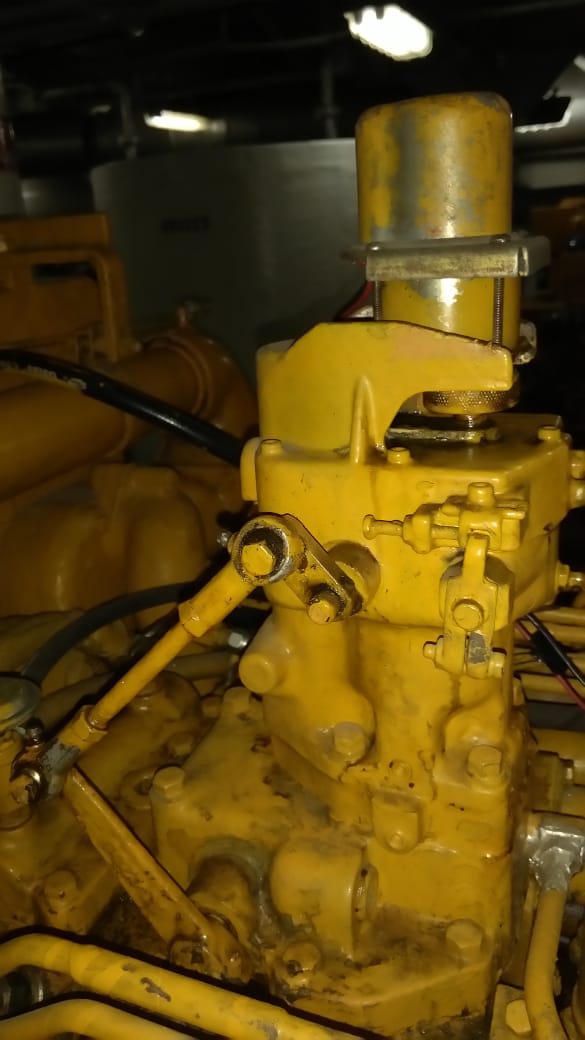
The mechanical-hydraulic governor — a Woodward UG8, UG10, PSG or 3161, or a mechanical governor built into an inline injection pump. Flyweights, a speeder spring, oil pressure and a compensating needle valve. That unit is overhauled and set on our injection bench alongside the pump it controls, and it has its own page: governor repair and calibration.
The electronic governing system — a speed control unit, an actuator on the fuel rack or throttle, and a magnetic pickup reading the flywheel teeth. Three separate components in a control loop, any one of which can produce the same complaint. That, along with engine ECMs and generator controllers, is what this page covers.
Plenty of engines in this market have both: an old mechanical pump with an electric actuator retrofitted, or a mechanical governor sitting under an electronic load-sharing panel. Tell us what is actually fitted rather than what the panel is labelled, and the diagnosis starts in the right place.
What brings people to this page
- An engine or genset that hunts, surges or will not hold a steady speed under load
- Overspeed shutdowns or a set that trips on under-frequency the moment load is applied
- An engine that starts and dies, or cranks and never fires, with the fuel system proved good
- A warning lamp or alarm on the controller that nobody can clear, or a set locked out and refusing to reset
- Intermittent faults that appear when the engine is hot, after rain, or when a loom is moved
- A derate — the engine runs but the power is not there, with no visible mechanical cause
- An ECM that has been quoted as a replacement and the number is hard to justify
- Water, corrosion or a jump-start incident in a plant room or engine room, and a control unit that has not worked since
- A long-idle standby set whose electronics have sat in a humid plant room for years
Generator-specific alarm and lockout behaviour — amber and red warning lamps, controller fault codes, sets that will not reset — is covered on the generator side: generator fault codes and generator repair and service.
Why control units get condemned when they are not faulty
An engine ECM sits at the end of dozens of circuits. It reads pressure, temperature, position and speed sensors, and it drives injectors, actuators and solenoids. When a reading is impossible or a driver circuit does not behave, it logs a code — correctly. The code describes what the ECM can see from where it sits, which is the circuit, not the component at the far end of it.
So a code that reads as a sensor fault is produced just as faithfully by a chafed wire against a bracket, a corroded pin in a connector under a heat shield, a poor earth on a rebuilt engine, a failed sensor, a broken screen on the loom, or the ECM itself. Six candidates, one code. Replacing the most expensive one first is not diagnosis, it is a purchase.
How we work through it. The codes are read and recorded before anything is disturbed. Live data is taken with the engine running and, where the fault only shows under load, with the engine loaded. Circuits are then measured at the connector — supply, earth, signal, resistance and continuity with the loom flexed — so a wiring fault separates itself from a component fault. Sensors are checked against physical reality rather than against each other: a coolant temperature reading is worth nothing on its own and everything next to a thermometer. Only when the circuit is proved sound does the control unit become the suspect.
That order is slower on the first afternoon and very much faster over the job. The mechanical side of the same discipline is on diesel engine diagnostics and fault finding.
What we do on the electronic control side
ECM and ECU work. Fault code reading and live data on electronically controlled engines, circuit-level testing of the loom and sensors, connector and pin repair, and repair of the control unit itself where the fault is in the unit — power supply sections, driver circuits, connector damage, corrosion and dry joints are all repairable conditions rather than automatic write-offs. Where a unit is beyond economic repair we say so plainly.
Electronic governing systems. Speed control units, actuators and magnetic pickups tested as the loop they actually are. An actuator is checked for free travel, current draw and return spring behaviour; a magnetic pickup for output and, just as often, for air gap; the speed control for its response to a known input. A hunting set is frequently a pickup gap or a sticking rack rather than a control fault, and that is cheap to find and expensive to guess at.
Actuator and linkage work. Fuel rack friction, worn linkage joints and a partially seized rack will defeat any governor, mechanical or electronic. This is checked on the engine before anything electronic is blamed.
Generator controllers and panels. Controller alarms, lockouts, sender and instrumentation faults, and the wiring between panel and engine. Panel-side work — controllers, AVRs, protection settings — sits with the generator pillar and is done in the same building.
Sensors, senders and looms. Speed, pressure, temperature and position sensors, engine harnesses, earths and connectors — the unglamorous half of electronic faults and the half that most often turns out to be the answer.
Setting up afterwards. A control fault is not finished when the code clears. The engine is run, loaded where the installation allows it and the speed and load response checked, because the complaint that started the job was a behaviour, not a code.
The honest boundary on replacement units and programming
If a control unit genuinely has to be replaced, a new one usually has to be configured to your engine — serial number, rating, calibration file — and that configuration is controlled by the manufacturer and its network. Any workshop that implies otherwise for every make on the market is overstating what it holds.
What we will do is tell you which side of that line your engine falls on before you spend anything: whether the fault is in the loom, a sensor, an actuator or the unit; whether the unit is repairable; and where a replacement will need manufacturer configuration to run. Send the engine model, serial number and the exact codes and we will tell you what the realistic routes are, including the ones that are not ours. That is a more useful answer than a quotation for a part you may not need.
Brand-side detail for the two makes this comes up on most is on Cummins engine repair and Caterpillar engine repair.
Test it before you buy a replacement
The decision that costs money here is the same shape as every other decision on this site: it is a measurement, not an opinion. A control unit is either passing its supplies, driving its outputs and reading its inputs, or it is not, and that is testable. So is an actuator's current draw, a pickup's output and a loom's continuity under flex.
Bring the unit and the fault, and let us test it. You get what was found, circuit by circuit, and the recommendation follows from that. If the unit is faulty and repairable, it is repaired here. If it is beyond repair, you are told so before a bill is built on the hope that it was not.