
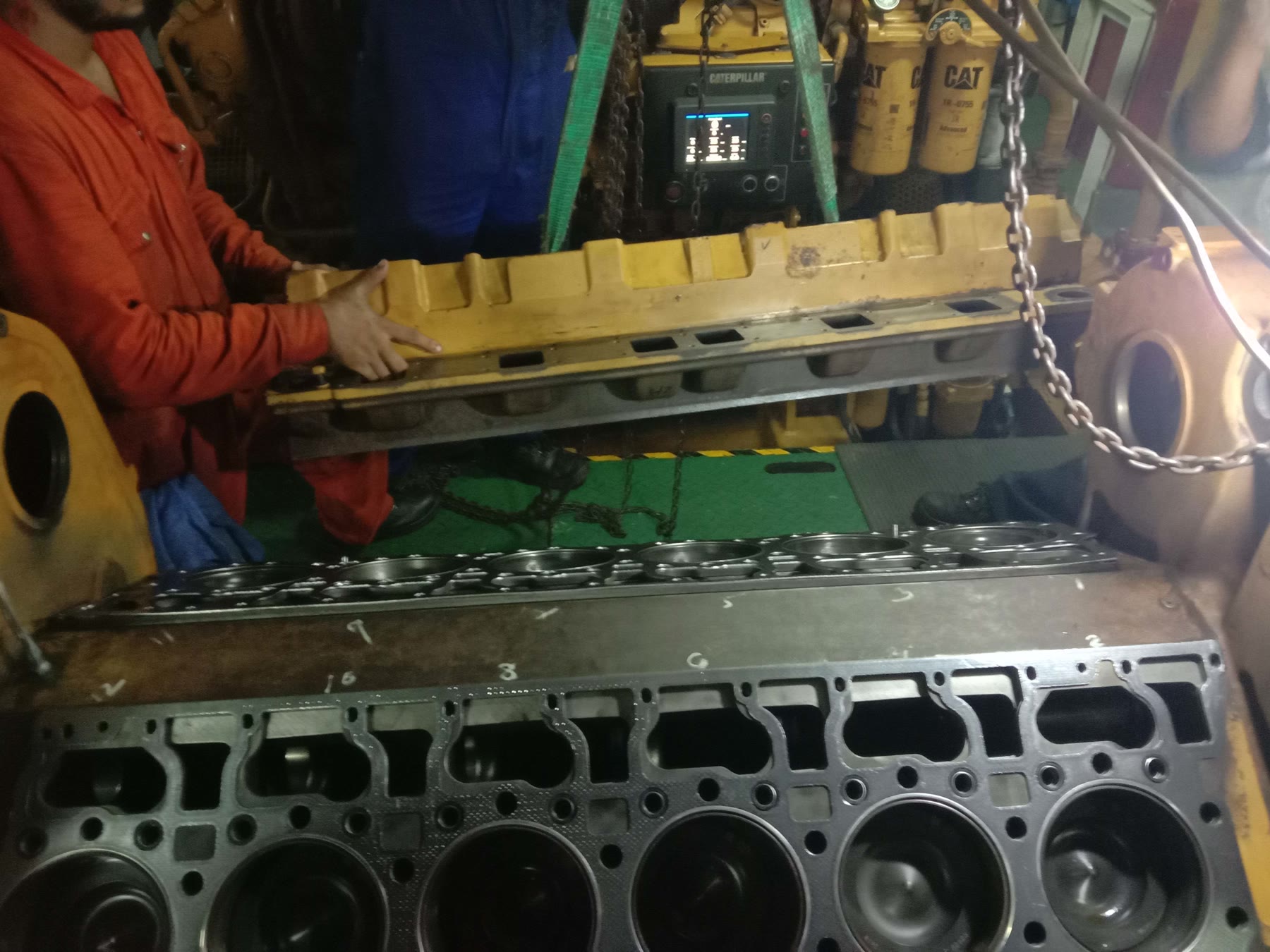
We overhaul heavy-duty diesel engines only: marine main and auxiliary units, generator engines, fire pump engines, plant and truck engines, and industrial diesels. We do not service car engines.
Top overhaul or major overhaul — the distinction that changes the quote
These two words get used interchangeably and they should not be. The difference is the bottom end.
Top overhaul is cylinder-head-and-above work: heads off, valves and seats reconditioned or renewed, injectors serviced and calibrated, head gaskets and seals renewed, valve clearances reset. The crankshaft and main bearings stay in place. On many marine and genset engines a top overhaul can be done in situ, without lifting the engine. It restores compression and combustion; it does not address bearing or liner wear.
Major overhaul takes the engine down to the block. Pistons, rings and liners out. Crankshaft out, main and big-end journals measured, ground undersize if required, new bearing shells. Block deck and main bearing bores checked and machined if out of true. Connecting rods checked for bend, twist and big-end bore stretch. Everything reassembled to specification and run.
Which one you need is decided by measurement, not by a service interval. If your problem is loss of compression, hard starting and smoke, a top overhaul may fix it. If you have blow-by pushing oil from the breather, falling oil pressure or bearing metal in the oil, the bottom end is involved and a top overhaul is money spent twice.
If you are not sure which you are looking at, start with diesel engine diagnostics — a compression test, a crankcase pressure reading and an oil analysis will usually settle it before anything is dismantled.
Symptoms that put an engine on the overhaul list
- Blow-by: visible pressure or oil mist from the crankcase breather, rising with load
- Oil consumption climbing over successive service intervals
- Blue smoke under load, or white smoke that persists once the engine is hot
- Falling oil pressure at rated speed with correct oil grade and a good pump
- Exhaust temperature deviation between cylinders on a multi-cylinder marine or genset engine
- Bearing material, chrome or iron trending upward in oil analysis
- Loss of power and rising fuel consumption for the same load
- A knock that changes with load rather than with speed
The process
1. Inspection and pre-strip record. Running data where the engine still runs — compression, crankcase pressure, exhaust temperatures, boost, oil pressure. Photographs before the first bolt comes out.
2. Strip and clean. Every component cleaned before measurement. Sludge and carbon make measurement dishonest.
3. Measurement. This is the stage the whole job hangs on:
- Crankshaft journal diameter, ovality and taper on every main and big end
- Cylinder liner or bore diameter measured at multiple heights and axes for wear, taper and ovality
- Cylinder head flatness across the deck, valve seat width and recession, valve stem and guide clearance
- Connecting rod big-end bore size and roundness, plus bend and twist
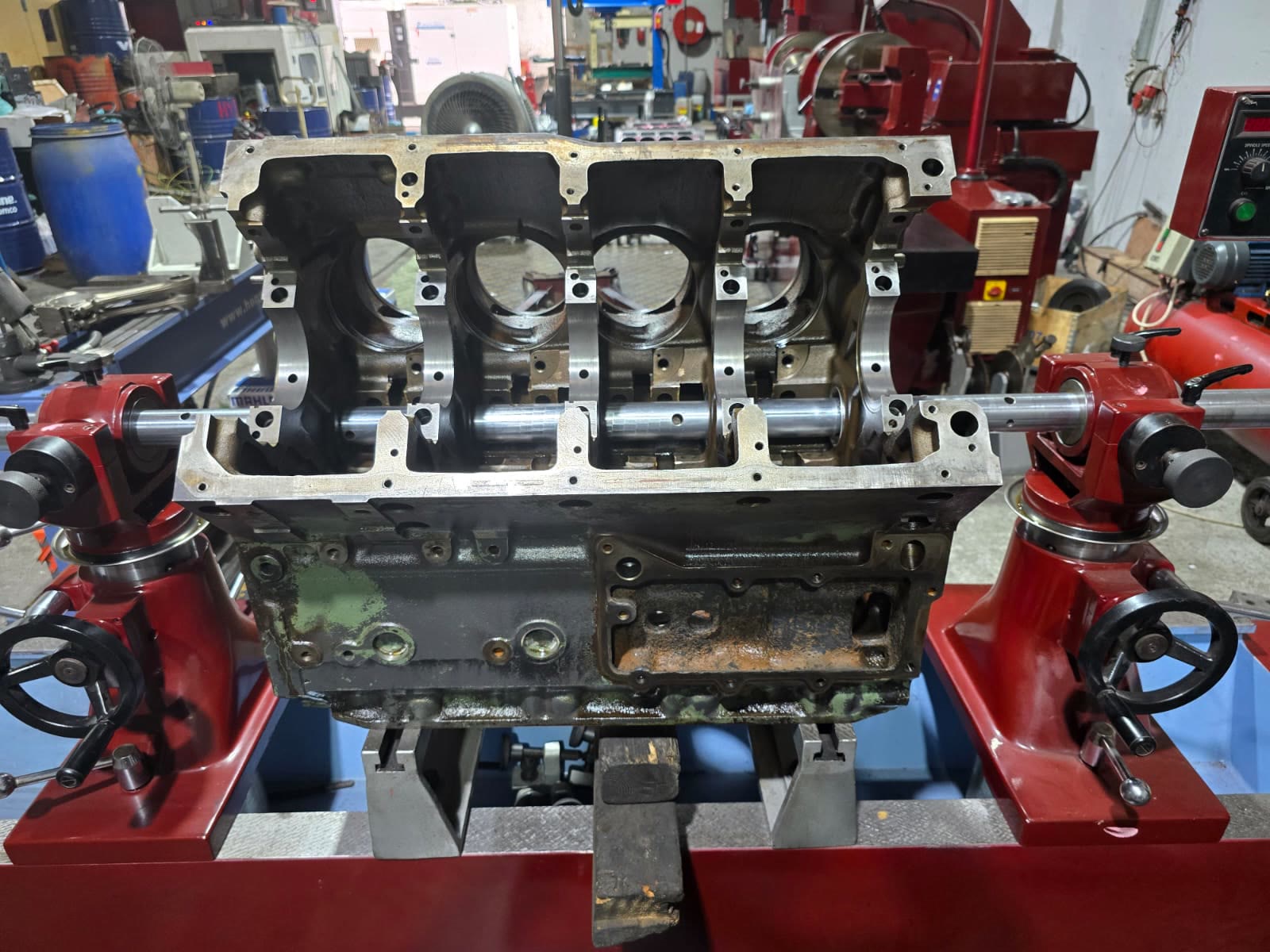
- Main bearing housing bore alignment
- Camshaft lobe height and journal wear
- Injector opening pressure and spray pattern; fuel pump timing and delivery
4. Findings and scope. You get the measurement sheet with the limits alongside the readings, and then the quotation. Not the other way round.
5. Machining. Anything recoverable goes onto our own machines — crankshaft grinding, cylinder reboring and honing, head surfacing, connecting rod reboring, line boring, press work. The detail of each of those operations lives in the machine shop section; this page will not duplicate it.
6. Fuel system. Injectors and injection pumps are stripped, tested and calibrated on our own benches. See fuel systems and calibration.
7. Ancillaries. Turbocharger stripped, inspected, rebuilt and balanced (turbocharger repair); coolers and heat exchangers cleaned and pressure tested; starter and charging alternator overhauled.
8. Rebuild. Assembly with recorded clearances, torque figures and valve and injection timing. Bearing clearances checked on build, not assumed.
9. Test. The engine is run before it leaves, and the running readings are taken and recorded — oil pressure, temperatures, and the same measurements that were used to diagnose it in the first place. An overhaul that has not been run is not a finished overhaul.
What you get back
- The completed engine, run and checked
- A measurement record showing what was found, what was machined and to what size, with the manufacturer's limits alongside
- A parts list stating for each item whether it is genuine or aftermarket
- Old parts returned if you want them — ask before the job starts
- A written warranty position on your quotation and invoice. Cover depends on the scope and the parts used, so it is stated for your job rather than left as a slogan
What a completed overhaul is written up as
Every overhaul leaves the same record behind, and it is the format the job records we publish follow:
| Field | What it holds |
|---|---|
| Customer and location | Named with permission, otherwise described — a Sharjah plant contractor, a standby set in a Dubai tower |
| Equipment | Engine make, model, rating, application and hours |
| Problem | The fault as the operator reported it |
| Repair | The single operation the job turned on |
| Scope of work | What was done, in order |
| Measurements | Found, machined to, and against which limits |
| Downtime | Days out of service |
| Result | What went back, and what it was run and tested to |
The measurements are the point. A record with three hard numbers in it is worth more to the next engineer who opens the engine than any amount of description.
Overhaul in the workshop or on site
An engine that has to be rebored, or whose crankshaft has to be ground, comes to Sharjah. Portable in-situ machining exists and specialist firms sell it, generally for shafts that cannot practically be removed from very large engines. For the sizes we overhaul, taking the component out and putting it on a machine gives better-controlled geometry, and it is quicker and cheaper than mobilising in-situ equipment onto a site half an hour from a machine shop.
Top overhauls are a different matter. Heads, injectors, pumps and turbos can all be dealt with in a plant room, on a barge or alongside — see on-site and in-situ engine repair for what genuinely can and cannot be done in place.
Overhaul or replace — let us measure it first
This is the decision the whole job hangs on, and it is a measurement rather than an opinion. Whether a crankshaft can be ground rather than replaced depends on four things that can be read off the shaft: ovality, hardness, bend and crack depth — plus how much material is left above the manufacturer's bottom undersize. A cylinder head turns on flatness, seat recession and cracks. A liner turns on wear, taper and ovality. A connecting rod turns on big-end bore size, bend and twist.
None of those can be judged from a photograph, a phone call or a service interval, and a supplier who recommends replacement without them is guessing in the direction that suits him. All of them can be settled quickly by a workshop that owns the measuring equipment and the machines.
So the low-commitment first step is not a quotation. Send us the component and let us measure it. You get the readings with the limits beside them, and then you decide.
An overhaul is worth doing when the block and crankshaft are recoverable and the engine is a known quantity. It stops being worth doing when the crankshaft is already at final undersize, when the block is cracked into a water jacket, or when parts for the model have become slow and expensive enough that the next repair will be worse than this one.
Where the engine has already failed rather than simply worn out, the framing is different — that is a rescue-versus-replacement decision, covered on engine reconditioning and rebuilding.