
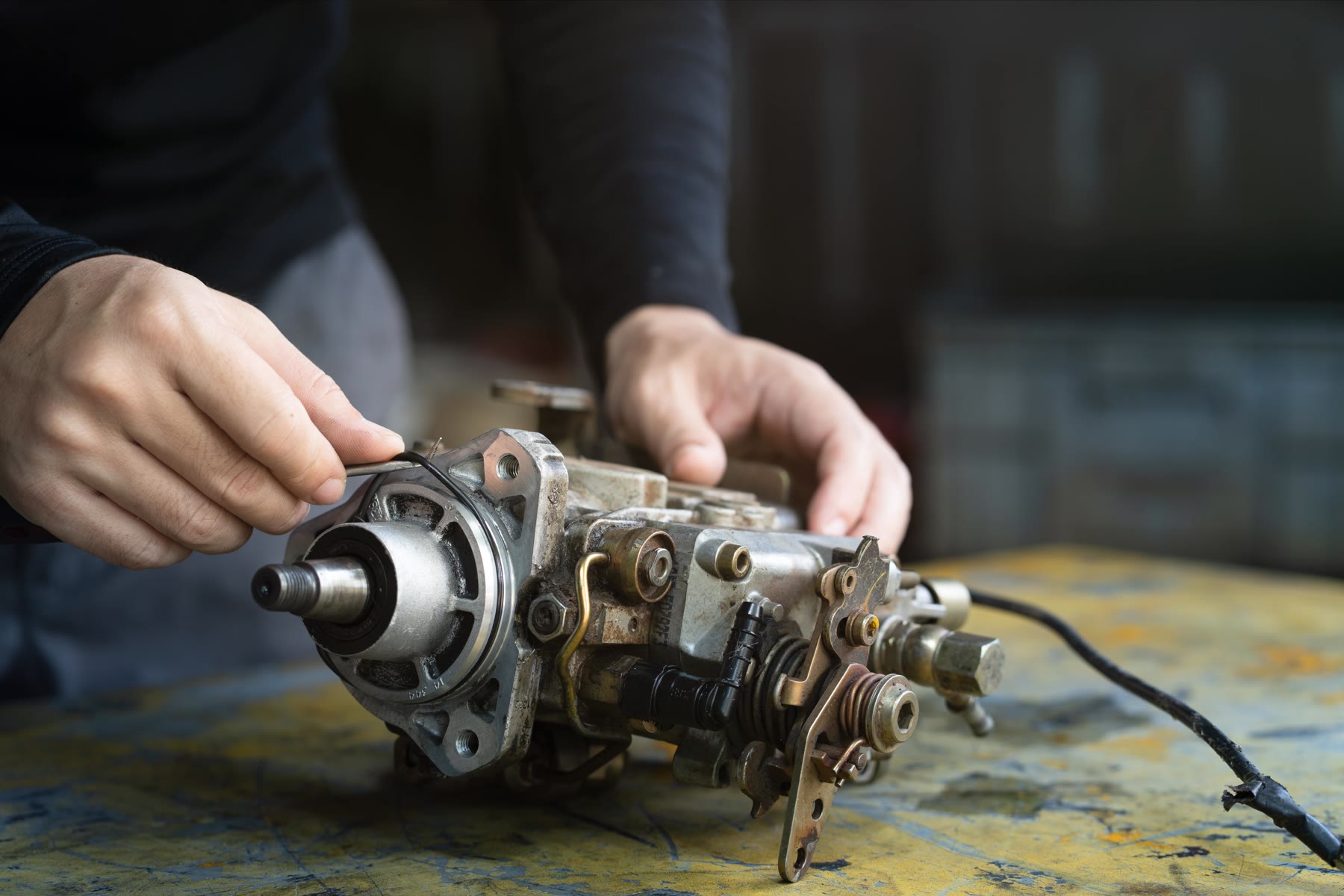
The practical Delphi problem in this market is not repair. It is recognition. A pump built in the sixties, a pump built in Britain in the nineties and a pump built in India last decade can be the same design wearing three different maker's names, and the owner of the engine usually has no idea that they are related. That confusion is what sends people out to buy replacement pumps they did not need, and unpicking it is most of what this page does.
One pump, four names on the plate
The rotary distributor pump that everyone in this region calls "the CAV pump" or "the Lucas pump" has changed owner repeatedly without changing its architecture. The name stamped on the plate tells you which decade the unit was built in, not what it is.
The lineage runs from CAV through Lucas CAV and Lucas Diesel Systems, to Delphi, which bought the diesel business in 2000 and continued the same product lines; the business has changed corporate hands again since. Alongside all of that, the same designs have been built under licence and joint venture in India for decades, largely for the tractor, light commercial and generator markets — which is why a UAE workshop sees plenty of these pumps that are neither old nor British.
What matters to you, practically:
- A pump plate reading CAV or Lucas does not mean the pump is unobtainable or unserviceable. The design is still in production in one form or another.
- Parts availability across this family is generally good — which is precisely why replacing one of these pumps is so often the wrong call.
- Different production sources mean components that look interchangeable are not always interchangeable, particularly hydraulic heads and rotors. Matching parts to the specific pump number on the plate matters more here than on most families.
- The number on the plate — not the engine model, not the tractor or genset badge — identifies the build, the internal specification and the setting data. Photograph the plate before you do anything else.
Which Delphi do you have?
A compact, roughly cylindrical pump with the high-pressure pipes leaving it in a fan or a circle, a single drive shaft, and no oil filler of its own — a DPA-family rotary distributor pump. A single rotor carrying opposed plungers, driven against an internal cam ring, distributing to each cylinder in turn through a hydraulic head. Governing is either mechanical, by flyweights, or hydraulic, by transfer pressure acting on a metering valve — and which one you have changes both the fault list and the setting procedure completely. This is the dominant Delphi architecture in the region.
The same shape, later, with revised metering and advance — DPC and the sealed DPS variants. The successors to the DPA, running higher pressures, otherwise recognisably from the same family.
A larger rotary pump on medium-duty industrial and agricultural engines — the DP200 series and its relatives. Fitted extensively to industrial engines in plant, gensets and agricultural machinery. Same distributor principle, heavier construction.
A rotary pump with an electrical connector and a control unit on it. The electronically controlled versions of the same family. These fail in two independent halves — the hydraulic pump and the control side — and the whole point of testing is to find out which half you are buying before you buy it. The hydraulic side is frequently perfectly serviceable when the unit gets condemned.
No high-pressure pipes to individual injectors, one thick pipe to a rail, electrical connectors on each injector — common rail. Delphi common rail equipment on light and medium commercial engines, and on the European and Indian light-duty diesels that reach this market. That work is a different discipline with different cleanliness requirements — see common rail injector and pump service.
Injectors bolted into the head with no high-pressure pipe, driven by the camshaft, electrically connected — electronic unit injectors. Delphi-built unit injectors appear on several heavy-duty European and North American engine families.
Send a photograph of the pump on the engine with its plate visible, plus the engine make, model and serial, and you will get an identification before anything is removed or transported.
Where these pumps sit in the UAE
Two applications account for most of the Delphi-family work that arrives here.
Generator sets and standby plant. A very large share of the region's small and mid-size standby sets are Perkins-engined, and a great many of those engines carry a pump from this family. A set that starts hard, hunts, smokes, or will not take load on the one day it is needed usually has a fuel fault, and on these sets the pump is old, fuel-lubricated and has often never been off the engine since commissioning. The engine side of that work is on Perkins engine repair and overhaul; the pump side is here.
Plant, agricultural and utility engines. Tractors, loaders, backhoes, pumps, compressors and lighting towers — engines that work in dust, are refuelled from drums and bowsers, and stand for months between seasons. This family is fitted across an enormous range of them.
Both applications share the same commercial reality: these are engines whose owners are being told, somewhere, that the machine is too old to be worth repairing. On the fuel system that is very rarely true.
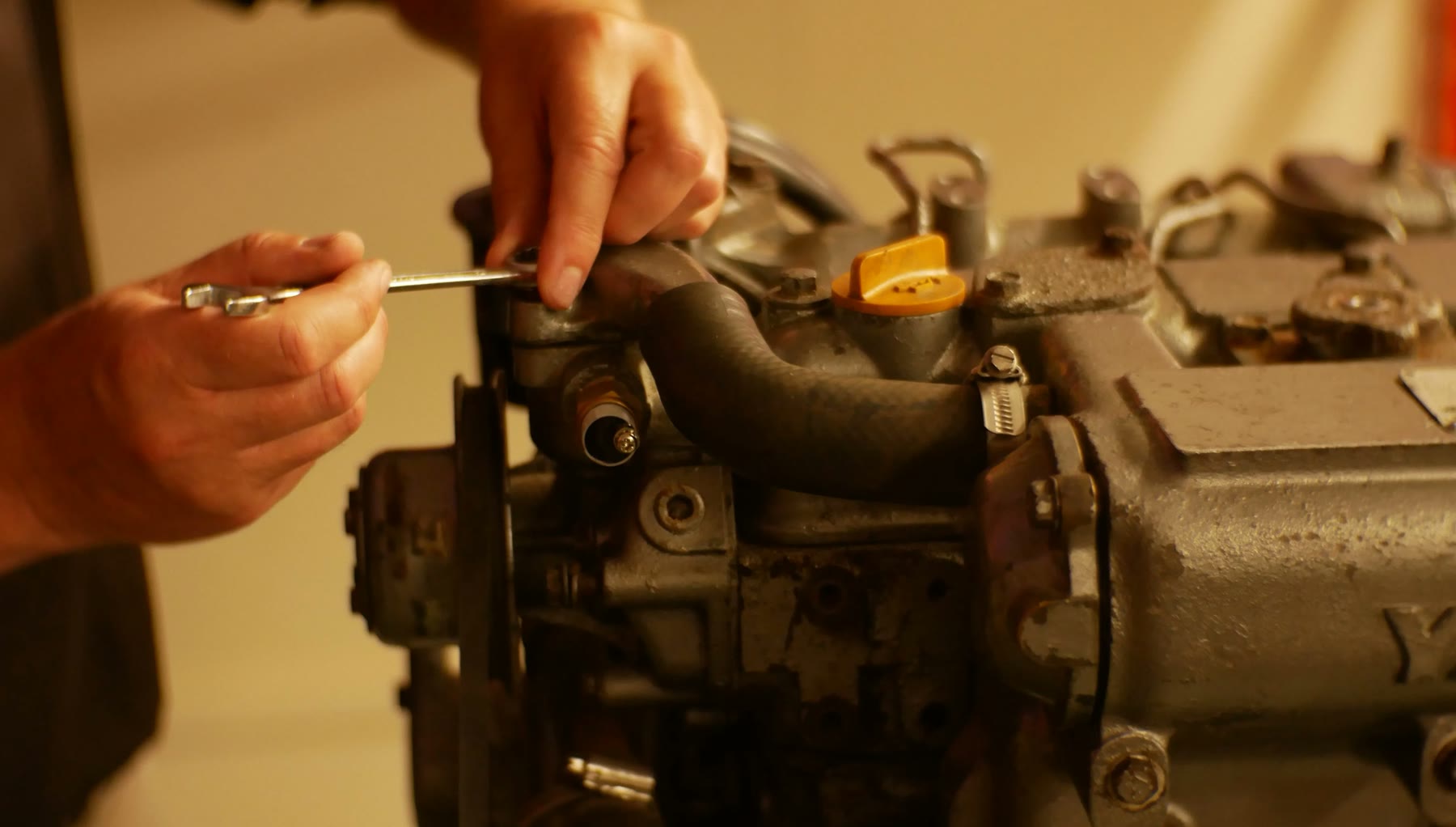
How a DPA-family pump actually wears out
These pumps are lubricated entirely by the diesel passing through them. There is no separate oil supply, no dipstick, nothing to check. That single design decision explains almost every failure we see.
The hydraulic head and rotor is the wear pair. The rotor turns inside the head at close clearance, and every particle and every dry moment attacks that clearance. As it opens up, the pump internally leaks: delivery drops off, hot starting gets difficult, the engine loses power at the top end, and the fault appears worse when the fuel is hot and thin. This is the component that decides whether an overhaul is worth doing, and it is measurable.
Transfer pump blades and the regulator. The vane pump that raises fuel to transfer pressure feeds everything else, including — on hydraulically governed units — the governing itself. Worn blades or a tired regulator produce symptoms that read exactly like a governor fault, and get treated as one.
The automatic advance. A seized or leaking advance mechanism means injection timing no longer moves with speed. Smoke, noise, poor economy, poor cold starting, and none of it visible on any gauge.
Shaft seals and the throttle shaft. Leaks here are the classic Delphi symptom that everyone recognises — fuel weeping down the pump body — and they are cheap to put right and expensive to ignore, because a pump that leaks out also draws air in.
Water and dirt. Condensation in half-empty tanks, a hot humid climate, refuelling from drums, and long standing periods. Water strips the lubricating film between the rotor and the head; abrasives do the same damage faster. In this region the fuel is the pump's biggest enemy and the filter is the only defence it has.
Aged, gummed fuel on a set that stands. Standby gensets and seasonal plant sit for months. What is left in the pump varnishes, and the first run after a long stand is when the pump is asked to work with the least lubrication it has ever had.
Delphi operations we perform
- Incoming bench test as received, recorded before anything is opened
- Full strip, clean and component inspection
- Hydraulic head and rotor assessment, and replacement where the clearance has gone
- Transfer pump blade, liner and regulator renewal
- Metering valve and metering port assessment
- Automatic advance mechanism strip, overhaul and setting
- Cam ring, roller and shoe inspection and renewal
- Drive shaft, seal and bearing replacement
- Mechanical governor overhaul, and hydraulic governing set on transfer pressure — see governor repair and calibration
- Shut-off solenoid and cold start device testing
- Maximum fuel, maximum speed and idle settings made to the pump's own setting data
- Delivery calibration across the speed range and cylinder-to-cylinder balancing
- Electronic pump control side and hydraulic side tested independently
- Mechanical injector and nozzle holder overhaul, nozzle replacement and opening pressure setting
- Common rail injector and pump testing under common rail service
- Final verification run and a signed test report on every unit
Nothing on that list is priced before the incoming test, and nothing is stripped or ordered until you have agreed the work. Nothing is done until you say yes.
Repair or replace — the head and rotor decide
A Delphi rotary pump is, in the main, an assembly of replaceable parts. Blades, seals, springs, the advance components, the governor parts and the drive shaft are all serviceable items. So the overhaul decision comes down to a small number of things that are not routinely replaced, and above all to the hydraulic head and rotor: its condition, and whether a head assembly is available for that specific pump number.
That is a good position for the owner of an engine to be in, because it is a question with a measurable answer rather than an argued one. The pump is run as received, stripped, and the wear pair assessed — and then you are told which of three things you are looking at: a pump that needs seals and setting, a pump that needs a head, or a pump that is not worth the parts.
It matters most on exactly the equipment people are most tempted to give up on. A twenty-five-year-old genset engine or a long-serving tractor is generally worth far more running than it is as scrap, and the fuel system is usually the cheapest part of keeping it alive. Where the numbers say replace, that is what you will be told, in writing, with the readings attached — see what our calibration reports contain.