
Established 2011, over 25 years of experience.
Two architectures, two failure patterns
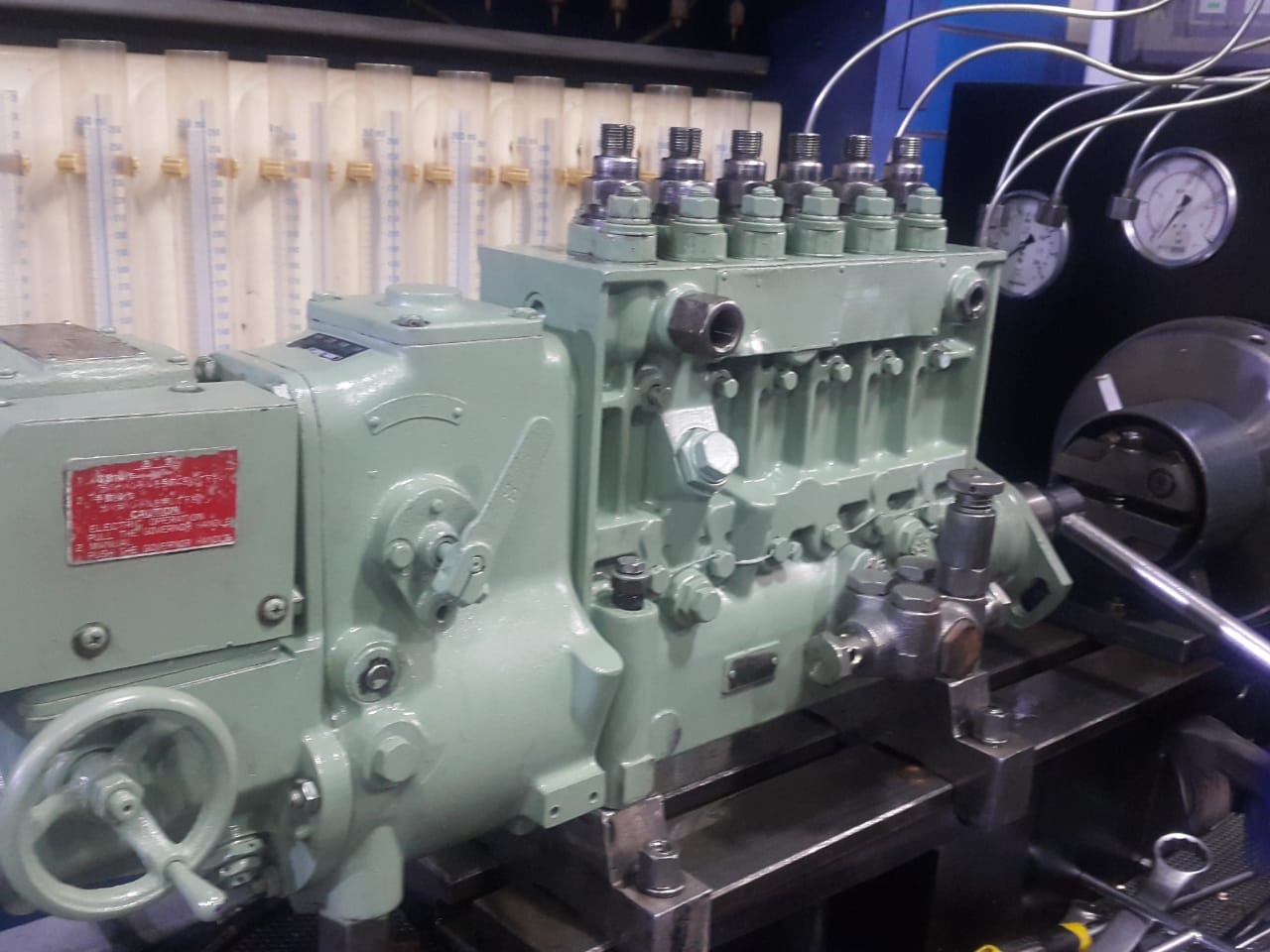
An inline pump is a row of independent pumping elements. One plunger and barrel per cylinder, sitting over a camshaft in the pump's own housing, each element driven by its own cam lobe and tappet, each with its own delivery valve. Quantity is set by rotating the plungers together on a control rack, so the helix ground into each plunger closes the spill port earlier or later. It is a robust, heavy, serviceable design with its own lubricated camshaft and bearings, and it is what you will find on most larger industrial, marine and generator engines.
What goes wrong on an inline pump is usually wear that spreads unevenly across the elements. One plunger and barrel scores; one delivery valve stops seating; one tappet or roller wears and changes that element's timing. The engine then runs on cylinders that are no longer receiving the same quantity at the same instant — which shows up as smoke, imbalance, vibration and one cylinder running hot, long before the pump refuses to run at all. It is also why an inline pump has to be phased as well as calibrated: each element must begin delivery at its correct angle relative to the others, not just deliver the right amount.
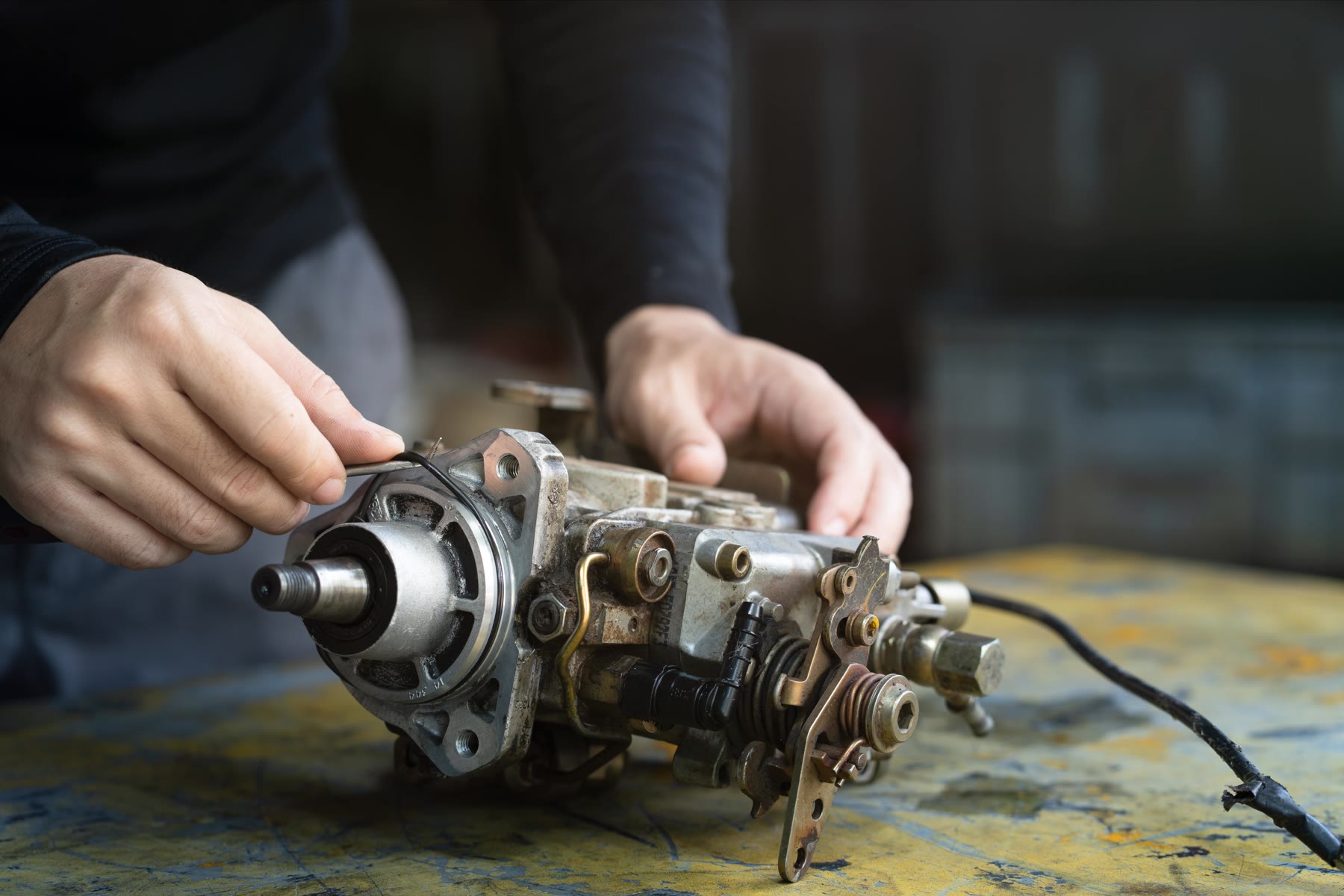
A rotary distributor pump is one pumping mechanism serving every cylinder in turn. A single rotor distributes fuel to each outlet in sequence. Depending on the family, pumping is done by opposed plungers driven inwards by a cam ring, or by a single axial plunger driven against a cam plate; metering is done by a valve or a control sleeve, and the whole assembly runs inside one compact housing with a vane transfer pump feeding it.
What goes wrong on a rotary pump is different, and the reason is one design decision: the rotary pump is lubricated entirely by the diesel passing through it. There is no separate oil supply. So fuel quality is not a maintenance detail on these pumps, it is the whole story. Water in the fuel strips the lubricating film between the rotor and the hydraulic head — a clearance measured in microns — and the head is scored. Abrasive particles do the same faster. Low-lubricity fuel does it slowly and everywhere at once. And because the rotary pump has one pumping mechanism rather than several, when it wears, every cylinder loses delivery together: the engine does not run rough, it just gradually stops making power and becomes hard to start, and everybody blames the injectors.
What overhauling pumps in house changes
The pump is tested before it is stripped. The incoming run, as received, is what tells you whether the pump is actually the fault. A meaningful proportion of pumps that arrive here test within specification, and the problem turns out to be supply, filtration, air, timing or injectors. That answer is only available to a workshop with its own bench, because a shop that subcontracts calibration cannot afford to test before it quotes.
Phasing and calibration happen on the same bench, in one sitting. On an inline pump those two operations are inseparable: change an element and the phasing moves, adjust the phasing and the deliveries move. Doing them across two companies is why pumps come back "calibrated" and still uneven.
The governor is set on the pump it belongs to. A pump and its governor are one machine. Setting the maximum speed, the smoke limit, the boost compensator and the excess-fuel device with the pump running is the last and most important part of the job, and it is done here — see governor repair and calibration.
Older pumps get judged on their real limits, not written off. Housing bore condition, camshaft and roller wear, rotor and hydraulic head clearance — these are the things that decide whether an overhaul will hold its calibration, and they are measurable. A shop that only replaces pumps has no reason to measure them.
The paperwork is written by the person who did the work. There is nobody to refer the awkward question to.
Inline pump operations we perform
- Incoming bench test as received, recorded
- Full strip, ultrasonic clean and inspection
- Plunger and barrel element replacement — supplied as matched pairs, never separately
- Delivery valve and seat replacement
- Camshaft, tappet, roller and guide inspection and renewal
- Camshaft bearing and end-float setting
- Drive shaft, bearing, key and seal renewal
- Control rack, rack travel and rack friction check
- Housing bore assessment and element bore condition
- Element phasing — each element set to begin delivery at its correct angle
- Port closing and static timing set
- Pre-stroke setting where the design specifies one
- Delivery calibration across all elements against the figures for your pump
- Cylinder-to-cylinder delivery balancing
- Smoke limit and boost compensator setting
- Maximum speed and idle speed setting
- Excess fuel and cold start device setting
- Governor fitting, run-in and adjustment on the pump
- Final verification run and signed test report
Rotary and distributor pump operations we perform
- Incoming bench test as received, recorded
- Full strip, ultrasonic clean and inspection
- Transfer pump vane, liner and regulator inspection and renewal
- Hydraulic head and rotor assessment for wear and scoring
- Hydraulic head and rotor replacement as a matched assembly
- Plunger, roller, shoe and cam ring inspection and renewal
- Cam ring condition and roller-to-ring wear pattern assessment
- Metering valve and control sleeve inspection
- Delivery valve and outlet condition
- Automatic advance mechanism strip, inspection and setting
- Shut-off solenoid and cold start device testing
- Drive shaft, seal and O-ring renewal throughout
- Governor weights, thrust sleeve and linkage inspection
- Delivery calibration across the speed range
- Advance curve set against the figures for your pump
- Maximum fuel, maximum speed and idle settings
- Final verification run and signed test report
Nothing on either list is priced before the incoming test, because until a pump has been run nobody knows what the job is. Nothing is stripped or ordered before you have agreed the work.
Which pump do I have?
Most people arriving here know the engine and not the pump. The quick version:
If there is a row of pipes leaving the top of the pump in a straight line, one per cylinder, and the pump is long and heavy with its own oil filler or dipstick — it is an inline pump. Bosch PE and PES families and their licensed derivatives, and the equivalents fitted to most larger industrial, marine and genset engines.
If the pump is round, compact, roughly the size of a large mug, with the pipes leaving it in a circle around the head — it is a rotary distributor pump. Bosch VE and its electronically controlled descendants, Delphi and CAV DPA, DPC and DPS families, and Stanadyne DB-series pumps.
If there are no high-pressure pipes to individual injectors at all, and instead one thick pipe going to a rail on the cylinder head with electrical connections to each injector — it is a common rail system, which is a different discipline and is covered under common rail injector and pump service.
Send a photograph of the pump on the engine with the data plate visible and you will get a straight identification and a straight answer before you remove anything.
Symptoms, by pump type
| What the engine is doing | Inline pump | Rotary pump |
|---|---|---|
| Hard starting, power down evenly across all cylinders | Less typical — points at the rack or the governor | Classic worn head and rotor |
| One cylinder smoking, knocking or running hot | One element or delivery valve | Rare — the pump serves all cylinders alike |
| Black smoke under load | Over-delivery on an element, or retarded phasing | Advance mechanism, or over-fuelling |
| Engine will not reach rated speed | Rack travel or governor | Metering valve or governor |
| Runs, stops, needs bleeding | Air on the suction side | Air, or transfer pump wear |
| Gradual loss of power over months, no single fault | Even element wear | Rotor and head wear from fuel quality |
| Sudden failure after a fuel contamination event | Elements scored | Head and rotor seized or scored |
Every row of that table is a measurement rather than a diagnosis, which is why the sensible next step is a bench test rather than a parts order.
Repair or replace — the housing and the head decide
An injection pump is mostly made of parts that are replaceable. Plungers, barrels, delivery valves, heads, rotors, vanes, seals, bearings and drive components are all service items. The pump body itself very rarely fails.
So the question is never "is the pump worn" — it always is. The question is whether the parts that cannot be replaced are still within limits:
- On an inline pump: the housing element bores and the camshaft. If the bores are worn or damaged, or the camshaft and its bearings are past their limits, a rebuilt pump will not hold its calibration and we will say so before you spend money on it.
- On a rotary pump: the hydraulic head and rotor. These are supplied and fitted as a matched assembly. Whether that assembly is available for your pump, and what it costs against a replacement pump, is often the entire economics of the job — and it is the first thing we check on an older unit.
- On any pump: parts availability. Some older families are still fully supported. Some are not, and the honest answer is a reconditioned exchange unit or a replacement.
A new injection pump for a large industrial or marine engine is frequently a long-lead import at a price that makes the whole engine look uneconomic. In most cases it does not need to be bought. But that is a conclusion from a test, not a sales position, and where the numbers say replace, that is what you will be told.
Pumps and engines we cover
Inline and rotary pumps from Bosch, Denso, Delphi, Stanadyne, Zexel and Diesel Kiki, on Caterpillar, Cummins, Perkins, Yanmar, John Deere, Scania, MAN, Volvo, Mitsubishi, Deutz, Doosan, Kubota and Hatz engines — generator sets, marine main and auxiliary engines, fire pump engines, compressors, agricultural and construction plant, trucks and buses.
For brand-specific detail see Bosch fuel system service, Delphi service, Denso service and Stanadyne pump service.