
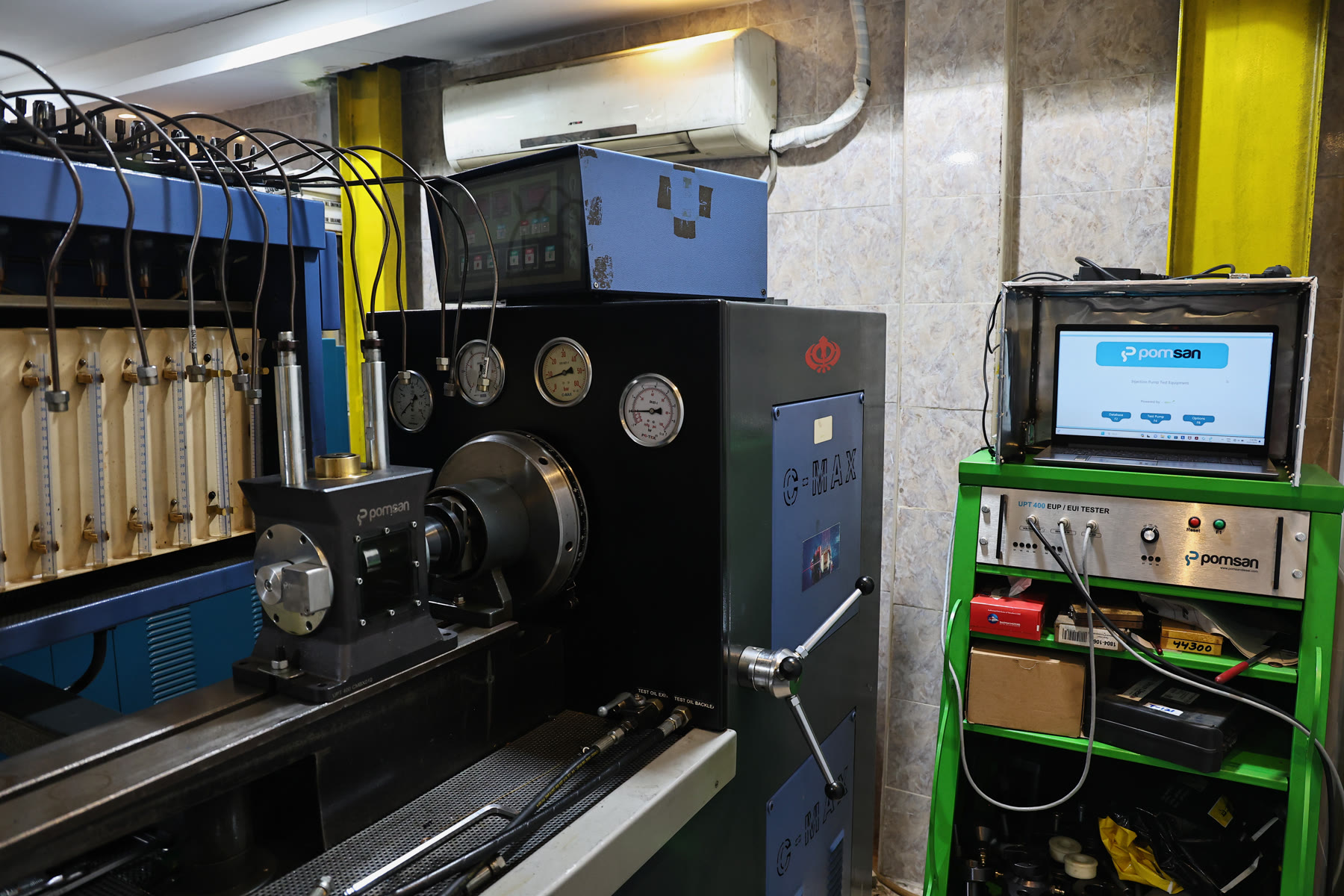
The thing that makes a Denso job different from any other injection job is that a Denso injector is not only a piece of hardware. It is a piece of hardware plus a number. Get the hardware right and the number wrong and the engine still runs badly. Almost everything on this page follows from that.
Denso is mostly a common rail problem
Bosch equipment arrives here spanning a century of technology, from mechanical inline pumps on eighties gensets to the newest common rail — which is why the Bosch page spends most of its length helping you identify which Bosch you have. Denso is not like that in this market. The great majority of Denso equipment that reaches our bench is common rail, and the rest is mostly the electronically controlled distributor pumps that immediately preceded it.
That narrows the diagnostic question usefully. With Denso, you are almost never asking "is this mechanical or electronic". You are asking three much sharper questions:
- Is the fault in the supply pump, the rail and its control, or the injectors?
- If it is the injectors, is it delivery that has drifted, or return flow that has opened up?
- Whatever gets changed or rebuilt, what does the ECU now need to be told about it?
The bench answers the first two. The third is paperwork, and it is the one most often skipped.
Correction codes: the part people get wrong
Every Denso common rail injector leaves the factory with its individual delivery behaviour measured and encoded, and that code is printed on the injector itself — Denso's version is the small square data-matrix code and the alphanumeric string beside it. It is not a part number. It is a description of that one unit's deviation from nominal, across the operating range, and the engine's ECU uses it to trim the commanded injection period so that six physically different injectors behave as one matched set.
What follows from that is practical and it costs people money:
- Move an injector between cylinders without telling the ECU and the compensation is now applied to the wrong hole. The engine will run. It will run rough, unevenly loaded, and nobody will be able to explain why.
- Fit a new or rebuilt injector and leave the old code in the ECU and you have deliberately mis-fuelled that cylinder. This is a common cause of "the injector was replaced and it made no difference".
- A rebuilt injector's behaviour has changed, because the parts inside it have changed. Its old code describes a unit that no longer exists.
So: when Denso injectors come off an engine, label each one with its cylinder number before it leaves the head, and photograph the code on each body. When they go back, whoever refits them needs the codes and needs to write them to the correct cylinder position. The codes for your units are read, recorded and issued with your paperwork so that nothing is guessed at on refitting. Tell us which engine and ECU you are working with at enquiry stage and we will confirm what is covered before you send anything — that is a shorter conversation than a wasted strip.
The Denso families we see
Common rail supply pumps — the HP-series. The heavy-duty inline-configuration pump used on larger commercial and industrial engines, and the compact single- and twin-plunger pumps used on light and medium applications. Different internals, different failure patterns, one shared characteristic: the pump is lubricated by the fuel it is pumping, so fuel quality is the pump's life expectancy.
The suction control valve. On the compact Denso supply pumps there is an electrically operated valve on the pump that meters how much fuel reaches the pumping element, and therefore controls rail pressure. It is a well-known casualty, it fails progressively rather than cleanly, and its symptoms — hard starting, a hunting idle, rail pressure deviation codes, poor power under load — are read almost universally as "the pump has failed". Very often the pumping side of the pump is entirely serviceable. Testing the metering side and the pumping side separately tells you which half you actually have to buy, and it costs a test rather than a pump.
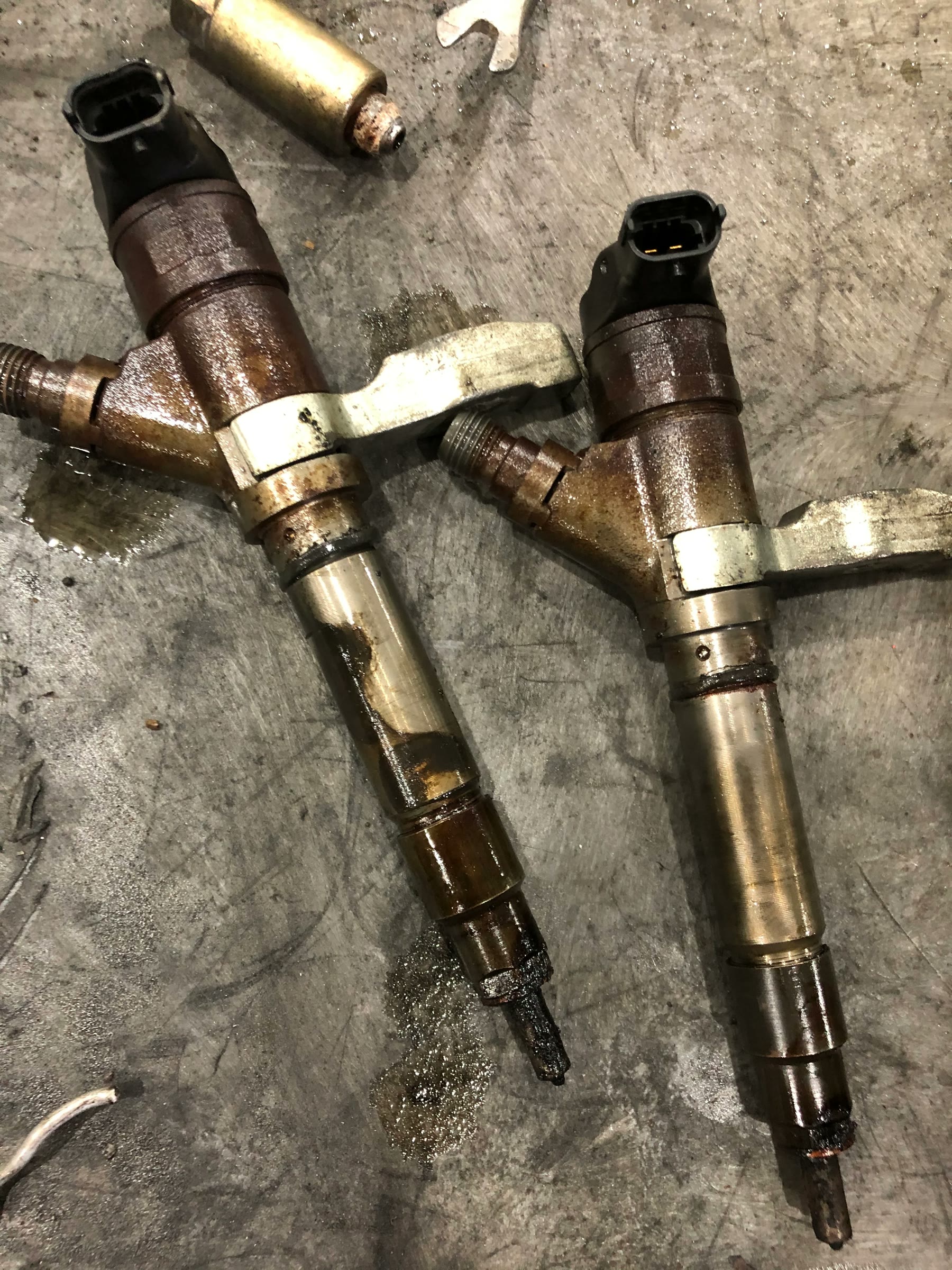
Common rail injectors, solenoid and piezo. Solenoid-actuated units across most industrial, marine auxiliary and commercial applications; piezo units on later light-duty engines. On the solenoid units, a great deal of the diagnosis lives in the return line: an injector whose internal clearances have opened up returns too much fuel to tank, the rail cannot be held up, and the ECU raises a low rail pressure fault while pointing at a pump that is doing its job perfectly.
Electronically controlled distributor pumps. The generation before common rail — a rotary distributor pump with a control unit and a solenoid metering the fuel rather than a mechanical governor. These still turn up under Japanese light plant, small gensets and light commercials in this region. They fail in two independent halves, hydraulic and electronic, and the same rule applies: test both before condemning either.
Older mechanical equipment. Inline and distributor pumps and mechanical injectors on long-serving industrial and marine engines. Fully serviceable, and dealt with alongside the rest of that work under inline and rotary pump repair.
Send a photograph of the unit and its data plate before you remove or transport anything, and you will get a straight identification and a straight view on the job.
The engines Denso equipment arrives on
Denso is the injection equipment on a large share of the Japanese-built diesel population, and in the UAE that is a very large population indeed. It reaches us on:
- Marine auxiliaries and small propulsion engines on workboats, barges, tugs and fishing vessels — see marine fuel pump and injector repair for how a job is organised around a sailing date.
- Compact and mid-size construction plant — excavators, loaders, rollers and telehandlers working in dust that no fuel filter was designed around.
- Generator sets, particularly the small and mid-size Japanese-engined sets under buildings, site offices and telecom cabinets.
- Trucks, tippers and mixers running out of the industrial areas.
- Agricultural, pump and compressor engines in irrigation and utility service.
Denso equipment is also fitted as original equipment to engines that do not carry a Japanese badge, which surprises people. Do not go by the engine maker's name on the rocker cover — go by the name cast into the pump body and printed on the injector.
How Denso equipment fails in the Gulf
The failure pattern here is not the pattern the equipment was designed against, and it drives most of what comes through the door.
Contamination, at rail pressure. This is the whole story of common rail. At the pressures a Denso rail system runs, a particle that would pass harmlessly through a mechanical injection system will cut a control valve seat or score a plunger. Once a seat is cut, that injector leaks internally for the rest of its life, and the leak grows. Dust, rust from tank floors and debris from a failed pump all do the same damage.
Water. Condensation in half-full tanks in a humid climate, plus long standing periods, puts water into diesel. Water removes the lubricating film between parts that are lapped to a few microns and rely on the fuel to keep them apart. Supply pumps go first because they have no other lubricant.
Debris migration after a pump failure. When a supply pump fails internally it puts metal into the fuel it is still delivering, and that metal goes into the rail, then into the injectors. This is why "the pump failed, so we changed the pump" is frequently the first half of a two-part repair, and why the injectors and the rail must be assessed after any pump failure rather than assumed to be innocent.
Heat on pump-mounted and injector-mounted electronics. Repeated heat cycling in a hot engine bay is a known failure route for control components, and it is a failure of the control side rather than the hydraulic side.
Deferred filter changes. More Denso equipment in this region is killed by an overdue fuel filter than by age. The filter is the cheapest part on the engine and the only thing standing between the fuel and a set of injectors.
Denso operations we perform
- Incoming bench test as received, recorded before anything is stripped
- Injector delivery measured across the operating range — pilot, main and post quantities separately, because an injector can be correct at full delivery and badly wrong on a pilot quantity of a few cubic millimetres
- Return flow and internal leakage measured
- Spray condition and seat tightness assessed
- Injector strip, ultrasonic clean and component inspection
- Control valve, nozzle, needle, spring and seal replacement where the parts are supplied as service items
- Reassembly to specified torque, then re-test
- Correction codes read, recorded and issued with the paperwork
- Supply pump strip, clean, inspection and rebuild
- Metering and pumping sides tested separately, so the failed half is identified rather than assumed
- Distributor pump hydraulic and control sides assessed independently
- Mechanical injector overhaul, nozzle replacement and opening pressure setting
- Final verification run and a signed test report on every unit
Nothing on that list is priced before the incoming test, and nothing is stripped or ordered until you have agreed the work. Nothing is done until you say yes.
Repair or replace — the bench decides
Denso common rail equipment is not uniformly rebuildable, and pretending otherwise would waste your money.
Some units are fully serviceable. Where the nozzle, needle, control valve, spring and seals are supplied as service parts, a properly rebuilt and re-tested injector performs to specification, and the economics against a new unit with an import lead time attached are not close.
Some are not. On certain injectors the wearing part that has actually failed is not available separately, and the honest answer is replacement. On piezo units in particular, a damaged actuator stack ends the discussion.
Supply pumps are usually the better news, because the most common single failure — the metering valve — is a component rather than a pump.
Which of those three positions you are in is a measurement, not an opinion, and it is measurable in an afternoon. So the useful first step is not a quotation and not a parts order: send us the unit to be tested. You get the readings, with what they mean written beside them, and if a unit is past economic repair you will be told so plainly. See what our calibration reports contain.