
Tank cleaning · fuel polishing · injection equipment
Generator fuel system service & tank cleaning
The commonest reason a standby generator fails when it is finally needed is the fuel it has been sitting on. We clean the tank, and we repair the injection equipment that tank has damaged — on our own benches.
Why it happens faster here
A standby tank is close to the worst storage condition you could design
The result is a set that starts and runs perfectly on a monthly off-load test — because a light, short run barely disturbs the tank — and then blocks its filters an hour into a real outage, when it is finally drawing hard from a bottom that the fuel movement has stirred.
Water gets in and stays
Warm days and cooler nights make a large tank breathe, and every cycle draws in humid air and condenses water on the walls. It settles at the bottom — exactly where the suction line takes fuel from — and it does not evaporate again.
Then it grows things
Water plus warmth plus diesel grows microbial contamination, living in the water layer and feeding at the interface. It produces a dark slime and an acidic by-product: filters block within minutes, the tank floor corrodes from the inside, and the debris that gets past becomes abrasive material in the injection system.
The fuel itself degrades
Standby fuel that has sat a long time forms gums and asphaltenes, darkens, and leaves deposits in the tank and filters. Biodiesel content increases the tendency to absorb water and to degrade in storage.
Nothing ever burns it down
A road vehicle's tank is emptied and refilled constantly, which is its own cleaning cycle. A standby tank is topped up onto whatever is already at the bottom of it, year after year. Add fine dust through open fillers, damaged breathers and poorly sealed covers, and it only accumulates.
The work
Cause first, then the damage
Assessment & water removal
- A bottom sample drawn from the tank, rather than a guess about what is in it
- Inspection of the water separator and the primary filter
- A look inside the tank where an inspection cover allows, and a check of the breather, filler and sealing
- Laboratory fuel analysis where the picture is unclear or a large volume of fuel is at stake, because the decision is between cleaning the fuel and disposing of it
- Water drawn off from the tank's lowest point — on a tank that has never been drained, the single highest-value hour anybody will spend on the set
Tank cleaning
- For a tank with an established sludge layer, draining is not enough — the deposits are stuck to the floor and the walls
- Residual fuel removed, internal surfaces cleaned mechanically, sludge and corrosion products taken out
- Internal inspection afterwards for pitting, and for the condition of the suction line and pick-up
- On base-frame tanks with limited access, the method is planned around what the inspection openings allow
Polishing & biocide
- Polishing is continuous circulation of the tank's fuel through filtration and water separation until it meets a cleanliness target
- The right answer when the fuel itself is worth saving — a large volume of otherwise sound diesel carrying water and particulate
- Cleanliness is expressed as a code rather than an opinion, and reported against your specification where one exists
- Biocide where microbial contamination is established — but water out, tank clean, then treatment, in that order. Biocide applied to a tank still holding a water layer buys weeks
- Polishing does not cure the cause. If the tank is corroding or the breather is missing, it comes back — and we would rather tell you that than sell the same clean-up twice
Filtration & injection
- Primary filter and water separator, secondary filter, lift pump, suction and return routing, pick-up height and the vent
- Air leaks on the suction side — the classic "starts, runs for twenty seconds, then dies", invisible from outside because the engine draws air in without leaking fuel out
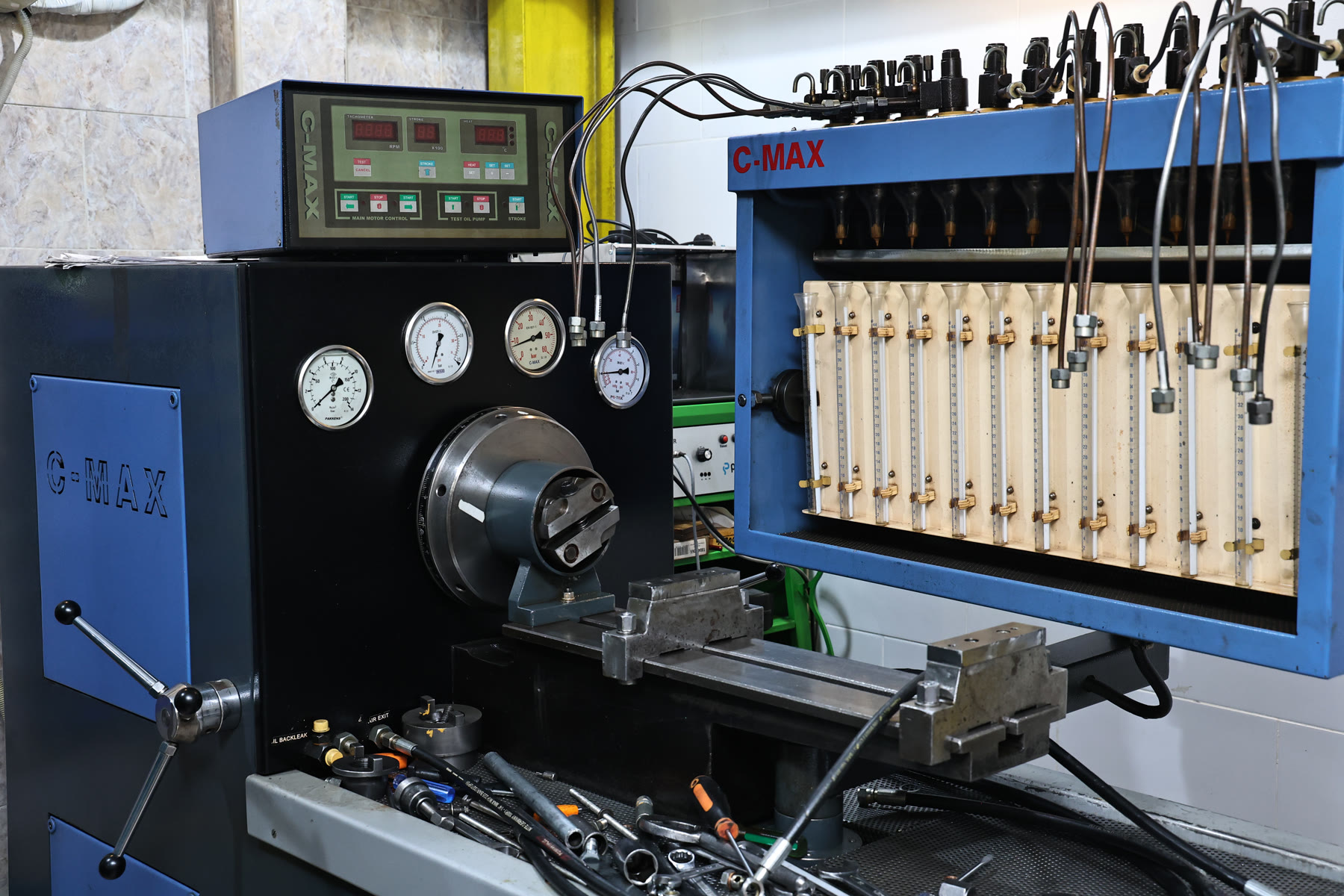
- Injectors and pumps come off and go on the bench: spray pattern, opening pressure, delivery and timing cannot be judged on a running engine
- The benches are ours — see injector calibration and pump calibration
Follow it through
How a dirty tank becomes an engine bill
Fuel work reads like housekeeping until you follow the chain. Water and particulate wear the injection pump and the injectors. Worn injectors spray rather than atomise, so fuel arrives as droplets instead of mist. Droplets burn late and incompletely, which puts unburnt fuel down the bores, washes the oil film off the liners and dilutes the sump. From there it is bore and ring wear, oil consumption, blow-by and eventually an overhaul — with the crankshaft and block on our machines.
That is a long way from a dirty tank, and it started there. Rebuilding an engine and then feeding it from the same tank is how a completed overhaul comes back within the year, which is why injection equipment is always tested as part of a rebuild here rather than refitted on hope.
- Keeping it clean afterwards
Drain water from the lowest point on a schedule and record what came out. Keep the tank as full as practical to reduce the air space that condenses water.
- Close the entry points
Check the breather, the filler cap seal and every inspection cover. Most contamination has an entry point, and it is usually visible.
- Turn the fuel over
A set that runs on load for a proper period consumes fuel and forces turnover; one that idles for ten minutes a month does not. Sample the bottom periodically, and change filters to the interval and specification in the engine's own manual — see generator maintenance.
Recognise any of these?
The symptoms that bring people to this page
- Generator fails to start, or starts and stops after a few seconds
- Filters blocking far sooner than the service interval
- Water visible in the separator bowl at every visit
- Dark, cloudy or slimy fuel; a sludge layer on a sample left to stand
- Black smoke, loss of power, or the set no longer carrying its load
- Rough running or hunting at constant speed
- Fuel consumption climbing with no change in load
- A set that passes its monthly off-load test but fails during a real outage
- Corrosion staining around tank seams, or a tank floor that has never been inspected
Broader diagnosis is on diesel generator repair and, where the set will not run at all, generator not starting.
Common questions
Fuel and tanks, answered
How do I know if there is water in my generator's fuel tank?
Draw a sample from the lowest point and let it stand in a clear container. Water separates and sits at the bottom; a slimy dark interface layer between the water and the fuel means microbial growth as well. Water repeatedly appearing in the separator bowl at every service is the same message.
Is fuel polishing worth it, or should I just dump the fuel?
It depends on the volume and on what the analysis shows. A large tank of otherwise sound diesel carrying water and particulate is a good candidate. Fuel that has genuinely degraded — heavy sludge, oxidation, badly off specification — is better disposed of properly, and we will say so rather than run a rig for a week to reach the same conclusion.
Can you clean the tank without draining the whole system?
Water draining and fuel polishing are done with the fuel in place. A genuine tank clean means the tank has to be emptied and the internal surfaces worked on, because the sludge is attached to them. What is practical on a particular tank depends on its inspection openings, and that is assessed on site.
My generator starts and then stops after a few seconds. Is that fuel?
Very often, yes. The classic causes are a blocked filter that lets the engine run until the bowl empties, or an air leak on the suction side. Both are fuel-system faults and both are cheap to find compared with the alternatives.
Do you repair the injectors and the pump as well, or only clean the tank?
Both, and they belong together. The tank is the cause and the injection equipment is the damage. Injectors and pumps are tested and calibrated on our own benches in Sharjah — see fuel systems and calibration.
How often should a standby generator's fuel be checked?
Water should be drained and the separator checked at every service visit, and the fuel sampled periodically rather than only after a failure. In this climate that is a routine item, not a precaution.
Filters blocking, or a set that will not run under load?
Call or WhatsApp +971 50 767 9050. Planning a tank clean or a fuel condition check instead? Email the tank size and type, the set details, and a photograph of a bottom sample stood in a clear jar — that single photograph usually tells us more than a page of description.