
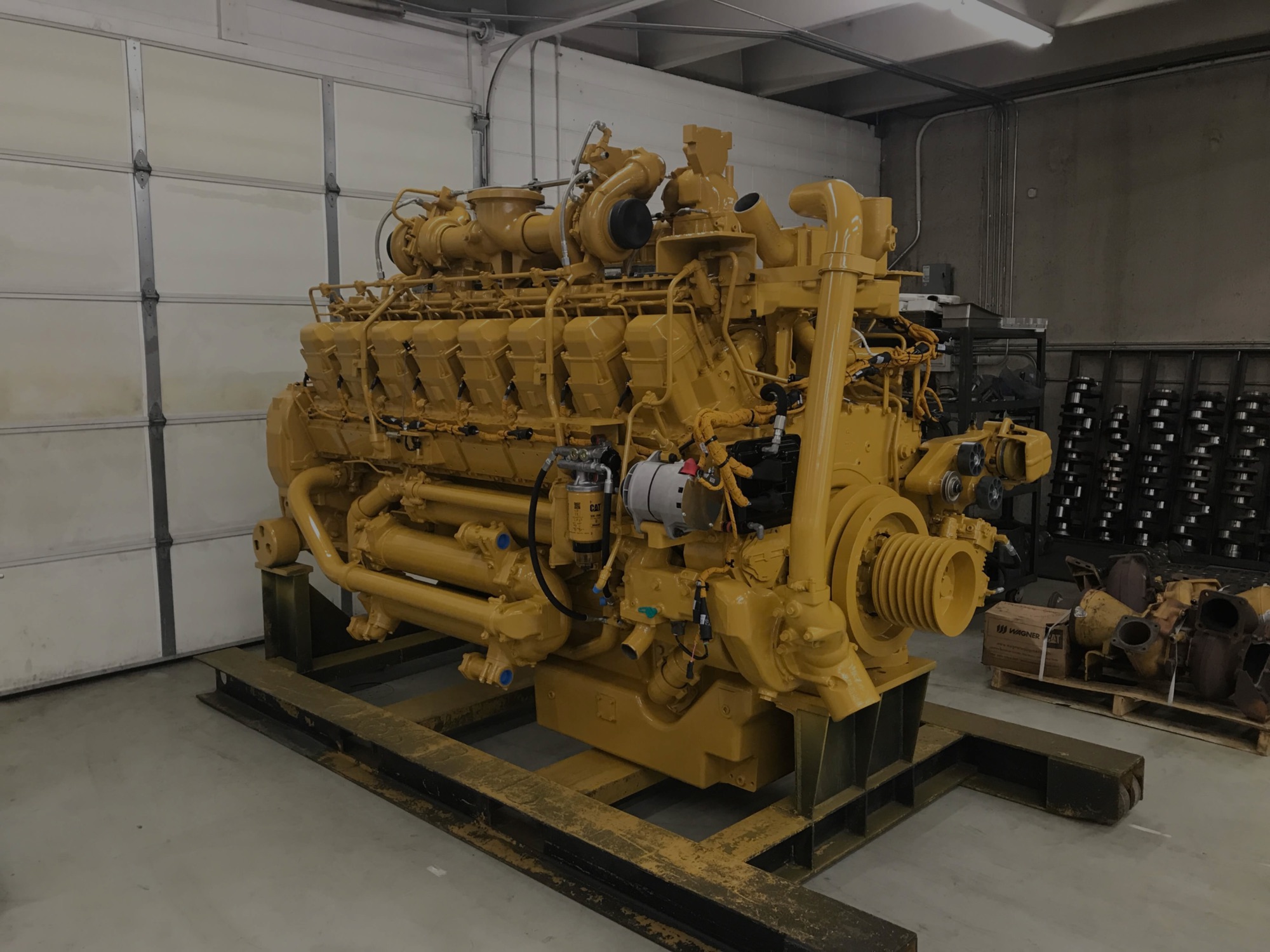
The engine half of the set
Diesel generator repair & servicing
The half that burns fuel, makes heat and wears out. Repaired on site across the UAE, or in the Sharjah workshop — where we machine the heavy components ourselves rather than sending them out.
Right page?
If the engine runs perfectly and no power comes out, that is an alternator or control fault — start at generator repair and service, or go straight to alternator repair and rewinding. If the engine is the problem — smoke, power loss, oil consumption, overheating, hard starting — you are in the right place.
Not the same job as truck engine work
A genset engine wears differently
It is a constant-speed industrial diesel, and three differences drive most of what we are called to fix.
It runs at one speed
Usually 1,500 rpm. There is no rev range to hide behind: governing, fuel delivery and combustion all have to be right at a single operating point. A fault that shows up as a rough patch on a road engine shows up here as frequency instability under load.
It spends most of its life not running
A building standby set may accumulate a few dozen running hours a year against thousands of idle ones. Time, not hours, degrades its coolant inhibitor, oil additive package, fuel, rubber and batteries. The engine that fails on the night of the outage is almost never the one that was worked hard.
It is frequently under-loaded
A diesel that never reaches proper cylinder temperature glazes bores, cokes injector nozzles and packs unburnt fuel and carbon into the exhaust and turbocharger — wet stacking. An engine-side problem with an engine-side fix.
Which is why we prove it on load
The way to show a light-loading problem is cured is a load bank test, not another off-load run.
Start with the symptom
Engine-side faults we are called to
Each of these has a page that works the fault through in order, so you can narrow it before you call.
Method
Diagnosing rather than guessing
The point of a diagnostic visit is to convert a description into measurements, because the parts bill follows from the measurements and not from the description.
Read the set's own record
The controller's event and alarm log holds the real history — start attempts, what shut it down, and what the temperatures and pressures were doing before it stopped.
Fuel before anything expensive
Water in the separator, filter condition, supply and return restriction, and whether the tank is the actual source — see fuel system service and tank cleaning.
Air and exhaust
Filter restriction, charge air leaks, turbocharger shaft play and end float, exhaust back pressure.
Compression and blow-by
A cylinder compression test and a blow-by assessment separate a fuelling fault from a mechanical one. This is the measurement that decides whether the next conversation is a service or an overhaul.
Oil, injection and cooling under load
Pressure at temperature, oil condition and a sample where the picture is unclear. Injectors and the pump on a calibration bench, because spray pattern and delivery cannot be judged on the engine. Then temperature behaviour with the set actually loaded, not idling.
When the measurements say worn rather than faulty
What we can do that a van cannot
The question becomes whether the crankshaft, block and head can be brought back to specification. That question has an answer here because the machines are in the same building as the measuring equipment: crankshaft grinding and polishing to the manufacturer's next undersize, and straightening; block line boring to restore main-bearing bore alignment, and deck surfacing; cylinder boring and honing with the crosshatch the rings need to bed; head surfacing, valve seat cutting and guide replacement, crack testing and pressure testing; connecting-rod boring and resizing; and injection pump and injector calibration.
Nothing in that list leaves our control, joins another workshop's queue, or comes back with a tolerance we did not take ourselves. That is the practical difference between a repairer with a machine shop and a repairer with a subcontractor, and it shows in the timescale as much as the price. More on the machine shop and on diesel engine repair and overhaul.
- Engine families we work on
Regularly through this workshop: Perkins, Cummins, Caterpillar, Volvo, Deutz, Yanmar, Kubota, Mitsubishi and John Deere, plus the engines under FG Wilson, Kohler and Onan badges. On the larger and marine end, MAN, MTU, Detroit and Wärtsilä.
- No dealership, any of them
Brand names describe the equipment we service, nothing more.
- On size
We take large work as well as small — very small work is what we decline, not the big jobs, and subcontracting is arranged where a particular operation genuinely calls for it. Send a photograph of the engine data plate and the component and you get a straight yes or no the same day.
The honest boundary
Service, repair or overhaul
All three get quoted as "a repair" by suppliers who have not opened the engine. A price given before compression has been tested is a guess with a variation order attached to it.
Service
The scheduled work that keeps the engine within its design condition: oil, filters, coolant, air, belts, valve clearances, readings logged. Covered under generator maintenance and preventive servicing.
Repair
A defined fault put right — an injector set, a water pump, a turbocharger, a head gasket, a starter motor.
Overhaul
Where the measurements say wear rather than failure, and the engine is stripped, measured against the manufacturer's service limits and rebuilt. That is generator and genset overhaul.
Priced in two stages
A fixed price to strip, clean, crack test and measure, then a firm price once the components have been read. Nothing is committed before the numbers exist.
Common questions
Genset engines, answered
How often does a diesel generator need servicing?
To the engine manufacturer's schedule for that engine, in this ambient — and on a standby set, to the calendar rather than the hour meter, because a set running twenty hours a year will never reach a running-hours interval while its coolant, fuel and batteries age anyway. Send us the engine model and we service to its own schedule rather than a generic one.
My generator smokes black under load. Is that serious?
It means the engine is receiving more fuel than it can burn with the air it is getting. The cheap causes are a loaded air filter, a leaking charge air pipe or a turbocharger not making boost; the expensive ones are injector condition and compression. They are separated by measurement in a couple of hours, and left alone black smoke washes bores and shortens the engine's life.
Can you repair the engine without taking the whole set away?
Often, yes. Fault-finding, servicing, injectors, turbochargers, water pumps, sensors, cooling and fuel work are done at your site. What cannot travel is the machining — a crankshaft, block or head has to come to Industrial Area 15, because the machines do not fit in a van.
It starts fine but shuts down on high temperature after twenty minutes.
That is a cooling fault presenting as an engine fault, and in this climate it is usually a radiator core blocked with dust and airborne sand, a failing water pump or a stuck thermostat. See radiator and cooling system repair.
Do you work on petrol generators?
No. Our work is diesel engines and diesel generator sets.
How do you decide between repairing and overhauling the engine?
By compression, blow-by, oil pressure at temperature and, once the engine is open, the measured wear on bores, journals and bearings against the manufacturer's service limits. Those are numbers, and they are taken before anything is committed rather than after.
Related
Everything else on a genset
Let us measure it
Set down now? Call or WhatsApp and describe what the engine is doing — whether it cranks, whether it fires, what the panel shows and what colour the smoke is. Planning work on a tired set? Email the engine model and serial, running hours and the symptoms. Photographs of the data plate, the exhaust under load and the breather tell us more than a paragraph, and are usually enough to say whether this is a site fix or a workshop job.