
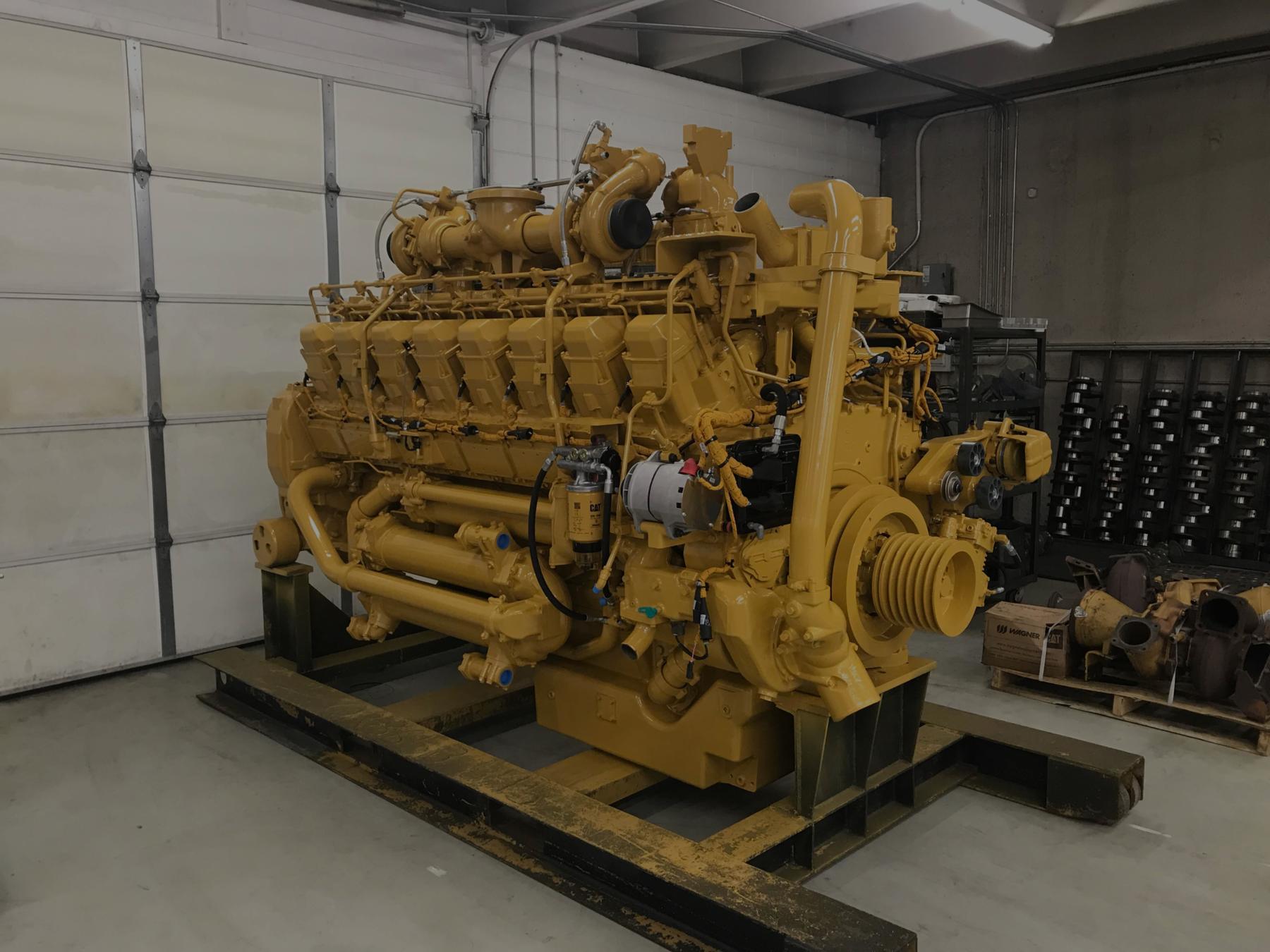
Symptom → cause → check → fix
Diesel generator troubleshooting
A working diagnostic guide, written the way we actually approach a set that is down: start at the symptom, narrow by what the panel says, check the cheap causes before the expensive ones — and know the point at which you stop and call.
Hold onto one idea
A genset is two machines on one bedframe
A diesel engine and an alternator, joined by a control panel that watches both. Almost every fault belongs to one of the three, and the first question is always: which one?
Engine will not run properly
Fuel, air, compression, cooling, starting and the governor. Rows 1 to 13 in the table below.
Engine runs, no or bad output
Excitation, AVR, windings, diodes, breaker. Rows 14 to 24.
Nothing runs, the panel is complaining
Controller, sensing, protection, wiring, battery. Rows 25 to 28.
The split that settles it
Watch the frequency. Frequency is engine speed — if it is steady and the voltage is wrong, the fault is on the alternator side. If the frequency is wrong, the fault is the engine.
Put the controller in Stop or Manual, never Auto: an AMF panel in Auto will crank the engine the moment it decides the mains have failed. Isolate the starting battery if you are working near rotating parts. Treat the alternator terminal box and the outgoing breaker as live even with the engine stopped — a set can be back-fed from the mains through a wrongly wired changeover. Exhausts and turbochargers stay hot long after shutdown. And never bypass, strap out or defeat a protection device to keep a set running.
Not a reset — a diagnosis
Stop, and call an engineer
If you see any of these, do not restart the set. Restarting is how a repairable engine becomes a scrap engine.
Half the diagnosis is already done
Read the panel first
Read the alarm and the event log, and note whether it is a warning — set keeps running, something needs attention — or a shutdown, where the set has stopped and latched.
| Panel says | What it means |
|---|---|
| Fail to start | The controller cranked for its configured attempts and never saw firing speed. Fuel, starting, or speed sensing. |
| Locked out / shutdown latched | A shutdown alarm has tripped and the controller will not restart until the fault is cleared and the alarm reset. A consequence, not a fault — find the alarm underneath it. |
| Loss of mag pu / speed sensing loss | The magnetic pickup on the flywheel ring gear has failed, its gap is wrong, or its wiring is broken. The controller no longer knows the engine speed. |
| Charge alt failure | The battery charging alternator is not producing. Belt, alternator, or the excite wire. The set runs until the battery flattens, then stops. |
| Under frequency / under speed | Engine speed dropped below the trip point. Load, fuel restriction or governor. |
| Over frequency / overspeed | Engine speed above the trip point. Governor, actuator or fuel rack. |
| Under voltage / over voltage | Alternator output outside limits. AVR, sensing, excitation, or genuinely wrong load conditions. |
| Low oil pressure / high engine temperature | Either a real protection trip or a failed sender. Verify with a mechanical gauge before you conclude the sender is lying. |
| Emergency stop | The mushroom button, or a break in the emergency stop wiring loop. Check the loop before assuming the button. |
| ECU warning (amber) / ECU shutdown (red) | An electronic engine's own ECU has raised a fault and passed it to the panel over CAN. The panel is only the messenger — the code lives in the ECU. |
| CAN / ECU data fail | The panel has lost communication with the engine ECU. Wiring, termination resistors, or a dead ECU. |
| Failed to open / failed to close | A breaker or contactor did not confirm the position the controller commanded. |
Alarm-by-alarm treatments: generator locked out, ECU warning lights, under-frequency shutdown, and how to read fault codes.
Thirty symptoms
The troubleshooting table
Four columns, in the order a fault is actually worked. Work down the check column in order — skipping to the expensive cause is how a sensing fuse becomes a rewind quotation.
| # | Symptom | What it usually means | What to check, in order | Typical fix |
|---|---|---|---|---|
| 1 | Nothing at all when start is pressed — no crank, no click | Flat or disconnected battery; isolator off; emergency stop latched; controller unpowered | Battery volts at rest and while cranking; battery isolator; emergency stop button and its wiring loop; controller DC supply and fuse | Charge or replace battery; clean and tighten terminals; release E-stop; replace blown DC fuse |
| 2 | Single click, no crank | Starter solenoid pulling in but starter not turning; heavy volt-drop; seized engine | Voltage at the starter main terminal while cranking; battery cable and earth strap; try to bar the engine over by hand | Clean or renew cables and earth strap; recondition or replace the starter. If the engine will not turn, stop — it is mechanical |
| 3 | Cranks slowly | Weak battery; corroded connections; wrong-grade oil; heat-damaged battery | Battery load test, not just voltage; terminals and earth; oil grade against the manual | Replace battery, renew cables, correct oil grade |
| 4 | Cranks normally, never fires | No fuel reaching the injectors; air in the fuel; solenoid not energising; blocked filters | Fuel in the tank and the tap open; solenoid clicking on crank; crack a fuel line at the injector; primary filter and water separator | Bleed the system; replace filters; repair or replace the fuel solenoid; check the lift pump |
| 5 | Fires and dies within seconds | Air ingress on the suction side; blocked filter; solenoid dropping out; line restriction | Bubbles in a clear filter bowl; filter restriction; confirm the solenoid holds after the crank signal ends | Cure the air leak — usually a filter seal or cracked line; replace filters; replace solenoid |
| 6 | Starts hard when cold only | Poor compression; worn injectors; failed cold-start aid; low cranking speed | Compression test; injector spray pattern on the bench; cold-start aid operation; cranking rpm | Injector overhaul and calibration; cold-start aid repair; if compression is low, plan an overhaul |
| 7 | Black smoke | Too much fuel or too little air: blocked air filter, worn or badly calibrated injectors, turbo not making boost, overload | Air filter restriction; boost pressure; load against nameplate; injector condition | Air filter renewal; turbo repair; injector calibration; reduce load or resize the set |
| 8 | White smoke | Unburnt fuel or coolant: low compression, injection timing, cold running, water in fuel, head gasket | Does it clear when hot, or persist? Water in the filter bowl; coolant loss; compression | Warm-up on load; drain water and change filters; injection timing; head gasket or head repair |
| 9 | Blue smoke | Oil into the combustion chamber: worn liners, rings or valve stem seals, or turbo seal failure | Blow-by at the breather; oil consumption rate; oil in the inlet manifold or charge cooler | Turbo overhaul, or engine overhaul if the bores and rings are worn |
| 10 | Overheating / high coolant temperature shutdown | Blocked radiator core; low coolant; failed thermostat or water pump; slipping belt; recirculating hot air in the plant room | Coolant level cold; core cleanliness; belt tension; fan operation; plant room ventilation | Core clean, coolant to spec, thermostat, water pump, belt, ventilation. See overheating |
| 11 | Low oil pressure alarm | Low level; wrong grade; diluted oil; blocked filter; worn bearings; failed sender | Level and oil condition; confirm with a mechanical gauge before blaming the sender | Correct oil and filter; if pressure is genuinely low on a hot engine, stop and measure bearing clearances |
| 12 | Oil consumption rising, breather blowing | Worn rings and liners; worn valve guides; turbo seals | Blow-by at the breather; compression test; turbo shaft play | Top or major overhaul |
| 13 | Coolant loss with no visible leak | Head gasket; cracked head; liner seal; oil cooler | Pressure test the cooling system; oil in the coolant or coolant in the oil; combustion gas test on the header tank | Head removal, crack test and surfacing, or liner and seal work |
| 14 | Engine runs, no output voltage | Lost residual magnetism; failed AVR; blown sensing fuse; open excitation circuit; failed rotating diode; breaker open | Is the breaker actually closed? AVR sensing fuses; any residual voltage at the terminals? AVR supply | Replace sensing fuse; flash the field; replace AVR or diode bridge. See runs but no power |
| 15 | Output voltage low and will not build | AVR fault or wrongly set; excitation circuit resistance; failed PMG; overload; low engine speed | Frequency first — voltage follows speed. Then AVR voltage trim; excitation circuit continuity | Correct engine speed; adjust or replace AVR; repair the excitation circuit |
| 16 | Output voltage high | AVR failed fully excited; sensing lead lost; sensing taken from the wrong phase | AVR sensing leads and their fuses; sensing configuration against the AVR type | Replace AVR; restore correct sensing. See voltage problems |
| 17 | Voltage unstable / hunting | AVR stability setting; loose sensing connection; unstable engine speed; step loads; failing diode | Is the frequency stable? If speed is hunting, the fault is the governor, not the AVR | Adjust AVR stability; repair governor or actuator; tighten sensing connections |
| 18 | Voltage collapses when load is applied | Set undersized for motor starting inrush; weak PMG or excitation; failed diode; engine cannot take the load | Starting kVA of the largest motor against the set rating; excitation under load; diode test | Staged starting or soft starters; excitation repair; correct set sizing |
| 19 | Frequency low / under-frequency shutdown | Overload; fuel restriction; governor or actuator fault; turbocharger lag on load acceptance; wrong speed setting | Load in kW against nameplate; fuel filter restriction; governor response; no-load speed setting | Reduce or stage the load; replace fuel filters; repair the governor. See under-frequency |
| 20 | Frequency high / overspeed | Governor or actuator failure; sticking fuel rack; wrong speed setting; sudden load rejection | Speed setting; governor linkage freedom; actuator operation | Repair governor and linkage; reset speed. Do not run a set that has overspeed-tripped until the cause is found |
| 21 | Set trips the breaker on load | Genuine overload; earth fault in the load; severe phase imbalance; faulty or wrongly rated breaker | Current on each phase; insulation resistance of the downstream load; breaker settings | Rebalance or reduce load; find the earth fault; set or replace the breaker. See tripping the breaker |
| 22 | One phase low or dead | Open winding or connection in the alternator; blown fuse; broken cable; failed breaker pole | Voltage phase-to-phase and phase-to-neutral on all combinations; terminal box connections | Repair the connection, or alternator rewinding if a coil is open |
| 23 | Burnt smell, discoloured windings, low insulation resistance | Overload, over-temperature, moisture, contamination, or a bearing failure that let the rotor rub | Insulation resistance to earth on stator and rotor; visual inspection in the terminal box | Clean, dry and re-varnish if marginal; rewind if a winding has failed |
| 24 | Alternator bearing noise / vibration | Bearing wear; misalignment; failed anti-vibration mounts; unbalanced rotor | Listen at the non-drive end; mount condition; coupling and alignment | Bearing replacement, mount renewal, realignment |
| 25 | Battery flat every time the set is needed | Charging alternator not charging; charger failed or unplugged; parasitic drain from the panel; battery at end of life | Charger output voltage at the battery; charging alternator output with the set running; battery age and load test | Repair or replace charger or charging alternator; renew battery; find the drain |
| 26 | Will not start automatically on mains failure, but starts on manual | Controller not in Auto; AMF/ATS mains sensing wrong; start signal wiring; configuration changed | Controller mode; mains sensing voltage at the panel; start relay operation; changeover control supply | Restore Auto; repair sensing or wiring; reconfigure the controller |
| 27 | Set starts but the load never transfers | Changeover contactor or breaker fault; transfer interlock; controller not seeing "generator available"; long timers | Generator voltage and frequency against the controller's availability window; contactor coil and auxiliary contacts | Repair the changeover; correct the availability window and timers. See AMF & ATS panel repair |
| 28 | Fuel gone, or the level reading is wrong | Leak, theft, or a failed level sender | Physical dip against the gauge; the fuel line and filter housing for weeping | Repair the leak; replace the sender; secure the tank |
| 29 | Water in the fuel, filters blocking repeatedly | Condensation in a warm part-full tank; microbial growth; contaminated delivery | Drain the water separator; sample from the tank bottom; look for dark sludge or a slime layer at the fuel/water interface | Tank drain and clean, fuel polishing, biocide dosing, and treat the delivery source |
| 30 | Wet exhaust, oily deposits at the manifold and stack, sooty run-up | Wet stacking from prolonged light-load running on a standby set | Historical load as a percentage of rating; oil weeping at exhaust joints | Load bank test to burn off deposits, then a real loading policy |
In practice
The three faults we are called out for most
Local conditions
Why these faults are more common here
Four conditions do most of it, and knowing which one you are living with shortens the diagnosis considerably.
- Heat kills batteries, not cold
People associate flat batteries with winter. Heat is harder on a lead-acid battery than cold is, and a battery that would give four or five years elsewhere gives noticeably less here. Rows 1 and 25 are the single most common reason a standby set fails to start in the UAE — and a battery that cranks slowly on a hot morning has already told you what it will do.
- Dust blocks cores and air filters faster than any schedule expects
A core half choked with airborne dust is survivable in a European winter and a shutdown in a Sharjah August, because ambient temperature sets the floor the cooling system works up from. Rows 10 and 7 are usually a cleaning problem long before they are a component problem — and the same dust drawn through a loaded air filter is why bores and liners wear faster here than the hour meter suggests.
- Warm, part-empty tanks make water, and water makes everything else
Condensation in the air space above the diesel, in this heat, is exactly the condition microbial growth needs. It blocks filters repeatedly, corrodes tank floors, and pushes abrasive debris through injection equipment worth considerably more than the fuel. If you are changing filters far more often than the schedule says, row 29 is where to look — and the fault is in the tank, not the filter.
- Standby sets fail from time, not from use
A set running twenty minutes a month never reaches a running-hours service interval, but its coolant inhibitor, rubber, fuel and battery degrade on the calendar regardless — and prolonged light-load running glazes the bores as well (row 30). The failure appears on the one day the mains actually drop. That is a maintenance regime problem, not a diagnosis problem: see preventive maintenance.
Before you phone
When to call, and what to have ready
Call when the diagnosis needs equipment you do not have — insulation resistance testing, injector bench testing, compression testing, controller configuration software, a load bank — or when the fault is on the stop-and-call list above.
The machine
- Genset make, model and kVA rating
- Engine and alternator model plates
- Controller make and model
- Running hours
The fault and the duty
- The exact alarm text, and the event log if you can photograph it
- What changed immediately before — a new load, a fuel delivery, a power cut, someone else's site visit
- Whether the set is standby or prime, and what it is feeding
- Whether it is currently carrying that load
Send it to +971 50 767 9050 on WhatsApp — a photograph of the alarm screen and the data plate is usually enough. We can generally tell you before anyone travels whether it is a site fix or a workshop job, and if it is something you can safely put right yourself we will say so on the phone. The workshop is behind the Yerevan Steel Factory in Industrial Area 15, Sharjah, if you would rather bring the component in. What we repair and where: generator repair and service; panel and AVR work: control panel and AVR repair. Planned work and quotations: jacob@abradiesel.com.
Common questions
Troubleshooting, answered
Why does my generator start but produce no power?
Almost always excitation. Check the AVR sensing fuses first, then whether any residual voltage is present at the terminals, then the AVR itself, then the rotating diodes. A set that has stood idle for a long period can also lose its residual magnetism, in which case the field has to be flashed before it will build voltage. If the windings are burnt, no amount of AVR work will fix it.
What does "generator locked out" mean?
A shutdown alarm has latched and the controller will not allow a restart until the fault is cleared and the alarm reset. It is not itself a fault. Read the alarm underneath the lockout — that is the one to fix.
Can I reset a generator shutdown alarm myself?
Reset a warning, yes. Reset a shutdown only once you know what caused it. Low oil pressure, high coolant temperature, overspeed and any electrical fault should never be reset and rerun blind, because the second run is the one that does the expensive damage.
Why does my generator shut down on under-frequency?
The engine speed dropped below the trip point. The usual causes are more load than the set can take, restricted fuel filters starving the engine, a governor or actuator fault, or a large motor started across the line without staging. Check the load first — it is free to check and it is often the answer.
How do I know whether the fault is the engine or the alternator?
Watch the frequency. Frequency is engine speed. If frequency is steady at 50 Hz and the voltage is wrong, the fault is on the alternator or AVR side. If the frequency is wrong or unstable, the fault is on the engine, governor or fuel side — and the voltage misbehaviour is a consequence, not the cause.
Is troubleshooting something I can do without an engineer?
The checks in the table are within reach of a competent site electrician or plant technician, and doing them saves everyone time. What needs an engineer is anything requiring instrumentation, anything on the stop-and-call list, and anything where the answer is "reset it and see". If you get to that point, call emergency generator repair on +971 50 767 9050.
Related
Symptom by symptom
Worked through it and still stuck?
Call or WhatsApp with the alarm text, the data plate and what changed before the fault. We will tell you whether it is a site fix or a workshop job. Open 7 days, 07:00–20:00.