
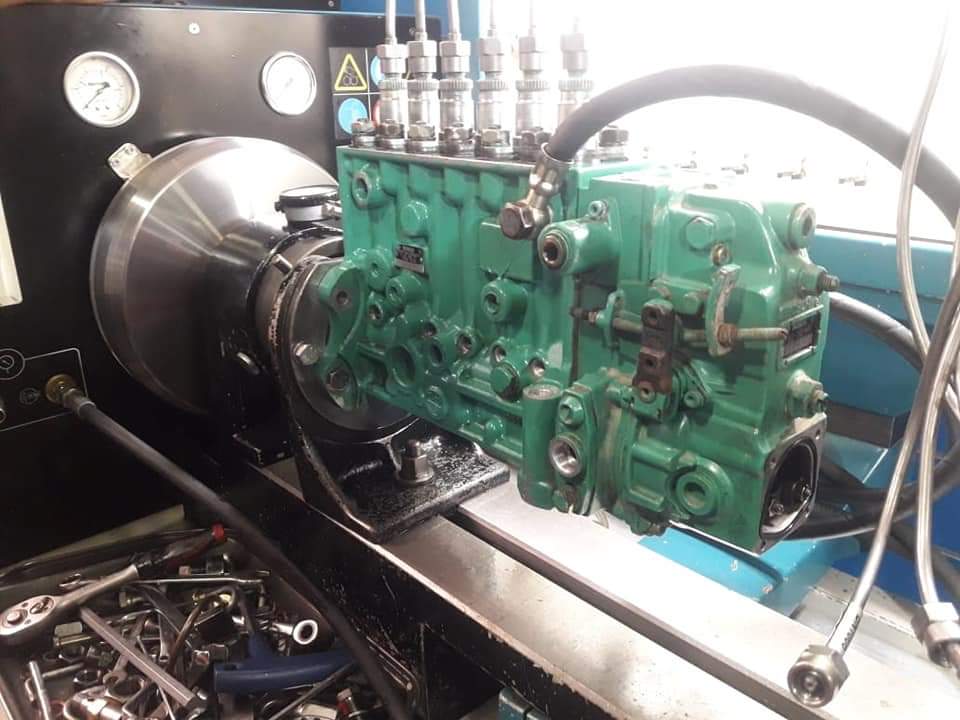
This is the mechanical inline pump page of the fuel systems pillar. Where Denso work is mostly common rail and Delphi and Stanadyne work is mostly rotary, a Zexel job is almost always a long, heavy pump with one pumping element per cylinder, its own camshaft, its own oil, a control rack running through it, and a governor bolted to the end. That architecture is fully serviceable, it holds its calibration for years once properly set, and replacement units for older engines are frequently no longer available at all.
Zexel, Diesel Kiki and Bosch — the relationship, and why it helps you
This is not corporate trivia. It changes what can be done with your pump.
Diesel Kiki was established in 1939 under a Bosch licence, and built fuel injection equipment to Bosch designs for the Japanese market for decades. The company was renamed Zexel in 1990. Bosch later acquired the majority of the business, which was reorganised as Bosch Automotive Systems Corporation in 2000 and subsequently became part of Bosch Corporation.
So a pump plated Diesel Kiki, a pump plated Zexel and a pump plated Bosch may be the same design under three names from three eras. The practical consequences:
- The type designations line up. The inline pump families are described in the same nomenclature Bosch uses — element size, housing type, number of cylinders — so identifying a Zexel pump identifies its Bosch equivalent, and the reverse.
- The service disciplines are the same. Phasing, port closing, rack travel, delivery balance and governor setting are done the same way on both.
- The parts landscape is broader than a single badge suggests. A component that is scarce under one part number may be available under another. That is a straightforward advantage to the owner of an old engine, and it is one of the reasons "the pump is obsolete" is so often wrong.
None of that makes us a Bosch or a Zexel agent, and we do not claim to be. It simply means these families are not orphans. Our Bosch fuel system service page covers the wider Bosch estate, including rotary and common rail equipment.
The equipment we see
Multi-element inline pumps. A row of high-pressure pipes leaving the top of the pump in a straight line, one per cylinder, and the pump carrying its own oil. Inside: one plunger and barrel per cylinder over a camshaft, quantity set by a common control rack, and a governor at the end. Everything from the compact pumps on four-cylinder light commercials and small gensets up to the large-element pumps on six-cylinder truck, marine auxiliary and industrial engines.
Single-element pumps, one per cylinder. On larger industrial and marine engines each cylinder may have its own individual pump, driven directly by the engine's camshaft. Same pumping principle, no pump camshaft, and each unit set individually. Marine work of this kind is organised around a sailing date rather than a workshop queue — see marine fuel pump and injector repair.
Rotary distributor pumps. The compact distributor pumps built under the same licence, on light commercials, small plant and small gensets. One axial plunger serving every cylinder in turn, lubricated entirely by the diesel passing through it, which makes fuel quality the dominant factor in its life.
Nozzle holders and injectors matched to the above.
Send a photograph of the pump on the engine with its plate visible, plus the engine make, model and serial, and you will get a straight identification before anything is removed or transported.
Which governor is on the end of your pump?
This is the section that matters most, and it is the one nobody asks about until something goes wrong.
An inline pump is a metering device. The governor is what decides where the rack sits at any given moment, and the type of governor fitted determines how the whole engine behaves. The same pump body, with a different governor, is a different machine to drive and a different machine to run a generator with.
- An all-speed (variable-speed) governor holds whatever speed the operator sets, from idle to maximum, and pulls the rack to defend that speed under load. This is what an engine driving a generator, a pump or a compressor needs, because the load changes and the speed must not.
- A minimum–maximum governor controls only idle and maximum speed, and leaves everything between them to the operator's foot. This is the truck arrangement.
- Boost-compensating and smoke-limiting devices on the governor restrict fuel until the turbocharger has produced boost, which is what stops a turbocharged engine pouring black smoke every time it is opened up from low speed.
- Torque control and excess-fuel devices shape the fuel curve across the speed range and give extra fuel for starting.
Why it matters in practice: a pump swapped for a "matching" unit with the wrong governor arrangement will run, and it will be wrong. The classic version of this is a genset engine that hunts, or drops speed and takes too long to recover on load application, because the pump that was fitted was governed for road use. The other classic is a turbocharged engine that smokes heavily on every load step because the boost compensator is disconnected, seized or simply absent.
Governor components are overhauled and set as part of the pump job, not treated as a separate mystery — see governor repair and calibration. Where an engine's behaviour rather than its output is the complaint, the governor is where the answer usually is.
Phasing, and what unbalanced elements actually cost you
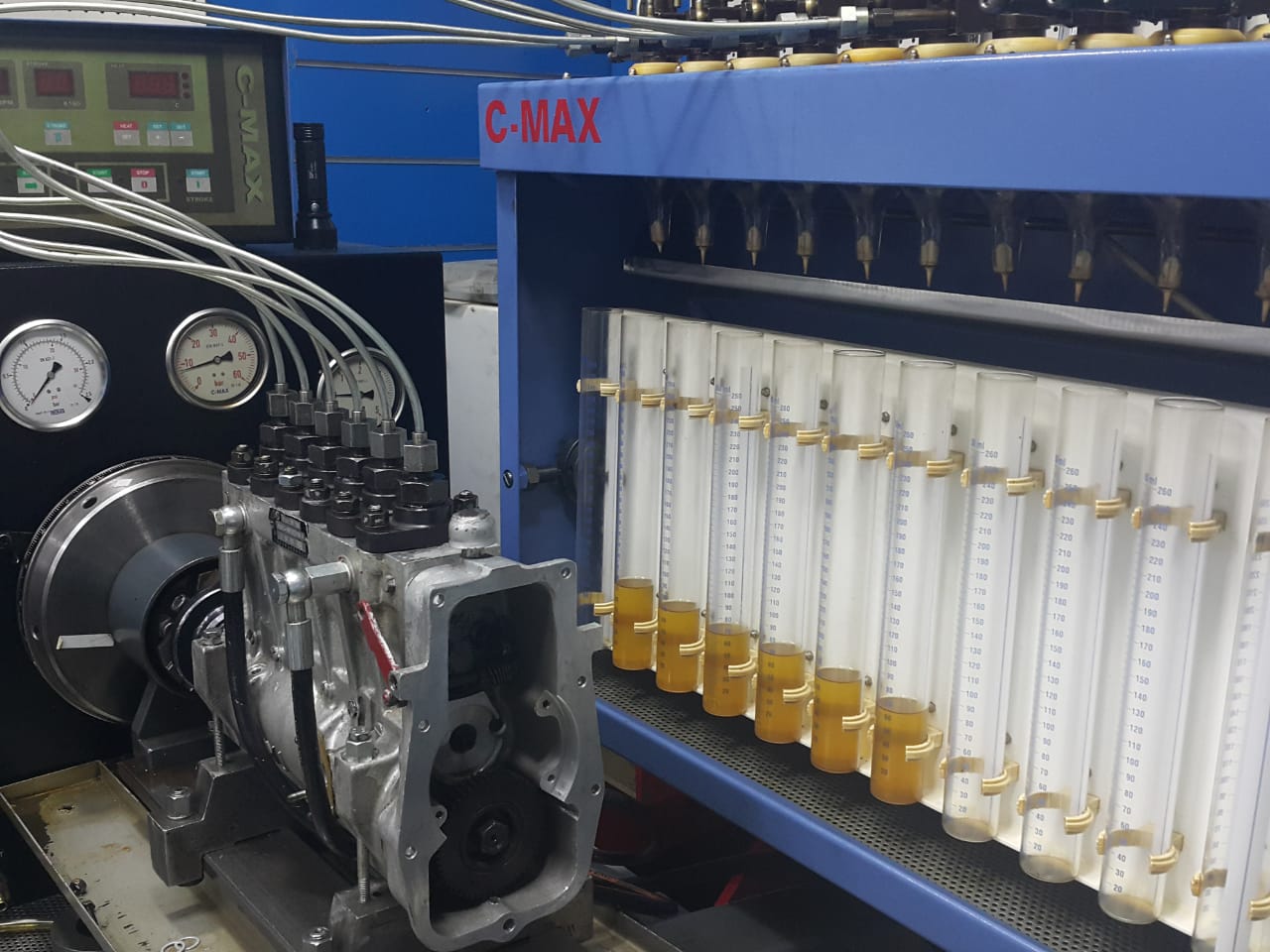
Calibration sets how much fuel each element delivers. Phasing sets when each element starts delivering, by setting the point at which the plunger closes its inlet port. Both have to be right, and phasing is the one that gets skipped, because it is slower and because an engine will run without it.
An inline pump with elements out of balance produces an engine where the cylinders are doing different amounts of work. On a truck that shows up as roughness, uneven exhaust temperatures and fuel consumption that has crept up with no obvious cause. On a generator engine it shows up as vibration, a set that will not hold frequency cleanly, and — over time — one or two cylinders carrying more thermal load than they were designed for. Neither of those announces itself as a fuel fault. Both are.
This is the whole argument for having a pump set on a bench rather than adjusted on an engine: on the bench, every element's delivery is measured against every other element's, across the speed range, and the readings go on paper. See fuel injection pump calibration for how that is done and what the report contains.
Where this equipment works in the UAE
Trucks, tippers and mixers. The Japanese commercial vehicle population in this country is enormous, and the industrial areas of Sharjah, Ajman and Dubai run on it. Older mechanically injected trucks are exactly the vehicles where a pump overhaul is the difference between another five years of service and a scrapyard. The engine side of that work is on truck and heavy equipment engine repair.
Construction and quarry plant. Japanese excavators, loaders, dozers and crushers, working in dust that no filter was ever designed around.
Marine auxiliaries and small propulsion engines on workboats, barges, dhows, tugs and fishing vessels.
Generator sets. Japanese-engined sets under buildings, yards, farms and telecom sites, most of which run a few minutes a month and are then asked for full load on the worst day of the year.
How these pumps fail in the Gulf
Water in the fuel. Condensation in half-empty tanks, humid air and long standing periods put water into diesel. Water strips the lubricating film between a plunger and its barrel — a lapped matched pair with a clearance of a few microns. Once scoring starts, the element is scrap and must be replaced, not cleaned.
Abrasive dust. The same failure, faster.
A sticking rack. Corrosion, varnish or debris on the control rack means the governor can no longer move the fuel where it wants it. The engine hunts, will not idle cleanly, or will not come back down from high speed. It is a frightening symptom and often a repairable one.
Delivery valve wear. The valve that unloads the delivery line after injection ends controls how cleanly injection stops. Worn valves and seats produce a late dribble, secondary injection, smoke and carbon on the nozzle tips — and they get blamed on the injectors.
Camshaft, tappet and roller wear. The pump has its own oil, and on a pump that has run a long time on tired oil this is real. It shows up as a pump that cannot be phased into balance because the mechanical timing of the elements has physically drifted apart.
Boost compensator diaphragms and linkages perishing in heat, so the engine smokes on every load step.
Deferred filter changes. More injection equipment in this region is killed by an overdue filter than by age.
Zexel operations we perform
- Incoming bench test as received, recorded before anything is opened
- Full strip, clean and component inspection
- Plunger and barrel elements replaced as matched pairs
- Delivery valve and seat replacement
- Control rack, sleeve and quadrant assessment and free movement restored
- Camshaft, tappet, roller and bearing renewal
- Element phasing and port closing set
- Delivery calibration and cylinder-to-cylinder balancing across the speed range
- Maximum fuel, idle and maximum speed settings made to the pump's own data
- Boost compensator, smoke limiter and torque control devices set
- Governor strip, overhaul and setting, to the governor type actually fitted
- Excess-fuel and cold start devices tested
- Single-element pump overhaul and individual setting
- Rotary distributor pump strip, rebuild, advance overhaul and calibration
- Nozzle holder and injector overhaul, nozzle replacement and opening pressure setting
- Shaft seals, gaskets and O-rings renewed throughout
- Final verification run and a signed test report on every unit
Nothing on that list is priced before the incoming test, and nothing is stripped or ordered until you have agreed the work. Nothing is done until you say yes.
Repair or replace — the housing and the camshaft decide
A Zexel inline pump is largely an assembly of replaceable parts. Elements, delivery valves, springs, seals, governor components and the rack hardware are all serviceable items. So the overhaul decision comes down to the parts that are not routinely replaced: the housing's element bores, and the pump camshaft and its bearings. If those are sound, an overhaul returns a pump that will hold its calibration for years. If they are not, you will be told so.
For older Japanese industrial, marine and genset engines this is frequently not a close decision, because a replacement pump may simply not exist to be bought, and the engine it feeds is otherwise fine. But that is a conclusion from a bench test rather than a position, and where the readings say replace, that is what the report will say — with the numbers attached. See what our calibration reports contain.